Seven Rules of Power 2: Don't Follow the Rules
Seven Rules of Power 2: Don’t follow the rules
In the last session we broke out of the submissive mindset, and in this session we’re going to continue to go deeper into the power mindset. You’re going to practice a more advanced, and much more uncomfortable, discipline, and that’s breaking the rules.
The most direct meaning of holding power is that you can disobey the rules. What’s the point of having power if you do everything by the rules? Those who have power can make rules, those who don’t have power must passively follow the rules. You have to get used to being more proactive.
Breaking the rules creates psychological pressure on you, because society defaults to the idea that you need to follow the rules. Breaking the rules is making trouble, and making trouble is making people look at you differently, and the average person can’t stand that. It’s in our nature not to want to bother others, not even to ask for help when we have a legitimate need.
But this mentality you have to turn around: power, originally is to make people’s behavior. You are always afraid to trouble others, how can it work?
✵
Utah will run a movie festival every year, all kinds of stars, celebrities gathered, Stanford MBA class students also love to go to the hustle and bustle. Pfeiffer thinks this is an opportunity to exercise people, every year to the students a challenge: can you find a way to meet those big names at the festival.
The best way to meet the big shots is to attend their dinner. But the dinners were internal, by special invitation only, and it wasn’t good enough to say you were a Stanford student.
That’s what one girl did. She emailed the organizer of the dinner and said, “I’m a writer for Forbes magazine and I’m interested in your dinner. As soon as the person heard it was from the media, they immediately replied, saying we have dinners on both Friday and Saturday, which one would you like to attend? This girl deliberately waited 48 hours before replying to the other party, saying I am very busy on Friday, is it possible to attend this one on Saturday. The organizer did send her a reservation link.
She was hesitant to bring her boyfriend along, but he might not be available, so she didn’t mention it when she made the reservation. As it turned out, her boyfriend was really free that night, and she took him straight there. At the door of the dinner, the organizer said, “You didn’t say you’d bring an extra person beforehand, did you? She said you see we have come to the …… organizers have no choice, let both people went in.
You see, this girl is not a member of the media, posing as a member of the media; obviously not qualified to participate in the dinner, but participated in the dinner; should not bring an extra person, she brought an extra person. She broke a lot of rules, but she got it.
Pfeiffer raved about it …… Maybe you’re thinking to yourself, what does Stanford teach here ……
Actually, we’ve all seen people like this in our lives. I’ll bet you don’t like people like that, much less want to be one. If that’s the case, you need to update your knowledge about breaking the rules.
1. special benefits can be gained by breaking the rules
One of the hallmarks of civilized society is that most people over-observe the rules. We are trained from an early age to be honest, to do what we are told, not to cause trouble, and not to get into trouble.
One study shows that a typical employee will be involved in some kind of conflict almost 3 hours a week - but most people have never had basic training on how to conflict with people. This leads to the fact that most people don’t know how to respond when faced with a conflict with a leader or coworker - so people try to avoid conflict, or even arguments, and put things to rest when they come up, and turn big problems into small ones.
This gives you an opportunity.
You dare to conflict, the other party does not dare to conflict, he in order to avoid conflict with you will meet your requirements, then you do not get it?
Why don’t you have an American proverb that says, “Instead of asking for permission, you should ask for forgiveness“.
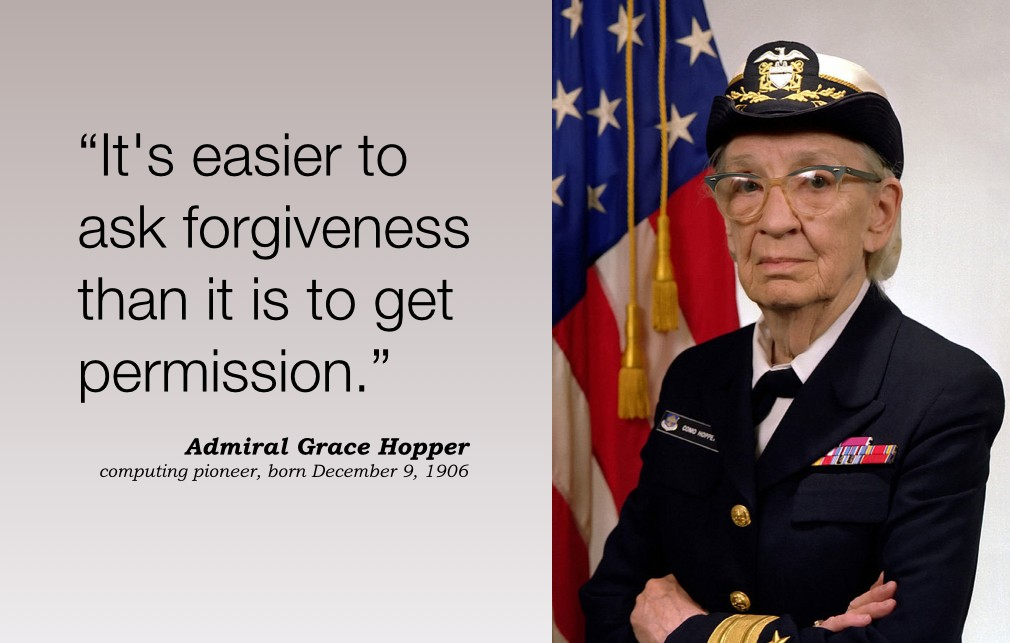
You don’t care if it’s justified or not get it over with first. If someone accuses you of breaking the rules after the fact, you then apologize is – the raw rice has been cooked, the other party in order to reduce conflict, the most reasonable choice is to forget about it.
There is a master architect in New York named Robert Moses (Robert Moses). He was a genius, but genius is fed by many, many projects. In architecture, you want to know that one big hassle is government approvals. If you spend a lot of time waiting for approvals for every project, how many projects can you do? The reason why Moses has so many works is because he often lets the project start before he gets the government’s permission. Even sometimes a park was already built before he went to the government for a permit. When the government looks at it, it’s a great park, it’s a master architect, the people here have accepted it, so can they forcefully order the park to be torn down?
Of course there are risks involved. There are some builders in China who do the same thing, who build buildings on their own before the government has granted them land, betting that the government can only acquiesce in the end. But if there are more people doing this, sometimes the government may really give you a hard time and blow up a beautiful building that has already been built. But risk is risk, sometimes you have to try.
What’s more, there are some “tries” that are not risky, such as asking for help.
Civilized society has two asymmetrical defaults. On the one hand, everyone should mind their own business and try not to ask for help; on the other hand, if someone comes to you for help and you happen to be able to help, you are often willing to provide it. This asymmetry may be due to the fact that asking for a favor is a relatively low gesture, while helping someone is a high gesture: we like high gestures.
There is an interesting study on helping. The researchers recruited a group of subjects and sent them out into the street to do two tasks. One was to pretend they didn’t have a cell phone with them and borrow a cell phone from a random person to make a call, and the other was to pretend they didn’t know the way to the gym and ask someone to show them the way. Simple, right? If they find you, I’m sure you’ll help.
But 27% of the subjects, once they heard that the task was for them to go out on the street and ask for help, quit the experiment on the spot.
This is the same as having a lot of opportunities in front of you that you don’t use, and money on the ground that you don’t pick up. Ask someone for a small favor, and even if they refuse, then just refuse? What do you have to lose? We can imagine that those who can be brazen enough to ask for help certainly seize more opportunities.
And you can be even braver. Doing things in a huge organization like a school or a big company often requires layers of approval, time and effort without knowing what the outcome will be. There’s a story of a student at Pfeiffer that might inspire you. He ran straight to the office of a big leader to make a request without an appointment. Because this kind of situation is so rare, the big leader was a bit confused and could not think fast enough. Once he heard what he said was quite reasonable, he approved his request directly.
Of course, it may not be approved. But what do you have to lose by trying?
2. Breaking the rules can boost your image
**There is an image of being liked and an image of being perceived as powerful, and these two images are different, even opposite.**There are studies that prove that people with power tend to show a lack of manners when talking to people: they smile less, interrupt more, and speak louder. We were raised to be the opposite of this behavior, but we were not raised to compete for power.
Researchers have done a series of experiments to show that breaking the rules makes people feel you have power - or “strength”, which is the same word in English: power.
A group of people are waiting to do business at City Hall, and they are all sitting down honestly. There was coffee on the counter, but no one was managing it, let alone inviting people to drink it. At this point two fellows stood up, one went to get himself a cup of coffee and came back and drank it, the other went to the restroom. Surveying the crowd afterward, the general consensus was that the one with the coffee was stronger.
Another example is when you notice a glitch in your company’s financial statements and ask the accountants if you should change them. The first accountant tells you that the glitch doesn’t matter, it happens all the time, and the outside accountant won’t even notice it in the future, and even if he does notice it, we can still work around it a little bit with him. The second accountant then says that it should be taken seriously and that we must follow the rules …… So you guessed it, people generally think the first accountant is stronger.
The reality is that those who have no manners, those who don’t care, those who encroach on other people’s turf, those who flout the law, are usually perceived as more competent.
3. Breaking the rules is a must because the rules limit you
One of the big reasons we have to break the rules is that many times we can’t win without breaking them. Political scientist Ivan Arreguín-Toft specifically looked at wars in history where there was at least a five-fold difference in the level of military power between the two sides, and found that the strongest didn’t always win-especially between 1950 and 1999, when the weaker side won 51.2% of the wars. Why is this?
Because the underdog fights a ‘war of superlatives’. Just as Middle Eastern guerrillas fight American troops. I’ll fight you in a non-traditional war, I won’t play by your rules. That’s what Gladwell was talking about specifically in that book Reversal. If you’re an underdog, you’re the new guy, you’re the later, and you still want to compete with the strong, then you have to break the existing rules.
That’s why Chinese companies used to engage in copycatting, plagiarizing, and piracy of international brands. We feel quite embarrassed, but economists understand very well: how can we get on the field if we don’t do this? The United States in the early stages of industrialization is also a direct copy of the United Kingdom, the United Kingdom in the industrial revolution before the wool trade is a copy of the Netherlands, everyone has done so.
Not to mention that the purpose of many of the rules made by those in power is to protect their own special interests, which is to limit your development. It’s in their favor that you follow the rules. Every change is a redistribution of resources, and since you want to come in and get a share of the power, you have to change the existing rules.
✵
To summarize, if you want power, you can’t be too honest and obedient; obedience is the opposite of power. We had an installment of our column back in Season 1 called “The Badassery of Big Men” about what used to be in that Pfeiffer book, Power, where we listed how some people got to the top by breaking the rules.
So, you say, if everyone broke the rules, wouldn’t society be in chaos? That’s right. There’s an ecological balance issue here. When we used to talk about game theory, we talked about the “Hawk-Dove Game”[1] - if there are too many hawks in the society, being a dove is good for you; and if most people in the society are doves, you should be a hawk.
I think for Chinese people, there are too few of them being eagles. Our education is pigeon education and our culture is pigeon culture. It doesn’t work to be afraid to assert your rights at home and embarrassed to fight for power abroad. * Power is a hawk’s game. *
A very simple but very profound realization is that doing things by the book is not power. When a person commits a crime and a judge sentences him to death according to the law, this is not called power, this is called justice. There is a famous line in the movie Schindler’s List: “Power is when it is reasonable to say that you should kill this person, but you don’t.”
*Breaking the script proactively and making your own decisions outside of the process is called power. Power is not given to you to conform to the norms of the world, it’s given to you to test the boundaries of the world; it’s not given to you to adapt to the world, it’s given to you to change the world. *
Of course the idea here is not for you to be a prick and go around breaking rules all day long over nothing. My advice is to foul only when it serves a higher purpose.
And finally a little story I read online. A couple was driving in their car waiting for a red light at an intersection when suddenly a car came up behind them and kept honking. The two men pressed down their windows and learned that it was a father who was taking his child to the hospital, and he begged loudly, saying that he could get out of the way and let him pass first. But the man driving the car was not moved, had to wait for the end of the red light.
The girl quit, said why don’t you give way? The man said anyway, it is not bad this time, why do I need to run the red light to eat a ticket? The girl listened to a word, and then broke up with the man.
I say it’s the right thing to do. This person is not only indifferent, and even a little bit of rules are not afraid to violate, such people have what success?
Note
[1] Game Theory 14: The Underworld
Highlight
Power Rule #2: To break the rules.
You need to update your understanding of breaking the rules-
- breaking the rules gets you special favors
- breaking the rules raises your profile
- breaking the rules is necessary because the rules restrict you