To summarize: what exactly is 'strategy'?

Summary: What exactly is ‘strategy’?
World Wide Steel Today let’s summarize the book “The Critical Difficulties”. What is strategic thinking? How to design a strategy? How do we strategically utilize our strengths? This book is mainly about corporate strategy, but what can we learn from it as individuals? You can review it by reading the manuscript, bookmarking it or sharing it. I wish you a productive day.
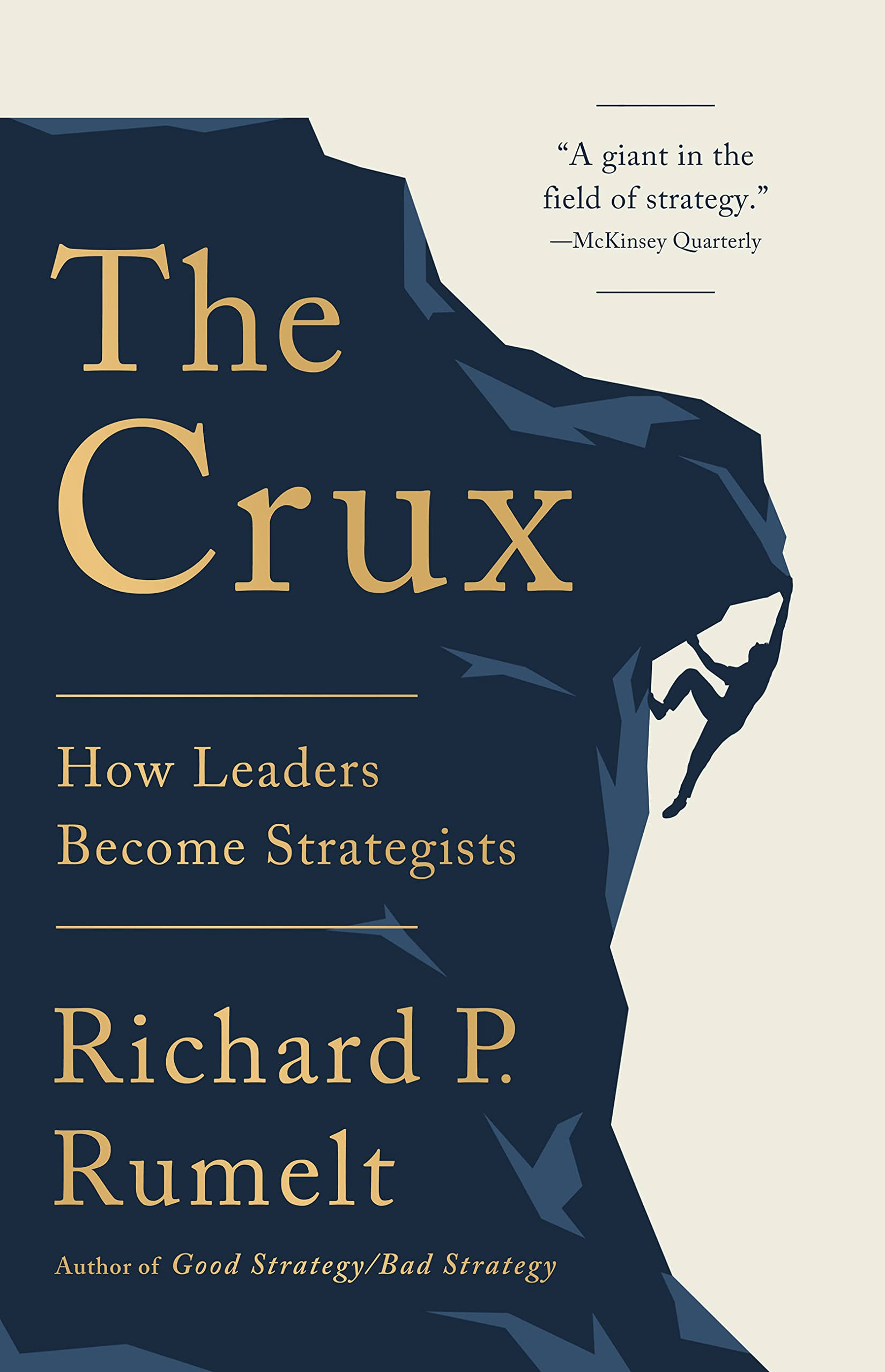
Book Title : The Crux: How Leaders Become Strategists
Author : Richard P. Rumelt, veteran strategic management thinker. Author of Good Strategy, Bad Strategy, and prior to his retirement as a professor at the Anderson School of Management at UCLA.
Publication date : May 3, 2022
Core Theme : Strategy is not chosen, it is created. You have to start by examining yourself to find out what the ‘critical difficulty (crux)’ is that you are facing. It’s about corporate strategy, but as individuals, we can learn from it too.
◆What is a ‘crux’?
◇The key difficulty is also called “core paradox”, that is, in the end what mechanism is hindering you, constraining you, why you can’t always do well in this matter - to make this core paradox clear, break through, and then your problem can be solved. The real strategy is to find and solve the key difficulties.
◇Find the key difficulties, combined with their own strengths, see what leverage you can mobilize, how to solve the key difficulties, and then the specific steps, which is called strategy.
◇Strategy can not be copied, not from a book of strategies to make choices. Strategy must start from oneself, find the key difficulties, figure out the main conflicts, and then see what specialties and levers you have to create a solution.
◆What situations require strategy design?
◇Not all strategies need to find the key difficulties, and only strategies with key difficulties need to be “designed”.
◇Two kinds of challenges do not need strategy design: selective strategies, engineering design challenges.
◇The one that needs strategy design is: “gnarly design challenge”: it includes two kinds of situations–not being able to see the key difficulties; there is no strategy for you to choose.
◆How to find the key difficulty?
◇The key difficulties are summarized by team members and then the key difficulties are ranked. There are two priorities for ranking: importance and addressability.
◇Importance is the extent to which the difficulty threatens the company’s core values, and addressability is to see if the company has any levers in hand that can solve the problem.
◇When both importance and manageability are high, the problem may be the key difficulty you need to solve.
◆ What is the basic idea behind strategy design?
◇One insight: find the key difficulty, then you need to take a leap of faith and think outside the current mindset.
◇Finding the key difficulty, discovering one’s own strengths, and then preferably taking a leap of thought, this is the basic set of strategy design.
◆How does strategy serve growth?
◇You have to break down your aspirations into key difficulty points and utilize your own strengths to solve them before you can call it strategy.
◇Four practical ways to bring about growth:
The first method is the core method, and the very essence of any company’s growth, called “delivering exceptional value to an ever-expanding market”
The second method is to trim the company. Sell off inefficient departments.
The third method is to react quickly to new situations.
The fourth way is to acquire another company. A good acquisition is one that keeps you strategically focused and deepens your underlying competitive strategy. There are really only two acquisition criteria - either it has the technology and platform you desperately need, or it can help you enter new markets.
◆ What are the misconceptions about strategy design?
◇Strategy is decisiveness, a subjective choice to do something and give up something. Strategy requires us to focus our efforts and execute with determination.
◇Compromise is fine, but there is one thing you have to stick to! That is that your actions cannot be in direct conflict with each other. You can’t ‘have it all, have it all, have it all’ or the project will go nowhere.
◇Giant babies make all kinds of wishes, and those wishes are all in conflict with each other, and politicians only make peace with those wishes and seek compromises; only a strategist can choose some wishes, abandon some wishes, and implement them resolutely. Strategy has to be prioritized and feasible.
◆ How do you diagnose the key difficulties?
◇The first means is to compare yourself with your peers. It seems as if the doctor comes up and first looks at your blood pressure, blood oxygen, liver function a few simple indicators. If the values are outside the healthy range, then there is something wrong.
The second means is to familiarize oneself with the people. Doctors when a long time will be very familiar with the patient’s psychology, so the patient in front of the doctor pretending or cover up is useless, strategic counselor is also the same. It is as if the doctor guides the patient to tell his condition.
◇The third means is data analysis. This is more specialized and requires precise measurements to obtain data.
◇The fourth means is to use a known frame of mind. A knowledgeable doctor will categorize the patient, and when the patient comes in, you will probably know what type he is.
◇The fifth tool is insight from the front line. People who solve problems on the front lines often see problems that people who are simply doing research in academia don’t see.
◆ How do you strategically play to your strengths?
◇Advantage is an asymmetry, something that makes you different from others, something you have that others don’t, something you can do that others can’t.
◇The five business advantages: information, technology, position, efficiency and system management.
◇Common business advantages of modern enterprises are: ‘coupling’, scale and experience, specialization and network effect.
◆What are the common “pseudo-strategies”?
◇Behavior under the banner of strategy that does not actually solve the real problem and does not have a strategic design.
◇One is the “pseudo-strategy”, which usually appears at the leadership level and is characterized by equating goals and visions with strategies.
One manifestation of this falsehood is the values statement. Values statements are not strategy. Strategy, which is about making real decisions, especially about what field you’re going to compete in, how you’re going to compete, and who you’re going to compete with, is the real thing.
Another manifestation of the false big empty is that the top pats its head and puts forward a macro goal, and the bottom makes plans in a hard-headed way, but in reality, no one knows how to realize it.
◇One is the “scorecard”, or performance appraisal, which generally exists at the middle and grassroots levels, equating strategy with management.
The scorecard is the implementation of the strategy, but not the strategy. Strategy is about deciding what to do, while the scorecard is about making sure it gets done. Strategy and scorecard appraisal are both united and opposed.
◆How do I develop a strategy?
◇Designing a strategy around key difficulties and then arranging for its implementation in terms of resources, organization and personnel to ensure that the strategy is coherent is the most important thing a leader should do.
◇There are three difficulties to overcome in developing a strategy:
The first difficulty is that people may love to talk about strategy, but they don’t actually like it.
The second difficulty is to take the ‘leader’s view’ as strategy.
The third difficulty is that there is no scientific theory of strategy in the world.
◇The process of developing strategy:
Companies are generally required to set up a temporary ‘Strategy Research Office’ consisting of leaders from the top level of the company and major business units, totaling no more than 8-10 people.
The strategy-setting meeting should take place one month before the company’s budgeting activities, which means that the strategy is set before the budget.
Participants should ideally find a clean place to dedicate the meeting, which usually takes three days. The entire meeting can be roughly divided into five steps.
The first step is private interviews.
The second step is the first day of the formal meeting, where participants list all the challenges they can think of for full discussion.
The third step was to select the most important and strategic challenges, the key difficulties.
The fourth step is to define the strategy.
The fifth step is to have a ‘strategy navigation’ session during the implementation process.
◆ Worth remembering -
◇Strategists can’t copy homework; strategists need imagination.
◇Dewey said that the surest source of new design ideas is reflection on perceived difficulties.
◇As a responsible adult, you need to know where your ‘growth’ is.
◇Strategy, one has to have to set priorities and see what is most important and what you can do instead of giving Christmas presents to giant babies.
◇To have policies and actions means that some departments are more important than others, some people are more important than others, and some people’s needs are more important than others.
◇Strategy is to have a realistic grasp of the situation beyond looking up at the stars and putting one foot in front of the other, and to make a bold change with a radical but workable program.