The Wild Problem (below): from r-strategy to K-strategy

Wild Problems (below): from r-strategies to K-strategies
In this talk we face up to the most crucial difficulty of the wild problem: if you don’t know what you prefer when the time comes, how do you choose?
Before I talk about Roberts’ solution, I’d like to introduce you to a theory from ecology that we can learn from, called “r/K selection theory”. This theory talks about how organisms weigh the quantity and quality of their offspring.
Some organisms pursue the number of offspring, which we call “r-strategy”. r comes from the English word rate, which stands for growth rate. r-strategy is characterized by reproducing a large number of offspring, hundreds or thousands at a time, but then leaving them to fend for themselves. Fish, seahorses, and especially plants, such as dandelions, use the r-strategy.
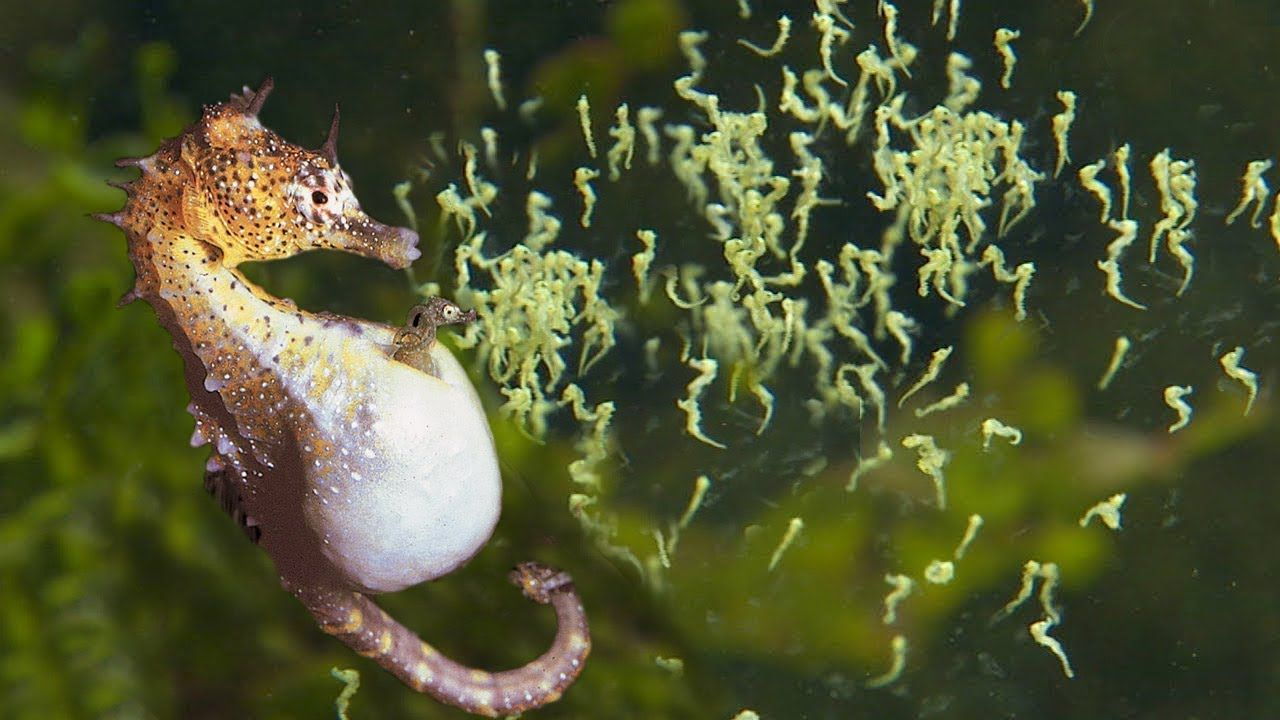
The r-strategy creatures are generally larger and have a lot of resources, to the point where you don’t really need to compete with other creatures for resources. That’s why r-strategy creatures have smaller bodies and shorter lifespans, and don’t have much combat power to talk about prosperity. But because of their large numbers, r-strategy organisms are more adaptable to changing environments, and even if there’s a sudden climate change or some other disaster, there are always a few lucky offspring who can survive and pass on their genes.
In contrast, the “K-strategy”, which comes from the German word Kapazitätsgrenze, meaning the capacity limit of the local environment, seeks quality rather than quantity of offspring. k-strategy organisms have a finite environment with only so many resources to live in, and have to fight for them. Animals like elephants, orangutans, tigers, and eagles are K-strategy, and they raise their next generation very carefully, allowing it to grow up slowly. And their offspring are all great as soon as they grow up: bigger, better fighters, and longer-lived.

K-strategy creatures have a sense of control over their environment. They believe that the future of their offspring is visible and the situation is more stable, so they are willing to invest for the long term. We can imagine that the K-strategy is the path to prosperity.
Note that I’m not talking about the individual organisms’ judgment in selecting a strategy, but rather evolution’s choice for them, natural selection. Simply put, the r-strategy and the K-strategy are both “rational” adaptations to the environment. If the environment is vast but volatile, and the life is scattered and precarious, then use the r-strategy; if the environment is stable but the resources are limited, and it is worthwhile and desirable to invest in competitiveness, then use the K-strategy.
The r/K selection theory does not explain all living things. For example, big trees and sea turtles are large, long-lived and have no natural enemies, but they also have many offspring and are also born without care, so do you think they are r strategy or K strategy? So this theory has now been replaced by the “life history theory” which has more detailed models and is rarely used in biology.
But the r/K selection theory is really succinct and compelling, and it’s very inspiring for the social sciences.
✵
For example, in his preface to a book [1], sociologist Mr. Dingxin Zhao makes the analogy that companies also have r-strategies and K-strategies.
In the early days of reform and opening up, there were many business opportunities in China but the legal system was not sound, you could make a small fortune in just any business, but it was difficult to make it big. The environment was unstable, and your company could be banned by the government before it got big. In this case, the company usually adopts the r strategy of making money when there is money, making a fortune and then finishing the job, not pursuing long-term development.
Later, as China’s legal system became more robust and the business environment became more predictable, many companies moved towards the K strategy, pursuing long-term development.
I see this transformation from r-strategy to K-strategy as being in line with Roberts’ proposal. Roberts suggests two fundamental solutions to the wild problem that correspond exactly to the r-strategy and the K-strategy.
✵
*First is the r-strategy. When you’re faced with a lot of options and don’t know exactly what’s going on with each one, you should try more and experience them for yourself. *
As an example, our column used to talk about Bill Belichick, the head coach of the NFL’s New England Patriots,[2] when we talked about The Mastery Training Manual. He is a legendary coach with a unique philosophy. Roberts describes one of Belichick’s strategies.
The NFL, like the NBA, has an annual draft. Fans know that the draft is divided into rounds and that “first round picks” are very valuable, only one per team. Belichick particularly interesting operation is that he will take his first-round pick, and other teams for a number of third- and fourth-round picks.
This is a bit incredible: who doesn’t know that stars are important? The value of a star can be worth a lot of ordinary players. But in Belichick’s opinion, you can’t tell if a player is a star from the draft. The reason he’d rather have a few more picks in the later rounds is that he wants to pull as many rookies as possible into his camp so they can actually participate in the team and observe it firsthand.
Belichick will test a player’s speed, agility, strength, and intelligence up close and personal, but more than that, he’s looking to see if the player is a good fit with the Patriots’ playbook, what the player’s personality is, and how well he’ll fit in with the team. These things you can not see from the draft information, you can only let him first into the team, slowly observe. Those who perform exceptionally well will stay; those who perform average will be dropped.
With quality unknowable, Belichick goes for quantity. Belichick uses the r-strategy.
The key is to add optionality to the mix. As we said in our column on options thinking [3], the great thing about optionality is that it’s just your right, not your obligation - Belichick has the right to keep any rookie, but he’s not obligated to give any rookie a long-term contract: of course, more of a good thing like that is better.
Some shopping sites are now giving customers the option of expanding the options available to them. One much-talked-about business case is Zappos, a shoe-selling site founded by Hsieh Kar-wah, which has an outright free-return policy that encourages you to buy several pairs of shoes at a time, in all sizes and styles, to try them on at home, keep the ones you like, and return the ones you don’t. This could become a more mainstream way to buy shoes.
Then there’s venture capital. Venture capitalists don’t really believe in which companies will make it big, in fact you’d be very lucky to invest in one out of ten companies that will become unicorns - but to catch unicorns, you have to invest more.
Sometimes people ask me if I’m optimistic about a new technology in a new company, and I’m never optimistic. I’ve never seen a company that I thought was particularly impressive on first hearing about it, and I’ve seen them all have major flaws. But my advice to people is never that you don’t invest - I always say if you have a lot of money you invest: if you’re going to invest in 100 companies, this one probably deserves to be on your list.
The point of this thinking is to start boldly and give up ruthlessly - it’s ‘treasure hunter thinking’. Try a few more so you know which one is best for you. Don’t be afraid to make the wrong pitch, sunk costs are not mistakes, they are just the necessary price of trying.
The r-strategy requires us not to commit easily. Before signing up formally with a company, it is better to have an internship to understand the process, just like talking about a relationship before getting married. Easy to promise people often can not fulfill the promise, not easy to give the promise is worth believing.
But you always have to commit. You always have to sign a long-term contract with some player, just as you have to get a marriage license with someone. People in the civilized world are unlikely to engage in r-strategies with their children: the child is born, can you not raise him?
✵
That’s why we also need the K-strategy. *The K-Strategy is the careful raising of a project, a business, a trip, but also a life. When you recognize something, you’re not content to be shallow with it, you want to make it big and prosperous with your own hands. *
But don’t expect things to go according to your plan.
Roberts draws an analogy, let’s say you’re traveling to Rome. You can read a lot of travel guides and book tickets to the sights, but don’t be too strict. Because you don’t know what you will like about Rome when you don’t get there. It may be that when you get to Rome, you’ll spend more time in the places that you find particularly good. You’ll have to adjust your plans based on what you learn in Rome.
To take this attitude a little further, you have to imagine a program as if it had a life of its own. To respect its own laws of development.
For example, if a writer writes a novel, they will say that the characters in their work have their own personalities, wills, and destinies, and that the author does not change them. Another example is when a poet says that a poem has a mind and voice of its own, and all the poet does is tap into that poem.
The most obvious is the child. A child will never grow up in that optimal way that you set out to do. Maybe you want him to learn math, but then he doesn’t want to learn math, and there’s really nothing you can do about it. There’s very little you can do.
But it’s not like you don’t control or intervene at all, there’s always some room for you to maneuver and maybe influence - not set - the direction of things, it’s just that you have to stay open to improvisation.
Roberts says that his proudest accomplishments are often choices that he didn’t plan much in advance and didn’t consider to be in line with his identity, the result of accidental dabbling. For example, he never thought he was going to do a podcast, he did not think he was suitable for audio programs, others pulled him to do it, and once he did it, he found that the results were quite good.

Roberts suggests that we look at our lives as a work in progress, or even a work of art: hold on to the mindset of curiosity and exploration to see how it will unfold next.
✵
We have to learn to say no to some things in life, otherwise we’ll get bogged down in all sorts of stuff and not get anything done - but you can’t say no to everything that’s “irrelevant” or you’ll miss out on a lot of good stuff. You can’t have no plan, but you can’t have a plan that’s too strong.
Be bold about wild issues, while keeping the option of ending them ruthlessly open. But you will have to make choices eventually, but choices aren’t about picking everything for the future at once, they’re about making commitments, continuing to explore, and finding the best way to grow.
The direction of exploration should always be in pursuit of prosperity. This means that we don’t always ask ourselves “do we like it”, but rather we want something greater: meaning, purpose, and love.
*The r-strategy is opportunistic, while the K-strategy strives for stability and control. Transitioning from the r-strategy to the K-strategy is when you mature. But you can’t be too mature - you still have to retain openness and malleability. *
There are no secrets here, but it can’t be said to be a cliché either. Strategic vision helps us think things through, and then it’s still the same thing: get it right, and you’re already halfway there.
This is the end of the book, I wish you live long and prosper !
(The End)
Note
[1] [German] Fidus de Hocher, The Amazing Senses of Animals (CITIC Publishing Group, 2022)
[2] Elite Day Classes Season 1, The Master Practitioner’s Handbook 3: The Man Who Paved the Way for Those Who Came Before Him
[3] Elite Daily Lessons Season 3, The Wisdom of Options 1: Just Rights, Not Obligations
Highlight
1.r strategy: when you are faced with a lot of options and don’t know what each one is really about, you should try more and experience it for yourself.
2. k strategy: carefully raise a project, a business, a trip, and also a life. When you recognize something, you are not satisfied with a shallow taste of it; you want to make it bigger and more prosperous with your own hands.
3. The r-strategy is opportunistic, while the K-strategy strives for stability and control. Transitioning from r-strategy to K-strategy is when you mature. But you can’t be too mature - you still have to retain openness and plasticity.