Scale mindset

Scale mindset
There’s a buzzword for American entrepreneurs called ‘scale’, which generally translates to ‘size’ or ‘expansion’. It’s originally a noun, but a cooler way to use it is to use it as a verb, meaning “to scale …… up”. I feel like this word is still too little used in the Chinese world.
By scale, I mean to replicate, mass-produce, popularize, grow, and develop something. It is not about addition, nor is it about multiplication as in the old days of “mechanized mass production”, but rather it is best to generate some kind of cumulative, positive feedback effect to achieve exponential growth.
We simply make a big word called “Scale Mindset”.
Scale Mindset is very much related to the “Growth Mindset” put forward by American psychologist Carol Dweck, which we often talk about in our columns, and it is also related to the “compound interest” that people love to talk about. Growth Mindset talks about changing yourself, compound interest emphasizes returns, and Scale Mindset is a more general way of thinking about doing things.
Simply put, you have to do things with this realization: * When you come across something, first think about whether it is scalable. *
✵
If you work for a company, you need to understand that a lot of the day-to-day stuff in your company is not scalable. For example, there are all kinds of daily maintenance, supportive, logistical tasks, what work dinners for you to set up arrangements and so on. These things are characterized by the fact that a person with two years of experience is doing this, and a person with 20 years of experience is also doing this. Your experience does not accumulate to allow you to have greater play, better results, you do these things without compound interest, can not grow.
That’s why Sam Altman, in his article How to Succeed[1], says right off the bat that you should specialize in things that have a compounding effect. It’s cumulative and therefore scalable: the more you do it, the bigger you get; the bigger you get, the better you get at it. That way you can keep growing and growing and growing faster and faster, creating exponential growth.
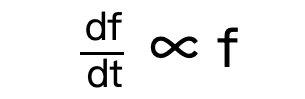
Scaling generally can’t be done by individual ability alone, but must be combined with some sort of leverage to make it work. This leverage can be capital, technology, branding or network effects. Managerial ability is probably scalable if it’s based on individual ability alone: the higher your managerial ability, the more people and complexity you can manage; and the more people and complexity you manage, the higher your managerial ability will be, and the more scale you can have.
All masters understand this: they should focus primarily on things that are scalable.
The Harvard Business Review reported a study[2] that said more than 90% of assistant professors at universities believe that their time outside of class should be spent on research, not on things like “faculty meetings”. We all know that the latter is just housekeeping, and what else a bunch of college teachers can do at a conference …… is not scalable. And do their own research, but can let you get a real compound interest.
Another survey showed that only 3.7% of university teachers were willing to participate in something like a faculty senate, and the gender differences were intriguing. Women’s willingness to participate was 7 percent, compared to only 2.5 percent for men. Why? Because women are less likely to say no to such chores. Research shows that in companies, non-extendable, domestic, voluntary work is also generally more often given to women. Even a female manager who arranges this kind of thing prefers to give it to a woman.
It’s called selflessness, to put it nicely. But mathematically, this is not good for women’s career development.
But the point of this talk is not personal growth. I’m more interested in saying that you can have a scale mindset in whatever you do. You have to know where the scaling point is. You’ve got to be really excited to find something that’s scaleable.
✵
Just in April, Greg Brockman, president of OpenAI, gave a TED talk [3] about what GPT-4 can do. He focused on ChatGPT’s plugin capabilities, something we’ve already covered in our column [4]. At the end of this talk, Brockman had an interaction with the presenter, and the two talked about how OpenAI discovered the ‘emergent effect’ [5] in language models.
Brockman said we are standing on the shoulders of giants, there are many research results on the market that we are trying …… but the real key breakthrough came from a very unexpected discovery.
In 2017, OpenAI had an engineer train a model using user reviews on Amazon.com, and the usefulness of the model was supposed to be simply to predict what the next character in a user review would be: would it be a comma, a noun, or a verb? Pretty simple text prediction.
Once the model was done, OpenAI wanted to do a test to see if it could analyze the sentiment in the text - that is, whether this user review of the product was positive or negative. It turned out that the model was surprisingly more accurate at sentiment labeling than all other models on the market at the time [6]!
This was very strange. You have to realize that this model wasn’t even considering sentiment, it was just analyzing syntax; those models that specialize in predicting sentiment might specifically look for sentiment-related words to determine what sentiment the passage is, but this model didn’t. Yet this OpenAI model happens to be the best at judging sentiment. The researchers found that the model somehow automatically grows a “sentiment neuron”, and if you set it to a positive value, the model generates positive ratings; if you set it to a negative value, it generates negative ratings – and that’s what the model does! -
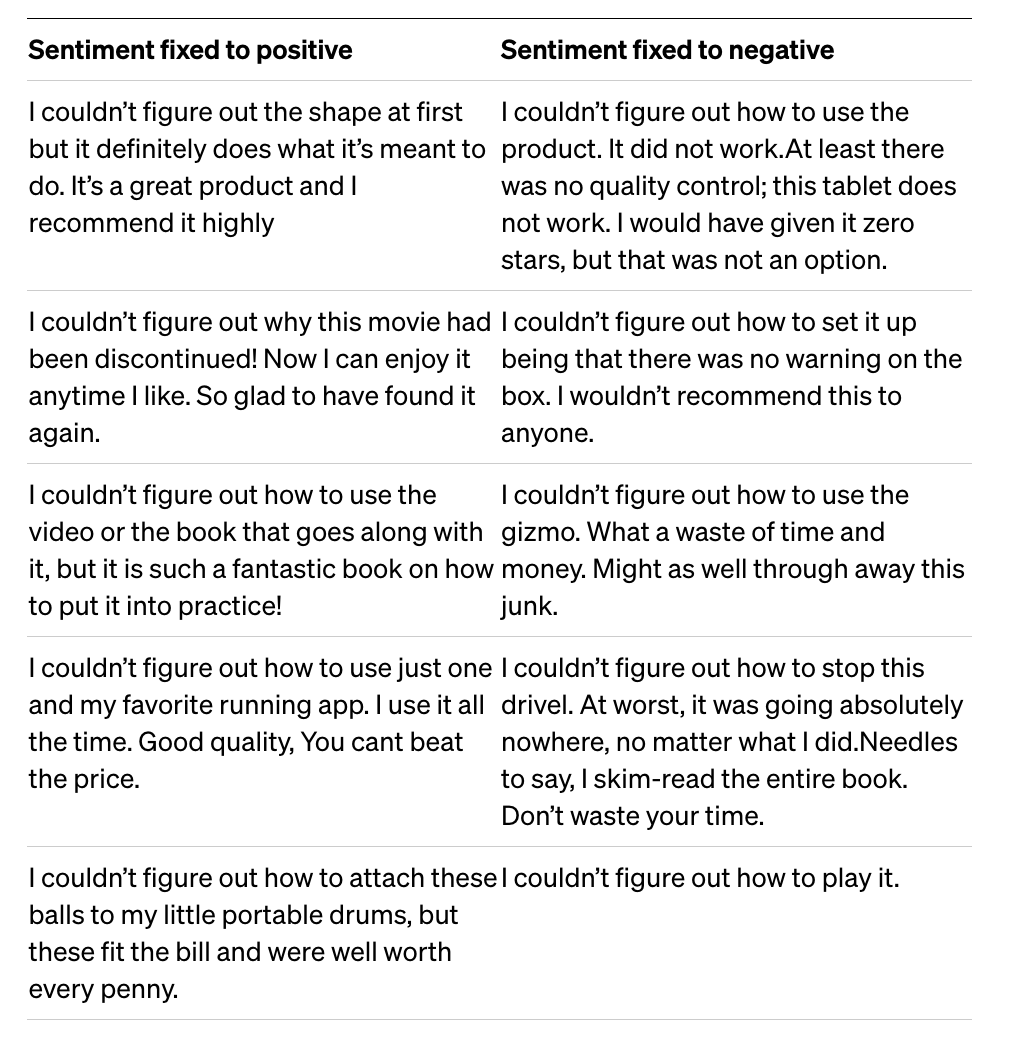
This is ‘emergence’. While models analyze syntax, sentiment is semantic. How does a syntactic predictor automatically generate semantic concepts? That’s something that’s not in the same dimension! You see this is the same phenomenon we talked about before, that neural network model that Wolfram said automatically captured semantics [7]. No one has yet been able to completely explain why this is.
That was the first time humans witnessed magic in a language model.
I also made a point of checking that this discovery happened before the famous paper [8] on Transformer came out. It seems that the real key breakthrough of GPT is not Transformer, but OpenAI’s emergence from syntax to semantics. This may also explain why Google invented Transformer, but OpenAI was the first to make an intelligent language model.
That was in 2017, when there were only sporadic reports [9]. Little did we know that was the dawn of AGI.
Getting back to the subject of our talk here, I’d say OpenAI’s scale mindset: as soon as they saw this amazing phenomenon, they immediately thought of scaling it - Brockman’s exact words were “you’ve got to scale this thing “.
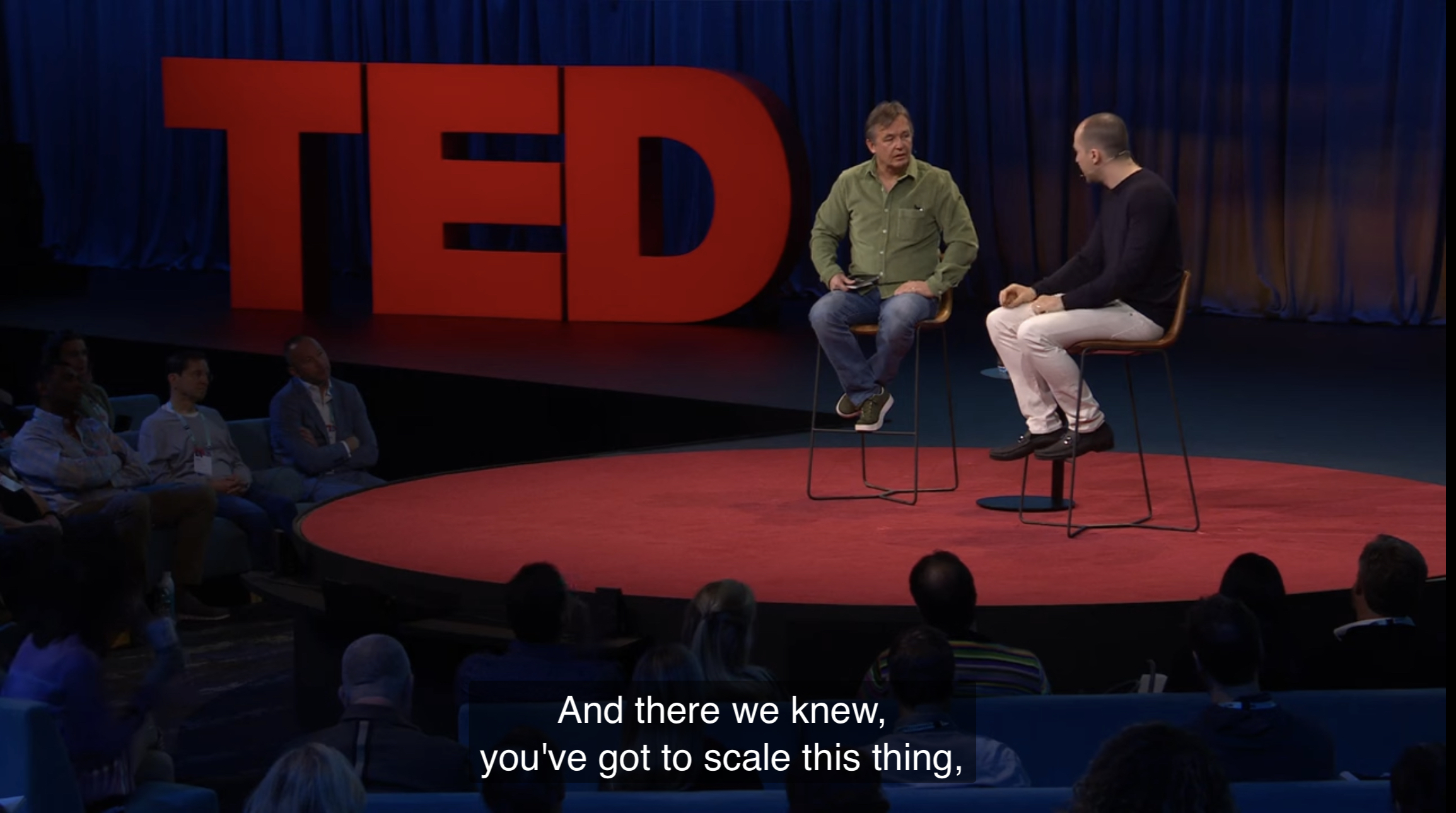
The scaling here is not about scaling the model many times over, or simply using the algorithm for something else, but rather growing it internally. This is the case with many things in engineering: we may not be able to say why syntactic predictions automatically bubble up to semantics, but we can still generalize the approach.
When you see something good, you rush to find a way to make it grow. This little tree was an apple tree, so how come it suddenly grows money? Let’s study it and see if we can make a money tree out of it – that’s the spirit of the scale mindset.
✵
Entrepreneurs don’t do things by doing the same job day in and day out, and they don’t just take their chances and dig for treasure, they go out and find a magic seed, nurture that seed well, and let it grow and produce scale. You have to be very sensitive to ‘scalability’ to do that.
Many traditional businesses are difficult to scale. For example, if you open a restaurant, if you want to rely on the chef’s craftsmanship to attract customers, it’s pretty much unscalable. No matter how good a chef you are, he can only make so many dishes a day. Unless you let him teach his craft to many apprentices - but if the craft is that easy to teach, then it’s only standardized, and that’s not an advanced craft. The KFC chain sells convenience and branding, not craftsmanship.
The same goes for doctors. Modern medicine has standardized as much as possible in terms of knowledge and methods of operation, but good doctors are still very scarce because you can’t just go through the motions, you need experience and brains and even creativity. Industries that need to be customized to the specifics of the client every time they provide a service, like lawyers and consultants, are also hard to scale. Then there’s traditional manufacturing, where you can mass produce, but because you have to use human labor, you need raw materials and machine plant, your marginal costs are quite high, and it’s hard to scale with impunity. That’s why traditional entrepreneurs don’t say the word SCALE very much.
But the new generation of entrepreneurs likes to talk about scale. this is because the computer and Internet era has seen the emergence of a number of products and services with very low marginal costs, such as software, web services, not to mention platforms …… all the bigger the scale, the faster the growth rate, the higher the benefits.
Under this kind of Internet thinking people will want to give scale to any business. For example, in the movie “Lost in Thailand”, Wang Baoqiang said I am a do scallion pancake, selling 2.5 yuan a, Xu Zheng immediately said that you should open 5000 chain stores ……

But not everything can scale. the service industry is traditionally difficult to scale because you have to use people, but there are only so many best people. Mr. Wang Yuchuan has been talking for the past few years that it is the emergence of AI that gives the possibility of ‘scaling the service industry’ because it can solidify the best human experience and make it replicable [10].
Anyway, entrepreneurs have to have this vision: when they see anything, they first think about how high its ceiling is, and whether I can scale it up 5,000 times.
✵
The scale mindset is not limited to business. It’s the math behind any business to grow and prosper.
I think an interesting case is how the Chinese Communist Party took power. There is a book called “Why the PLA can win” by Xu Yan, which has been specifically talked about by Fatty Luo before [11]. This book has the scale thinking model in it.
For example, Chiang Kai-shek focused on “generals” and liked to set up military schools and training courses, specializing in training generals. Chiang Kai-shek’s famous saying is “fighting a war is fighting a general”, treating soldiers as expendable, spending money on recruiting in the early stage, and then simply capturing soldiers in the later stage. Moreover, Chiang Kai-shek also likes to use his own townsmen, talking about the first line. In our language, Chiang Kai-shek is non-scalable.
Mao Zedong, on the other hand, emphasized on “soldiers” and famously said that “soldiers and people are the basis of victory”. It is interesting to note that the Red Army was not paid, but not only did they have a constant supply of soldiers, but they were also proud of their sacrifices. Why? If you talk about nothing else but entrepreneurship, it is because Mao Zedong invented a scalable system. This system promised soldiers long-term family benefits - land for a successful revolution - that Chiang Kai-shek could not provide.
Later, during the War of Resistance Against Japan and the War of Liberation, the CCP learned not to be ideological or ultra-leftist externally, but to talk about patriotism and the economy, and to combine it with the immediate interests of the people, which was SCRALABLE, Xu Yan said. For example, at the critical moment of the civil war, the slogan of the Communist Party’s campaign in the nationalized areas was “anti-civil war”, “anti-hunger”, “anti-persecution”, which was the greatest common denominator of all Chinese people, and its scalability was certainly high. Of course, the scalability is high. Even if you don’t like Leninism, you have to support my fight against hunger, right? This is the realization of Mao Zedong’s saying, “Make many friends and few enemies”.
In other words, in the process of seizing power, the CCP is a platform that can accommodate exponential growth.
✵
Even if you don’t want to be an entrepreneur, you can apply the scale mindset.
You have to allow yourself to be scalable. When you see a good book, you should find and read all of that author’s books; when you hear a good podcast, you should subscribe to, or even read through, that channel; when you get an inspiration, you should research a theory, which leads to a habit, or even make a life change.
The scale mindset requires us to see something good like an insatiable businessman discovering the tip of a golden mountain: *No matter how tiny it may seem, as long as you determine that it has the potential to scale, you have to grab it and do whatever you can to make it grow and maximize its potential. *
Notes
[1] https://blog.samaltman.com/how-to-be-successful
[2] https://hbr.org/2018/07/why-women-volunteer-for-tasks-that-dont-lead-to-promotions
[3] https://youtu.be/C_78DM8fG6E
[4] AI Topic 12: Your AI assistant is here!
[5] AI Topic 3: Language Modeling’s Moment of Enlightenment
[6] https://openai.com/research/unsupervised-sentiment-neuron This briefing is dated April 6, 2017; paper: https://arxiv.org/abs/1704.01444 April 5
[7] AI Topic 11: GPT’s undercard and lifeline
[8] Attention Is All You Need https://arxiv.org/abs/1706.03762 June 12, 2017.
[9] https://futurism.com/ai-learns-to-read-sentiment-without-being-trained-to-do-so
[10] LAW - Inspiration Club, Issue 46 | WANG YUQUAN: Who can win the US-China tech game?
[11] LAW, Issue 39 | How hard is it to innovate?
Highlights
- “Scale Mindset” means to replicate, mass produce, popularize, develop and expand a thing. It is not to do addition, nor is it just to do multiplication as in the previous “mechanized mass production”, but it is better to produce some kind of accumulative, positive feedback effect to achieve exponential growth.
- When you see something good, no matter how small it seems, as long as you determine that it has the possibility of scaling up, you have to grab it and not let go, and find ways to make it grow and maximize its potential.