Red Capsule of Consciousness 5: Controlled Hallucinations

Consciousness Red Capsule 5: Controlled Hallucinations
In the previous lecture we stated Damasio’s doctrine that human consciousness should come exclusively from sensations, emotions and internal signals of the body, and that no mystical element is needed here. But Damasio’s theory seems to be too general, and in this talk we introduce another new theory from a popular brain neuroscientist, Anil Seth.

Seth is a professor of cognitive and computational neuroscience at the University of Sussex (UK), born in 1972, and is considered to be in his prime. He shows respect for Damasio, but he has an exclusive theory of his own.
Seth came out with a book in 2021 called Becoming You: the New Science of Consciousness[1] detailing his theories.
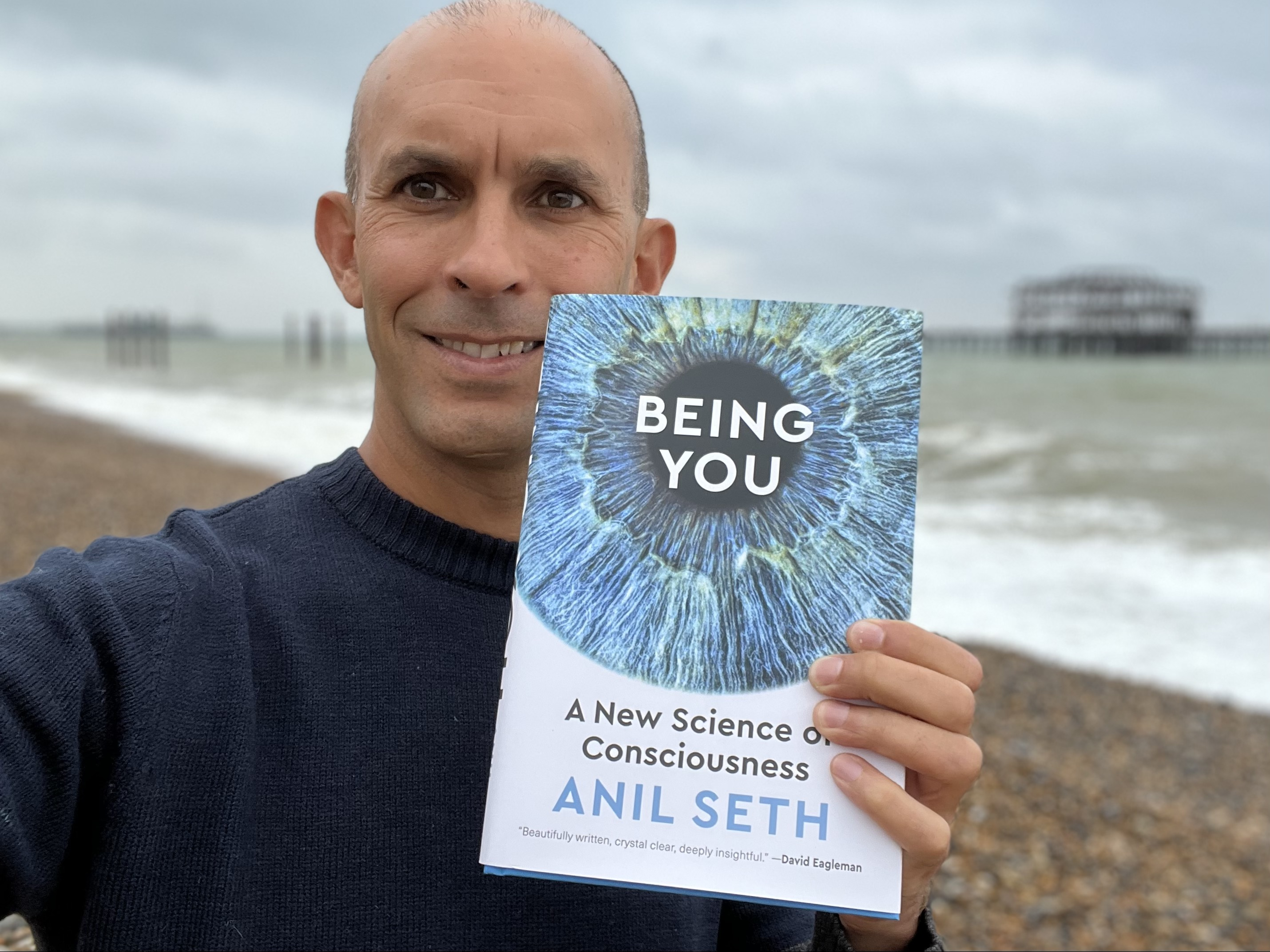
Instead of spending all day talking air-to-air about what the ‘hard questions’ of consciousness are, Seth says, we should study the ‘real questions’ of consciousness.
The so-called real problem is that if we assume that consciousness is purely physiological, and we categorize it into different types and see what the properties of each type are, can we explain those properties? If you explain those properties clearly, the “hard problem” will automatically dissipate.
Seth divides consciousness into three main types [2]. The first type is “are you conscious“ - that is, are you awake, in deep sleep or in a vegetative state. The second type is yourperception, for example, when you see the color red, you have a “sense of red”. The third category is “Self“. The focus is on the second and third categories, i.e., external and internal awareness, which is similar to Damasio’s categorization.
Seth’s signature theory is called “ predictive processing (predictive processing)“[3], and key to this theory is the notion that: *All your consciousnesses, are illusions. *
✵
Let’s look at an example that caused a lot of buzz a few years ago. There is a dress in the photo below, can you tell us what color it is?
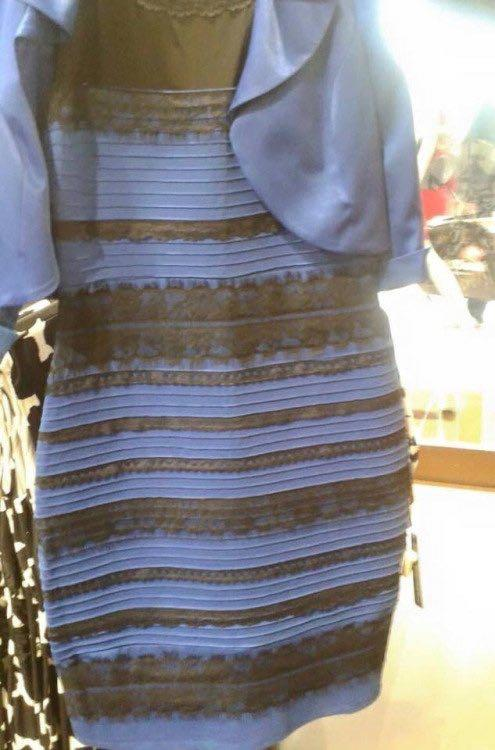
To some, it looks like a white and yellow skirt; to others, it clearly looks blue and black.
This is a very peculiar example because each person can only see what they see - to me, for example, it’s white and yellow, and I can’t imagine how anyone could see it as blue and black. Maybe this is blue-black to you, and maybe you need to ask a few more friends to appreciate the paradox. You’ll find that people are firmly divided into two camps.
What’s going on here? Here’s how Seth explains it in an interview [2]: The key is whether, by default, you took the photo indoors or outdoors.
Let’s say we have a piece of pure white paper, and you look at it outdoors and it’s white. When you take that paper indoors, because indoor light is usually yellowish, the white paper becomes yellowish in tone, right? You measure it with an instrument, and the tone on the white paper indoors is just yellowish. But that’s not what it looks like to you – you still firmly see a snow-white white paper.
That’s because the brain automatically does compensation when it processes color signals. You know you’re indoors, so you automatically remove the yellow light, even though you don’t realize this compensating action. And outdoor light, even on a cloudy day, is bluish, and the brain compensates accordingly.
The background in the photo of the dress is so small that one can hardly tell if it was taken indoors or outdoors, and if the background light is sunlight or light. Some people think it was taken indoors, and their brains automatically compensate for the yellow light, and they see the dress as blue-black; while others think the dress was taken outdoors, and their brains compensate for the blue light, and they see white and yellow.
Here’s a picture I found elsewhere that might make it a little clearer for you–

The point is, you’re not telling yourself “this is indoors” or “outdoors”, you’re not even thinking that way – your perception of color is completely automatic, it’s done before generating consciousness. consciousness before it’s done.
For example, in the following recently popular photo, at first glance you think there’s a red Coke can in the center – <!
– – more –>. – more –>
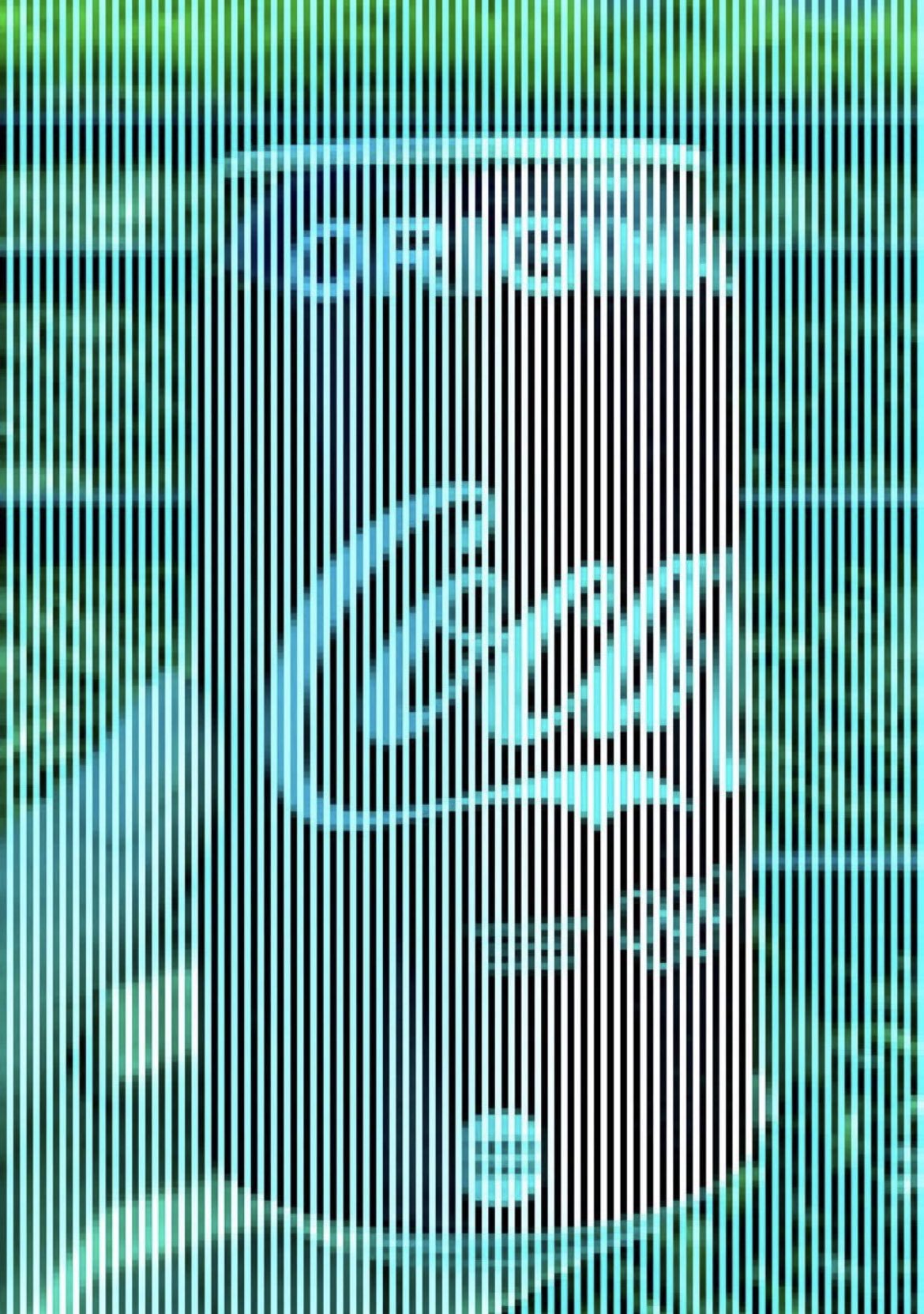
But if you zoom in you’ll see that there is no red color in the picture at all! This is also the result of brainstorming.
The color you perceive is a very subjective thing, an illusion if you will.
✵
More technically called “ controlled hallucinations *”. Your perception of color is not a spectral signal that enters your eyes, but rather your interpretation of the signal, which can also be described as a story that you now make up. *
This is true of any perception. Then there’s a teacup in front of you, for example, and you only see the front of it, but you very naturally assume that it’s a three-dimensional object, that its back is pretty much the same as the front, that it’s round – these self-evident perceptions are the same as your perceptions of a white sheet of paper and a skirt, which you made up in your head.
Seth says that including this ‘objectness’ is also an illusion you made up.
That’s not to say that you don’t have a cup in front of you, of course - you’ve had a lot of use out of this illusion - but strictly speaking, the pile of light signals coming into your eyes alone isn’t enough to prove that there’s a cup there: those signals are just photons! There’s no label on the photons to tell you whether they’re coming from the white paper or the cup. You really aren’t making this up though, your hallucinations are indeed controlled by environmental information, hence the name controlled hallucinations.
It’s not just colors and objects, but even concepts like space and time, which are stories we tell ourselves, are also controlled illusions – and Kant would have known this for a long time, and he would have said that none of these things are ‘thing-selfs’.
The controlled illusion is our active interpretation of external information. It’s something we actively initiate, something we actively compensate the white paper for light, something we grope for from the inside out.
✵
This leads us to Seth’s theory of ‘predictive processing’, also called ‘predictive coding’.
To “see” something is to “predict” what it is, e.g., a cup, using a model that has been constructed in the brain. This is an inside-out signal flow, where you use your prediction of the cup to find the cup.
Then you get sensory feedback, like when you touch it and realize it’s not a cup, but a diorama on the wall. This outside-in signal flow tells you if your prediction was wrong.
Through these two signal streams, the brain predicts and calibrates the prediction based on the feedback, generating a controlled illusion about the cup – these two streams go back and forth in a continuous loop, where you interact with the environment in a continuous stream of predictions, generating a continuous stream of illusions, which creates your awareness of the outside world.
✵
Predictive processing can be demonstrated with many experiments.
For one thing, it’s easier to be aware of things that fit your predictions.
Experiments in which people are shown a bunch of images, some of which are predictable to the subject and some of which are not, result in faster perception and more accurate judgment for the predictable images.
For example, when we talked about the book “Evolutionary Ideas” [4], we said that “dark blue” and “light blue” are both blue to Chinese and English speakers, so we have a weaker distinction between them; whereas in Russian and Greek, dark blue In Russian and Greek, “dark blue” and “light blue” are two completely different words, which are considered to be two completely different colors, and as a result, Russians and Greeks are more sensitive to these two colors in brain imaging experiments.
In fact, the concept of “color” itself is just a story or an illusion. Think about it: the same flower, because bees can sense ultraviolet light, the color of the flower in their eyes is completely different from ours. ……
On the other hand, if you don’t have a “string” in your head beforehand, and you don’t actively anticipate something, you probably won’t be able to see it.
For example, you may have heard of a famous experiment called “The Invisible Gorilla”. There are two teams on the field playing a passing game, and you’re asked to stare at one of them and count how many passes they make – and you’re staring so hard that you can’t even see a gorilla walking across the field.
Then there’s ‘Change blindness’, which means that if you’re not looking, you won’t even notice when a slow but dramatic change occurs in your environment, such as the color of a wall changing.
All of these experiments show that we do experience the world from the inside out, not from the outside in. So you say, sometimes I do notice a change in my environment, ah, how does that count? I think it’s not so much that it was a change in the environment that made you notice, but that it was an error in your original prediction that made you notice.
✵
And how does Seth explain the other layer of consciousness, the ‘self’? Seth says, *The sense of self is also a controlled illusion, caused by the brain’s continuous prediction and feedback of body signals. *
In experiments, this is reflected in the fact that when the sensations in your body match your predictions, you believe more strongly that it is your body.
For example, the experiment with the prosthetic hand we mentioned earlier has a formal name, the “rubber hand illusion”[5] – the
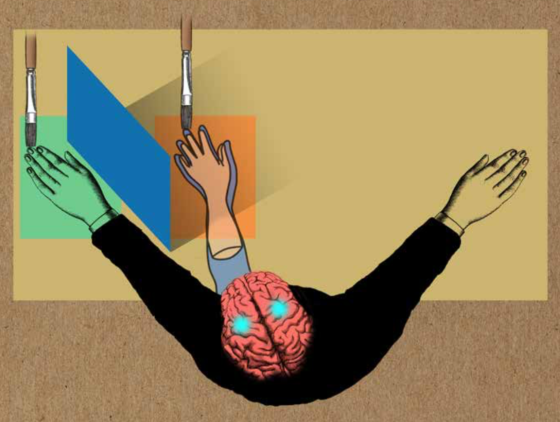
Why do you think that rubber hand is your real hand after some manipulation by the experimenters? Because when the fake hand was touched, your corresponding real hand was also touched at the same time, and they were touched in exactly the same position and with exactly the same strength. The sensations on your hand exactly match the predictions you made by observing the fake hand, so you think that fake hand is your hand.
Similarly, if an experimenter touches your face and another face that looks like yours simultaneously, you think that person’s face is your face [6].
Seth’s lab also did an experiment like this [7]. Subjects put on virtual reality glasses and saw a virtual arm that changed color to the rhythm of their heartbeat, red and white.
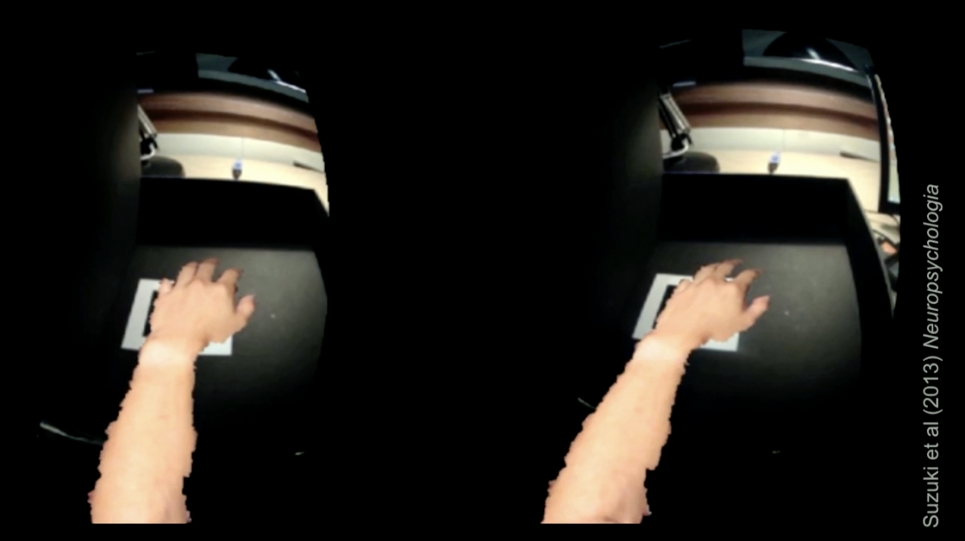
Experiments have found that if the color change of the virtual hand happens to be in sync with your heartbeat, you will strongly feel that it is your hand.
It fits the prediction, so the illusion is formed. So how do you know that your “real hand” isn’t an illusion? They are all illusions, but some are more useful than others.
✵
Sight, hearing, touch, etc., plus internal perception, all of these perceptions are our controlled illusions, which help us to predict and judge the position and shape of objects, and whether or not our body is our own: can I hold that cup? This is my foot, don’t step on the nail.
All emotions are also controlled illusions that help us predict and judge the value of the current situation: whether it is good or bad, whether we should embrace it or stay away.
Our sense of self, our identity in society, the stories we keep telling ourselves, are even more controlled illusions that help us predict and judge what action we should take next: from encouraging ourselves to stick to our homework, to choosing which college to attend and what job to take.
These hallucinations are useful, of course, but you know they’re ultimately hallucinations: very similar photoelectric signals could very well come from something completely different, and there’s no law of physics preventing you from going out the door tomorrow, turning left, and going to the train station to take a train to a strange place thousands of miles away to be a stranger ……
*All of consciousness – your six senses, your experience of interacting with the world, your free will, your social identity – is nothing more than an illusion you’ve made up for yourself. You form consciousness by perpetuating these illusions while predicting and feeding back. *
✵
I think this theory of Seth’s is the most plausible explanation of consciousness that seems to be available.
There’s nothing mystical in it, but it’s a liberation of the mind: the world you feel is not the real world at all, but a Matrix, a controlled illusion.
Descartes thought that the external world could be an illusion created for him by some great god, and that only the fact that he was “thinking” was real – not realizing that the external world could be real, and that only the fact that he was “thinking” was an illusion. Only “he himself is thinking” is an illusion.
The word “illusion” here does not mean “lie”, but “not fully representative of the real world”. Consciousness is a story you distill from the real world, a distorted representation. Sometimes that representation fits your predictions and you think it’s true, not realizing that just as we can do many predictable things in video games, we can live a long life even in lies.
The world just stays there honestly and pays no special attention to you. Consciousness was initiated by you first, and it is you who are lying to yourself.
Annotation
[1] Anil Seth, Being You: A New Science of Consciousness (Dutton, 2021).
[2] https://www.quantamagazine.org/what-is-the-nature-of-consciousness-20230531/
[4] Evolutionary Idea 2: List of Sets
[5] https://neurobanter.com/2019/04/19/guest-blog-phenomenological-control-response-to-imaginative-suggestion-predicts-measures-of- mirror-touch-synaesthesia-vicarious-pain-and-the-rubber-hand-illusion/
[6] https://nautil.us/our-super-malleable-sense-of-self-309910/
[7] https://www.ted.com/talks/anil_seth_your_brain_hallucinates_your_conscious_reality/
Getting to the point
- ‘Controlled Illusion’: your perception of color is not a spectral signal that enters your eyes, but rather your interpretation of the signal, which can be described as a story you are now making up.
- ‘Predictive Processing’: your six senses, your experience of interacting with the world, your free will, your social identity – all are nothing more than illusions you make up for yourself. You form consciousness by predicting and feeding back, and by perpetuating these illusions.