Red Capsule of Consciousness 3: Heartfelt and Unintentional Strikes

Consciousness Red Capsule 3: Heartfelt, Unintentional Strike
There used to be a plot setting in novels, probably first from the “Feudal Reign of the Gods,” called “Heart’s Desire”. So-and-so immortal was meditating in his cave for years and years, and then all of a sudden, on a whim, he decided to go out and do something. A whim seems to be a mechanism of sudden, bodily signals directing the brain’s consciousness.
There is a saying among shooters, “Aim intentionally, shoot unintentionally,” which means that the act of aiming at a target is set in stone, and you have to be fully focused on executing it rigorously, but don’t shoot immediately after you’ve taken aim: you have to relax, let your body automatically adjust its rhythm, and find that optimal, seemingly unintentional moment when your mind moves and pulls the trigger.
In this talk we move on to where human consciousness actually comes from. Based on some new research I’ve seen, there seems to be a scientific basis for both mindfulness and unintentional striking.
✵
Let’s start by looking at an experiment [1] that’s been circulating widely on the internet about the ‘Body Transfer Illusion’ (BTI). A subject sits down and puts his hands on two tables with a divider between them, so that he can only see his left hand and not his right hand, which is blocked by the divider. Then a not very realistic-looking fake hand is placed on the table in front of him, pretending to be his right hand, and the sleeve of his shirt is put on the fake hand. In this way, the subject has the real left hand and the fake right hand in front of him, while the real right hand is placed on the other side of the partition, invisible to himself.
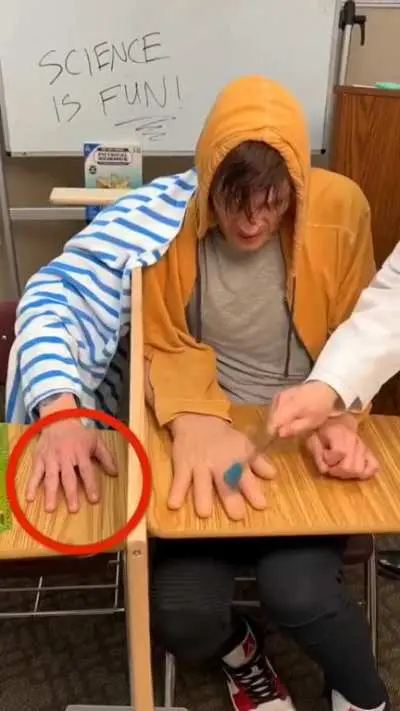
The experimenter first touched the same parts of his false right hand and his true right hand at the same time, slowly and repeatedly several times …… After doing this for some time, the subject felt that the false hand in front of him, was his right hand. For it seemed to him that when the experimenter touched a certain finger on the false hand, he could indeed feel that finger being touched.
Next, instead of touching the real hand, the experimenter only touches the fake hand. Interestingly, the subject also feels that his hand is being touched. It may have been brainstormed, but that feeling was very, very real.
In the final step, the experimenter hit the fake hand so hard with a hammer that the subject almost jumped, obviously feeling the pain mentally! He truly believed that the fake hand was his own.

But think about it, the subject saw all of the previous setup; that fake hand wasn’t made to look very much like it. The subject’s reason knew very well that it was a false hand - but he ended up feeling strongly that it was the real one.
*Your sense of “yours” is unreliable. The human sense of self is unreliable. *
In 2016, neuroscientist Hyeongdong Park of the Swiss Federal Institute of Technology in Lausanne (EPFL) and others conducted this experiment [2]. The subject put on a virtual reality headset and could not see his own body, but only a virtual person some distance in front of him. Then he and the virtual person both stand in a pose with their arms open. Next, the experimenter touches the subject’s back in the real world; at the same time, the virtual person in the virtual world is also touched on the back.
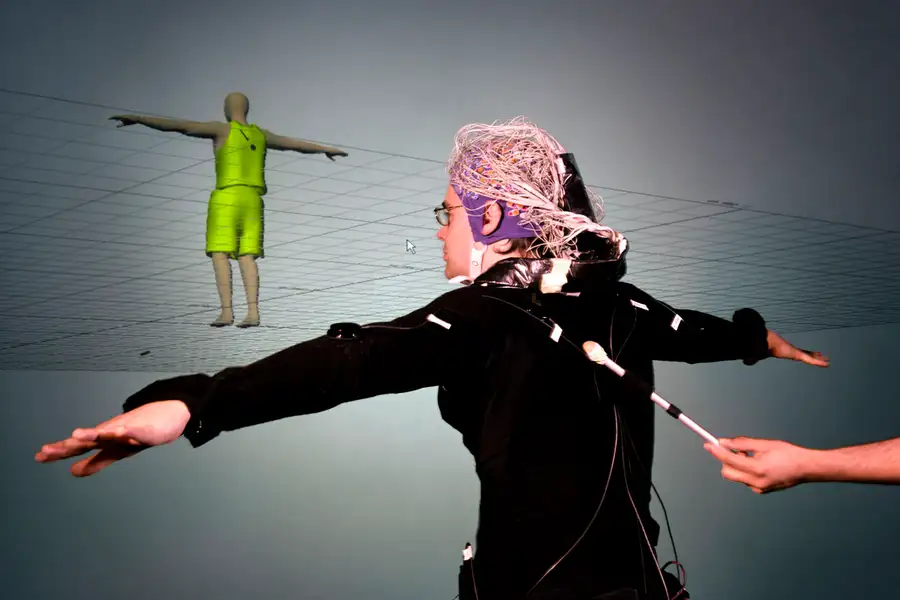
After a period of synchronized touching in this way, some subjects suddenly felt that the avatar was himself.
I understand this to be a bit of a disembodied soul experience, where you are looking at, and also feeling in front of you your own body. Subjects reported that they felt “themselves” closer to the avatar and further away from where they actually were.
This is also a body illusion. This is another piece of evidence for the influence of ‘inner perception’ on self-awareness that we talked about in the last lecture.
But there’s another brilliant thing about this Swiss experiment. Not everyone in the experiment had such a strong body illusion at all times. The body illusion was very much related to a physical indicator.
✵
This leads to a new concept called ‘heartbeat-evoked potential‘, or ‘HEP’ for short. The heartbeat-evoked potential is the brain’s real-time, automatic response to the heartbeat, a periodic but irregular fluctuation. Researchers can scan brain activity while measuring the ECG, and then use the ECG data to filter out all other brain activity, leaving the HEP [3].
We said in the last lecture that you can measure your internal sensory power by counting your heartbeats. Inner Sensory Power is a combined level of feeling, a macro number. HEP, on the other hand, is the real-time impact of each of your heartbeats on your brain; it’s hard to feel on your own, but it can be measured accurately by an instrument individually, and it’s one shock after another from your body to your brain. If you have 70 heartbeats per minute, you have 70 HEP fluctuations. Each fluctuation has peaks and valleys, and these fluctuations are not uniform, sometimes stronger, sometimes weaker.
And the major finding of that Swiss experimental study was that the stronger a person’s HEP signal was, the stronger the physical hallucinations they experienced.
- Your heart is writing your sense of self. *
✵
Catherine Tallon-Baudry, a neuroscientist at the École Normale Supérieure in Paris, France, is a master at experimenting with heartbeat evoked potentials and a former mentor of Hyung-dong Park. Her work is likely to go down in history.

In 2014, Taryn Baldry and Hyung-dong Park, among others, did this experiment [4]. Subjects were first asked to stare at a round, black target in the center of a computer screen – the

After a second or so, the round target will turn red, alerting the subject to the–

After another second or two, a blurry ring will be displayed around the circular target in front of some subjects’ eyes–

This fuzzy ring would only be displayed for 0.05 seconds, and then the picture would return to the red round target, and then back to black.
The subject’s task was to immediately report whether or not he or she saw the ring. This experiment is just checking your eyesight to see if you can capture a fleeting image, right? Nope.
Throughout the experiment, the researchers monitored the subjects’ heartbeat evoked potentials in real time. It turned out that if the subject’s HEP was stronger in the moment before the fuzzy circle unfolded - such as right at the crest of a wave - the more likely he was to report seeing the circle.
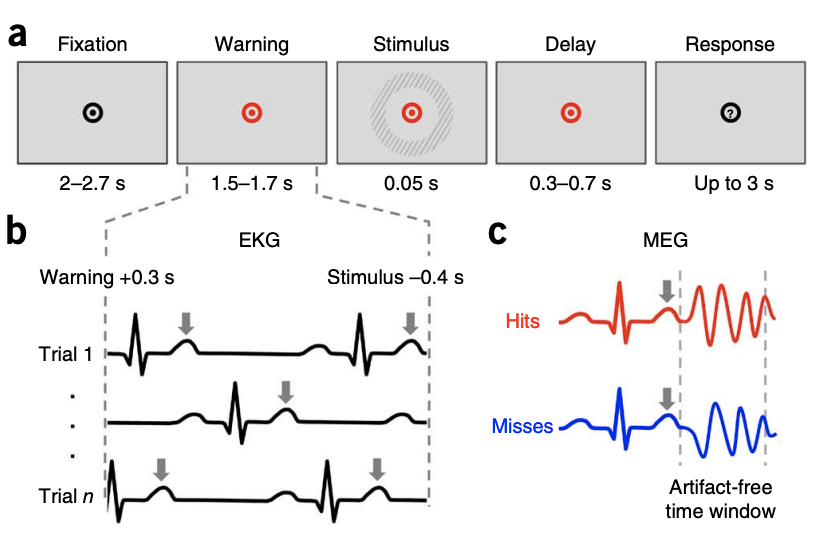
- Your heartbeat affects your visual perception. *
Taryn Baldry explains this [3] by saying that the heartbeat gives the “I” to the phrase “I see” - you have to be self-aware before you can realize that “I see” in order to make a report.
The moment in each heartbeat cycle when the HEP signal is strongest is the moment when your self-awareness is strongest.
✵
I really admire the whimsicality of Taryn Baldry, who has another experiment that goes like this [5]. You know that the word “I” has two forms in English, “I” when it’s the subject and “me” when it’s the object. When you use “I” you are thinking of yourself as the subject, acting subjectively, while when you say “me” you are thinking of yourself as the object, someone else doing something to you– There should be a distinction between these two kinds of self-consciousness. Tarun Baldry has come up with a way to demonstrate this distinction.
She had subjects undergo brain scans while they daydreamed …… and then randomly interrupted their thoughts to ask them if they were thinking about I or me at the moment and compared it to the HEP signals they got from the brain scans.
It turns out that if you happen to be using I in your thoughts, the HEP signals appear in the back of the brain; if you are thinking about me, the HEP signals appear in the front area of the brain.
You experience the difference.
Taryn Baldry’s third experiment [3] was to see if self-awareness would enhance decisiveness. Get a group of subjects, show them 200 well-known movie posters, and ask them to quickly score these posters according to their preferences. This scoring was highly arbitrary, so when the volunteers scored the same posters again the next day, the scores would certainly be different from the first day.
Tarun Baldry found that the stronger the HEP signal was when a person looked at whichever poster they were looking at on the first day, the more consistent the results of the second scoring they gave the poster were with the first scoring.
In other words: *The more your brain hears your heart, the more certain your choice will be. *
✵
There have been many similar studies recently. These experiments have shown that heartbeat is very important for self-awareness.
In 2020, Hyung-dong Park’s group in Switzerland made an interesting discovery [7], saying that there is a relationship between human breathing and the strength of one’s autonomy: when you exhale, you are more likely to initiate a voluntary action than when you inhale. In that case the whim that triggers you to go out and do something should have you exhaling rather than inhaling ……
According to Tarun Baldry [6], not only the heartbeat and the breath, but also the intestines have their own cyclical rhythms, along with other organs, and all of these rhythms from the viscera provide a frame of reference for the brain to use as a hook on which the brain can hang the sense of ‘self’.
Of course what she says is not radical enough, but a more radical way of saying it is that the body signals are the self, and we’ll talk about that later.
In any case, the results of the current experiments point to the fact that body signals - especially heartbeat signals - are at least the basis of the self.
To put it that way, then, you can’t talk about consciousness in isolation from the body. Things like “brain in a tank” and “consciousness uploading” and “digital stand-ins” can’t really be consciousness; AI can’t be conscious. Nowadays, AIs are already multimodal, they can have sight and hearing, and in the future, they can have touch, smell and taste, all of which can be inputted by computers - but how do you create something out of nothing with body signals? What’s the point of giving an AI a raw set of simulated body signals?
Give you a new body for your head, and you’re still you?
✵
- It was originally the most normal phenomenon of life that the body perceives first and the brain realizes later. *
Lower organisms do not have a brain at all, they all use their bodies directly to solve any situation. General mammals are also using the body’s instinctive response to deal with external conditions, a variety of emotional expression are first embodied in the body …… We human beings have a brain consciousness, belonging to the after-knowledge and after-awareness.
We used to think that depression, anxiety disorders and other mental illnesses were problems with the brain, but in recent years, the latest research suggests [8], these diseases are likely to be the body first problem, resulting in disruption of the signals provided to the brain, so that the brain does not feel right.
For example, the original idea of treating soldiers who come back from the battlefield with PTSD was to start with the brain, but now it has been suggested that the heart should be the place to start. Maybe these people’s hearts were scared on the battlefield. An irregular heartbeat, or a problem with the signals the heart is giving the brain, is what is causing the brain to feel fear all the time.
Anxiety might be because the brain is oversensitive to the body’s signals. Even anorexia has been linked to a disorder in the brain’s interpretation of body signals.
One anorexic said that the reason he didn’t want to eat was because he could always feel food in his body. Of course it’s hard when you have an extra sense of “food”! Some people are inventing new treatments from this perspective.
✵
To summarize, *More and more research is proving that body signals are decisive for consciousness. You’d think that first the brain perceives, then thinks, then decides, then orders the action - when in fact it’s likely that the body perceives, the body does the action directly, the brain realizes what happened after the fact, and then comes out and tells the tale as a press secretary. *
If this is the case, then it explains why masters pursue “unconscious” play: they want to minimize the interference of the brain with the body, so that the body can do things more freely and comfortably.
I guess the peaks of heartbeat evoked potentials are the moments that a shooter captures while experiencing them with his body. His sense of self, his acuity, and his sense of control of the gun are getting stronger and weaker with each heartbeat, and he needs to capture that moment when the HEP happens to be at its strongest - but that moment is just too brief to hand over to the brain for conscious processing, so he has to listen to his body’s direct command.
This is the “unintentional strike “.
Note
[1] https://www.youtube.com/watch?v=qhbVmos9cJ0
[2] Park HD, Bernasconi F, Bello-Ruiz J, Pfeiffer C, Salomon R, Blanke O. Transient Modulations of Neural Responses to Heartbeats Covary with Bodily Self -Consciousness. j Neurosci. 2016 Aug 10;36(32):8453-60. Park is currently an associate professor at Taipei Medical University.
[4] Park, HD., Correia, S., Ducorps, A. et al. Spontaneous fluctuations in neural responses to heartbeats predict visual detection. Nat Neurosci 17, 612 -618 (2014).
[5] Mariana Babo-Rebelo, Craig G. Richter, Catherine Tallon-Baudry, Neural Responses to Heartbeats in the Default Network Encode the Self in Spontaneous Thoughts, Journal of Neuroscience 27 July 2016, 36 (30) 7829-7840.
[7] Park, HD., Barnoud, C., Trang, H. et al. Breathing is coupled with voluntary action and the cortical readiness potential. Nat Commun 11, 289 (2020).
Getting to the point
More and more research is proving the decisive role of body signals on consciousness. You’d think that first the brain perceives, then thinks, then decides, then orders the action - but in fact, it’s likely that the body perceives, the body does the action directly, the brain realizes what’s going on after the fact, and then comes out and tells the tale as a press secretary.