Red Capsule of Consciousness 1: New Solutions to a Thousand-Year-Old Dilemma
Consciousness Red Capsule 1: New Solutions to a Thousand-Year-Old Problems
In this talk we open an experimental mini-topic about human consciousness.
Why are people conscious? What exactly is consciousness? Can consciousness be separated from the body?Do AIs and animals have consciousness? Can human consciousness be uploaded to a computer?
We’ve actually covered this topic several times in our column, but there have been a lot of new developments recently. Especially with the heat of AI, there has been a growing academic discussion about consciousness. I’ve done some research and feel that in the last two or three years, scholarly understanding of consciousness has risen to a whole new level. These new understandings are arguably not at all on the same level as the everyday thinking of the common people, the claims of religious people, including the conceptions of philosophers in the past, and are much more profound and advanced, so I have to tell you a little bit about it.
Let’s get it out of the way, this is an experimental topic.
The various doctrines I’ve talked about in my columns before are supported by myself, at least at the moment I’m talking about them. It may be that after a while new experimental evidence and new doctrines come out and my understanding changes, but at least at the time, I was very much in favor of that theory. Our column consistently speaks of ‘current scientific understanding’, which represents, at least to some extent, the consensus of front-line scientists and the mainstream of the academic community.
But this time I can only guarantee that what I’m talking about comes from front-line scholars and is absolutely fresh, not mainstream. Because there is no mainstream in the study of consciousness right now. There are heated debates in various directions, and it is at a stage where there is not even a consensus on the definition. That’s why we are not aiming for correctness in this topic, but for …… appreciation.
Instead of listing all the schools of thought, I’m just going to give you an explanation of consciousness by a brain neuroscientist, a philosopher, another brain neuroscientist, a physicist and a practitioner from India. Their accounts are very different, but I feel as if there is a connection in them that could form a layered and coherent story. I’m probably the first person to put these statements together, but I can’t say I support these doctrines. Let’s enjoy the strange writing and analyze the doubts with each other.
If you listen, these doctrines will turn your perspective upside down. But this topic will not rebuild you a new outlook. I just want to stimulate your thinking, maybe open up your brain plasticity and have a more open mind.
✵
Simply put, consciousness is your ‘subjective experience’.
It’s normal to feel pain when you stick your hand with a needle; the pain is a signal that alerts you that your body is being harmed and needs to be taken care of quickly. Pain is just a feeling, it can’t be considered consciousness.
*Consciousness is when, in addition to the pain, you feel pain. *
You may feel feelings of self-pity and self-love for being stuck with a needle, you may feel a million pangs of pain, you may question why fate has ordained it this way …… Or, you may feel things that my words can’t describe. These subjective feelings outside of the objective signal of pain are consciousness.
Consciousness includes all subjective feelings, such as your experience of the color red. For example, your experience of the color “red” must be more than just a specific frequency of light waves or a color code, there is something else.
In addition to the microcosm, we will focus on the macrocosm, that is, the consciousness of “self”. Why do people have an “I”? What is the “I”? Let’s review what others have said before us.
✵
There was no concept of robots in ancient times, but it has long been recognized that self-awareness and the body can be separated. A person missing an arm is still a person, so the arm doesn’t seem to be an essential part of the ‘I’.
This may make you think of the ‘soul’. The old people believed that the soul and the body were two separate parts, and that the body was just a temporary home for the soul, which would go somewhere else when the person died. This is a nice wish and means that people don’t really die …… But this dichotomy can be more than just a wishful thinking.
By purely thinking, Plato argued that there must be a spiritual world in addition to the material world in which our physical bodies reside. Plato says that things like math don’t really exist in the material world. There is no number “2” in the material world, nor is there a perfect circle. They are strictly mathematical concepts. But you know that 2 and the circle exist - then they can only exist in some spiritual world, which we now call the ‘Platonic world’. Then since there is a spiritual world, perhaps the human soul comes from the spiritual world.
There are many problems with Plato’s argument. Maybe the perfect circle is just a figment of people’s imagination and doesn’t have to be real in either spiritual world …… But two thousand years later, Descartes, had a much stronger argument for dualism.
Descartes first asked, how can you believe with certainty that something is real?
Think about it, maybe everything around you is an illusion generated for you by some great god, maybe you’re playing a virtual reality game. Descartes asks you to rule out everything that is suspicious. Maybe the mountains outside your window are fake, maybe the house you live in is fake, maybe the cell phone you are touching is fake. It’s all nothing more than electrical signals, just a brain-computer interface problem.
Then to take it a step further, your hands, your face, your head, might also be illusions. It may be that all these sensory signals are deliberately generated by the Great Spirit to fool you.
But you know, there is one thing that is definitely not an illusion. That is, “I am analyzing myself,” this thing. Otherwise, where did all this discussion come from? It is your own mind. Your mind, it must exist.
This is the famous “I think, therefore I am”.
Everything material can be cut down, only the spirit must exist. Descartes argued from this that since the spiritual world exists, God should also exist, and he helped the Church find a cornerstone for its worldview.
So in the eyes of previous scholars, spirit is a tougher being than matter. Houses fall down, people die, even the earth will one day go up in smoke - but not math, because math doesn’t mean it doesn’t ……
✵
Countless scholars in later generations have debated these statements by Plato and Descartes, so we don’t need to go into detail. The biggest problem with spirit-matter dualism, in my opinion, is that it is useless.
For example, if you assume that the material world is virtual, then this cell phone in front of you may not exist the next second. But what is the use of such a belief? How are you supposed to organize the rest of your life?
On the contrary, if you assume that the material world is real and you believe that the cell phone will not disappear in the next second, this will be useful for you. We can study what laws the matter in the world conforms to, we can predict future changes, we can make inventions, we can transform our lives. In fact over the years, the physical world has never failed to live up to our beliefs.
That’s why after the Industrial Revolution, people generally believe that matter comes first, and dualism is becoming less and less marketable. Especially now, with the popularity of virtual reality games, some philosophers have argued that even “reality in games” is real [1]. As long as the program is reliable, the equipment you buy in the game won’t suddenly disappear, and you’ll be able to farm and buy a house just as you would in the real world, so why assume that all of this is an illusion?
If there is some consensus among various modern scholars on one aspect of the problem of consciousness, that consensus is that we should assume that the material world is real - but that human consciousness, on the other hand, is likely to be an illusion.
It was not any great god who really deceived Descartes, but himself.
✵
First of all you have to understand that “intelligence” is not the same as consciousness .ChatGPT has a very high level of intelligence, probably smarter and more capable than 90% of the population, but no serious scholars think that it has a consciousness - at least GPT-4 shouldn’t have one yet. It doesn’t get angry when you scold it, it doesn’t feel pain when you mistreat it, and it doesn’t worry about its future. In fact it has such a limited short-term memory that if you have a good chat this time, you won’t even recognize you the next time you talk.
Of course you can engineer the GPT to act like it’s conscious through cues, it can even play the role of a what’s-his-name. But you know that’s just playing.
The AI doesn’t seem to need to be aware at all. If the AI can do all of its share of the work, and then have some self-protection and escalation, why would we want it to be conscious?The AI’s consciousness is likely to be a problem for us.
Secondly, * consciousness might be an emergent phenomenon. * Now that the GPT has sprung up with features like ‘thought chain’ that were not originally set up, then maybe it can spring up with consciousness in the future. Regardless of how it emerges, you know that this consciousness is just the output of a whole bunch of parameters, and we can absolutely copy a trained AI to another set of servers without loss, there shouldn’t be any mystery here.
But ‘emergence’ is a catch-all term, you can’t just come across a complex phenomenon that you can’t explain well and be like ah, it’s emergence, period. We still want to know why human consciousness is the way it is and not something else.
The point is that we now understand some of the nature of human consciousness, and we want to know more.
For example, we know that the brain is a ‘plural polity’[2] and that there is not just one voice in your mind when you are faced with any choice, but at least seven modules competing to be the first to speak. We also know that your ‘experiential self’, which is responsible for experiencing the present moment, and your ‘narrative self’, which is responsible for telling a story afterward, are two different things. The ‘I’ that Descartes called ‘I think, therefore I am’ is not singular.
Where do all these “I’s” come from? Why aren’t we “selfless” like AI? Is the existence of the concept of “I” a burden, or does it have any special meaning?
We also want to know what consciousness can do to us, and what we can do to it.
✵
This mini-feature will first shatter people’s fond imaginations of consciousness before leaving behind a perhaps greater hope.
We’ll start with a new understanding of consciousness from brain neuroscience: your body’s internal signals are directly involved in your consciousness. Consciousness is not just an activity of the brain, but also the perception of all parts of the body, an embodied intelligence. This means that so-called ‘consciousness uploading’ doesn’t exist at all, and it also means that AI can’t have human consciousness.
Taking this a step further, brain neuroscience could also say that consciousness is just a practical, convenient sense that animals have, and that AIs can have, just not in the same way that people do. Because you have consciousness, you have a coherent sense of the world, and it’s convenient for you to do things.
And then I’m going to talk about a particularly advanced theory, a new explanation of consciousness that the great Stephen Wolfram, who has been mentioned repeatedly in our column lately, came up with two years ago. It’s an immensely profound realization, and I’ll just dramatize it:**The three cornerstones of physics - general relativity, quantum mechanics, and statistical mechanics - are the way they are because our consciousness demands it.**The reason I’m writing about this topic is stimulated by this statement. How do you understand this statement? We’ll get to that in time.
To make it a little more exciting, I’d also like to talk about what an Indian practitioner said about ‘karma’. If you know a little bit about Buddhism, karma means karma - but his explanation is very different from the Chinese Buddhist explanation. Perhaps karma is a mechanism by which human consciousness and the outside world interact through human behavioral patterns ……
✵
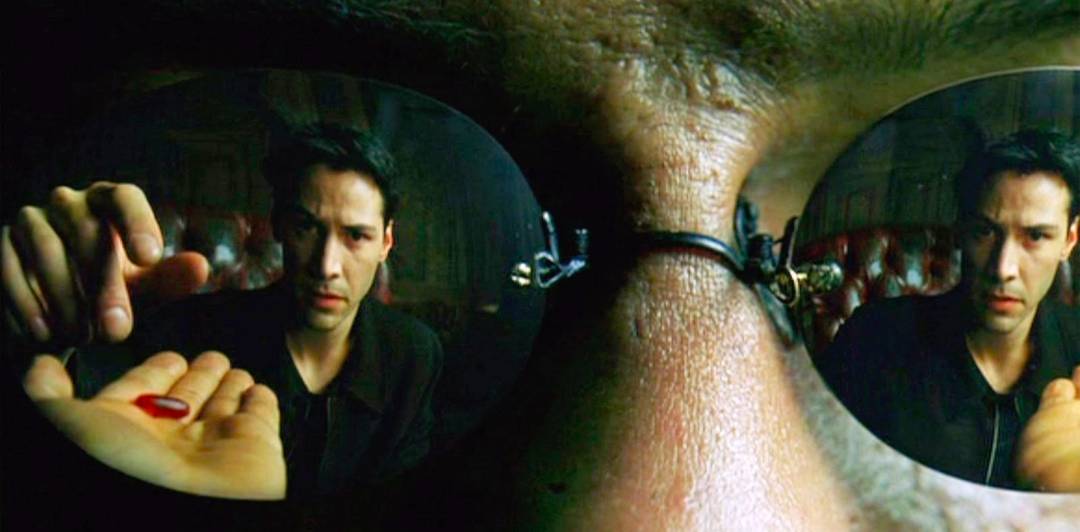
In the launch of the second season of Elite Day Class, I borrowed an allusion from The Matrix: there are two capsules in front of you, choose the blue capsule and you go back to your daily life and just believe in what you want to believe in - and you chose the red capsule.
So I’m obligated to tell you something different.

Maybe in a few years, all these doctrines will be proven wrong. But I’m sure they will be somewhat positive for you.
China’s native orthodox doctrine, known as Confucianism, had fallen into total involution by the Eastern Han Dynasty, and there was nothing left to learn, everyone was getting into minutiae and prophecies and fortune-telling and whatnot. It was only later, with the invention of metaphysics by the hippies of the Wei and Jin dynasties and the arrival of Buddhism from India, that the Chinese had a fresh source of ideas.
We look back, metaphysics and Buddhism’s worldview right or wrong is no longer important, the important thing is that they provide a logical discursive way of thinking, open up the human mind, stimulate the imagination, jump out of the inner volume.
- I think the same is true of the current discussion of consciousness, not necessarily right, but it is a resource for thought. *
I’m hoping to help you sort out the underlying logic of these doctrines so we can do some discursive thinking, its at least a mind exercise, and I hope you’ll participate.
Annotation.
[1] [U.S.] David Chalmers, translated by Xiong Xiang, Reality Plus: Every Virtual World is a New Reality (CITIC Press, 2023).
[2] Why Buddhism is True 3: The Brain is a Pluralistic Polity
Highlight
- consciousness is that you feel pain in addition to pain.
- one aspect of the modern consensus among various scholars on the issue of consciousness is that we should assume that the material world is real - but human consciousness, on the other hand, is likely to be an illusion.
- ‘Intelligence’ is not the same as consciousness; consciousness may be an emergent phenomenon.