Q&A: will the GPT replace us?
Q&A: will the GPT replace us?
From Day Class: Policy and Modeling
Reader Chenglong Dai: Do epoch-making products like the iPhone, WeChat, and cloud computing count as filling structural uncertainty? And that’s why they have so much economic and social value?
Wan Wan Gang Reply -
Yes, from a predictive modeling perspective, the biggest thing these new technologies do is make human behavior visible. In the days when there were no cell phones, where a person had been and what they had bought was invisible, and it was almost impossible for researchers to get reliable data. Now that data is available, especially consumption records, models can provide merchants with valuable predictions ……
What I find most interesting is that during the New Crown epidemic, the government launched a ‘streaming campaign’ based on individual cell phone trails, which went a long way towards controlling the epidemic.
But for researchers, these data are not currently used to their full power. Streaming is a direct call to data from cell phone base stations - data that has privacy implications and is generally not shared with researchers - and has not made the prediction models any better.
The ideal for researchers would be to get their hands on data volunteered by citizens.During the 2020 outbreak, both Android and Apple introduced a Bluetooth-based service on their phones: as long as both parties had the service turned on, a newly crowned infected person’s cell phone could automatically notify surrounding cell phones that you were now in close proximity to an infected person. But as you can imagine, few local governments have required this feature, and even fewer infected people are willing to turn it on.
As far as I can tell, the quality of research in social aspects these days is often not so much about how smart you are or how good your modeling is, but what level of data you can get. There’s a lot of interesting data out there, but you don’t always get it.
From Day Lesson: How to Make Decisions Based on Probability
Reader Kona Chen: Is virtual earth also modeled with big data? This is a bit hard to understand, for example, for war, after all, the reality of the human mind is ever-changing, virtual Earth is not the essence of the creator’s thinking?
Reader Hanprove: Wan sir, turbulence and butterflies that talk about complex systems is difficult to model, that the earth itself is a complex system, how to build a virtual earth?
Reader Ella: But will there be more trouble when it can really be accurate enough to take everyone’s reactions into account? After all, if everyone adjusts their actions based on the probability of the previous prediction, then the previous prediction won’t hold, and the result after the actions are adjusted will still be unpredictable, right?
Wei Wei Gang replied -
Virtual Earth predictions are certainly much more complicated than weather forecasts, but I rather think that Virtual Earth is not only very feasible and very useful, but even simpler than weather forecasts in a sense.
We already know that there is a limit to how accurately we can predict the future, beyond which we can only give probabilistic predictions. But probabilistic predictions are good enough.
First of all, if you are thinking about a very macroscopic thing, small uncertainties become large certainties. Let me give you the most intuitive example. For any individual, it is impossible to predict whether there will be a traffic accident in the coming year. So would you say that predicting traffic accidents is a pointless exercise? No! The graph below shows the number of people who will die in the United States due to traffic accidents each year from 2008 to 2020 - the
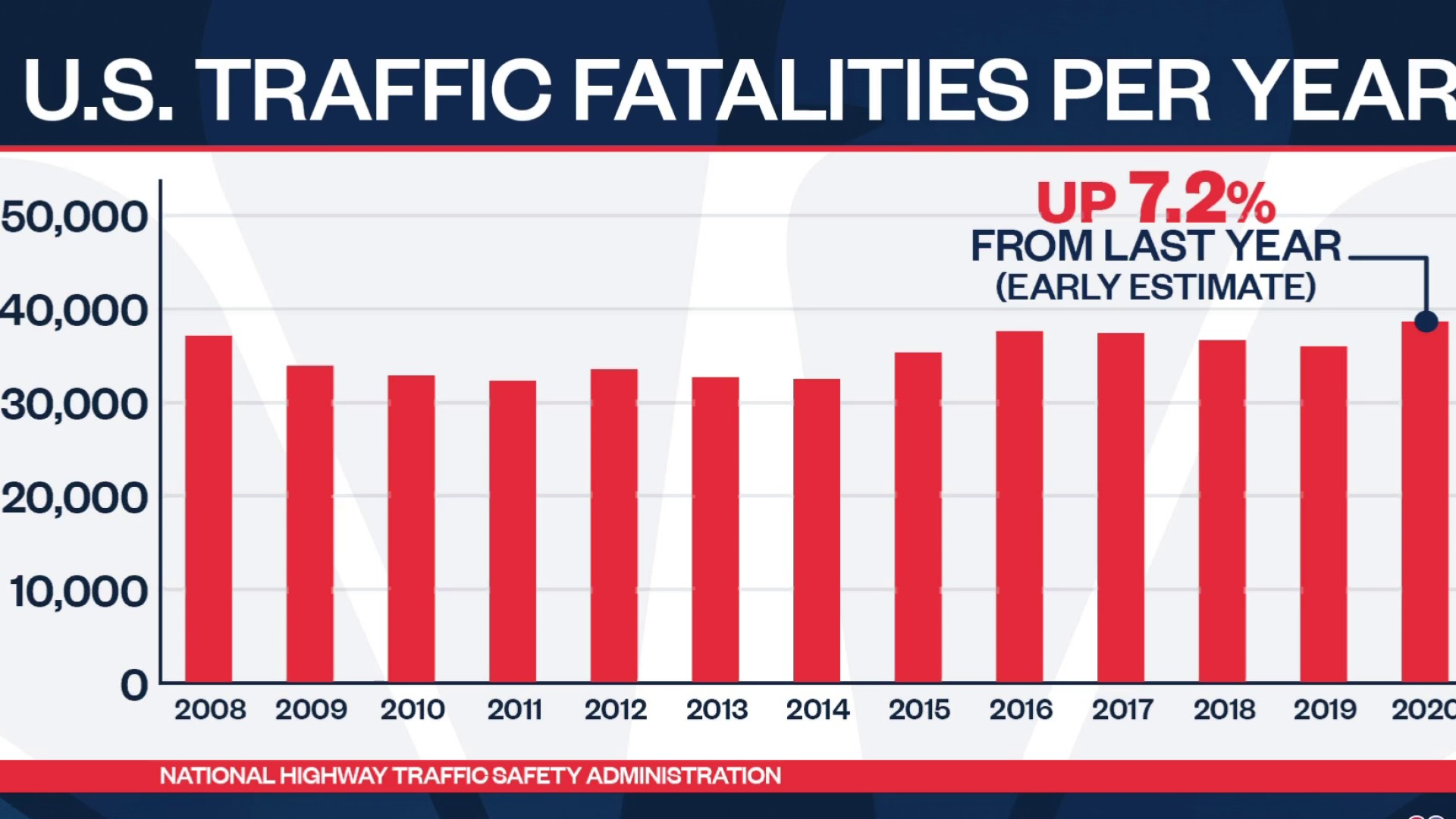
As you can see, the number fluctuates between 30,000 and 40,000 per year, which isn’t a big fluctuation. Government departments don’t need any complex modeling at all to determine roughly how many fatalities there will be in the coming year. And you can also tell which places and times of the year will have more traffic accidents.
This is just like every consumer is very uncertain whether he will buy something or not and how much he will spend on it on Double 11, but the merchants are very certain that there will be extremely high spending on Double 11. And even if the consumer knows that he has been predicted by the model, he will still take almost the same action.
So probability on a small scale put on a large scale is certainty. What we want to know most is what factors can influence the probability. For example, if the economy is bad this year, will individuals be less willing to spend money? How much will the turnover of Double Eleven decrease? Virtual Earth can provide predictions in this regard.
Of course, some individuals will be like turbulence, and his decision alone will have a significant impact on the system. For example, Putin’s impact on the Russian-Ukrainian war. In this case, Virtual Earth’s prediction of the big event can only be a probability.
But there is still a lot that can be done here. To go to war or not to go to war may only be at Putin’s whim, but the reaction of the world’s countries after the war, whether to impose sanctions on Russia or not, can be predicted. And this prediction is best not to beat your head against the wall, because it involves some technical details.
For example, if sanctions are imposed on Russia, energy prices in European countries will rise, then the people will complain, and to what extent will that complaint, in turn, make governments drop sanctions? Every step of this requires quantitative predictions.
If someone does not care about these, follow their own feelings and say something like “sanctions is a lose-lose situation, the West can not get away from the Russian energy, so the sanctions will not last”, that is irresponsible. The reality is that after a winter of super price increases, the European energy prices have come down - sanctions against Russia did not make the West suffer great economic losses.
It would be helpful if there was a virtual planet that linked energy prices, public opinion and political decisions.
From Day Lesson: Fractal Universe and Superdeterminism
Reader wings: What can Mr. Wan tell us about the verification method of Palmer’s “Invariant set postulate”?
Mr. Wan replied…
The invariant set postulate seems to be mathematically fine, but whether this is the case in our world must be verified by physical experiments. Palmer, in collaboration with other physicists, did suggest the possibility of an experimental verification.
I don’t know the details, but from what the book says, I understand it to be pretty much like this. Standard, quantum mechanics, which assumes that there is inherent uncertainty in the microscopic world, assumes that the physical states of particles can change continuously through space and time, with infinite possibilities. Palmer, the invariant set hypothesis, on the other hand, assumes that legitimate physical states exist only on invariant sets - and invariant sets are a fractal structure, not just any orbit.
Intuitively, let’s imagine a straight line. Unusual quantum mechanics considers any point on this straight line to be legitimate. The invariant set considers only those points on the straight line that fit the fractal structure to be legitimate.
Doing so means that there are fewer quantum states in the invariant set than in unusual quantum mechanics.
Mathematically, Palmer and co-workers derived a result that for a quantum mechanical system with N particles that satisfies the fractal structure described by the p-income of the invariant set, as N tends to the logarithm of p, the possible combinations of states of this quantum system will be fewer than what is predicted by unusual quantum mechanics.
This conclusion cannot be verified at present because we cannot manipulate a quantum system with many particles. If quantum computers become more advanced in the future, a large number of subsystems will be possible.
So this theory of Palmer’s, if it’s right, is like putting an upper limit on how complex a quantum computer can really be. And that’s not good news.
Reader Cranky: Is superdeterminism mathematically possible to argue? If it’s not possible, what’s the difference between that and God’s creationism?
Van Wagenen replies -
I believe that superdeterminism is mathematically self-consistent, but it is significantly different from God’s creationism, at least for the God that the average person imagines. If the world was created by God, we could probably have the following two reasonable speculations -
**First, God had a choice when he created the world.**He could have chosen the world this way or that way; he could have made it evolve faster or slower; he could have determined the physical nature of it.
**Second, after the world is created, God can still fine-tune it from time to time.**For example, he can make temporary changes if he sees something wrong, or he can give a hand to any person if he sees that he is doing well.
To put it bluntly, God has free will. Super-determinism, on the other hand, believes that everything is predetermined, and once the whole system is turned on, it must evolve in accordance with the established rules, not what you want it to do it, any fine-tuning and intervention is impossible, there is no degree of freedom here.
*There is no free will that is not controlled by the laws of physics, is the most fundamental difference. *
So you’re saying that maybe God didn’t have a choice in the first place, and he never came over and fine-tuned the world after it was opened, and maybe God doesn’t have any miracles apart from the laws of physics - well, I’m saying that if God is like that, then what’s the difference between him and the laws of physics? What’s the difference between him and the “laws of physics”? Then I can say that I believe in God, too.
From Lesson of the Day: Regulating Brains with Noise
Reader Hongliang: Wan sir, right now AIGC (AI generated content) still has a threshold, you need to know what to ask and how to ask it in order to get an effective answer. But over time, the foolproof operation will greatly reduce the difficulty of using it. If users don’t even need to master how to regulate the temperature, will human beings definitively go all the way down the road of low IQ?
Wagner Steel replied -
Generative large language models like GPT do indeed greatly reduce the difficulty for users to program, write, etc. to do all sorts of things for dummies, so to speak. At the moment they are not perfect, for example, ChatGPT generated programs can have errors in them, and users have to be really knowledgeable to use them well. But that’s not the fundamental problem.
The fundamental problem is that GPT allows us to automate certain operations purely in the way they are described in natural language. If GPT can help you write a program today, and maybe GPT can help you run a program tomorrow, then what do we need a program for? Wouldn’t it be better to just let GPT do the whole thing?
But even at that point, manipulating computers to do things, is not without threshold. Take programming for example, people still have to think clearly about the functions they want to achieve, inputs and outputs, intermediate processes, and tell the GPT in an organized language. what the GPT does is actually translation work: it translates natural language into program language. With GPT, we may no longer need to memorize the syntax of a programming language, but we still have to know the mathematical structure of the thing we want to do.
- At least for now, math is not obsolete, aesthetics are not obsolete, and creativity is not obsolete. To put it this way, GPT doesn’t replace us, it liberates us. * The language model allows us to ignore the grammatical details and get right to the essence of things.
And that’s the direction human society has evolved in since there’s been automation. I remember when I was a kid, in the late 1980s, people cared a lot about how well they could write, and kids were required to practice writing every day, and something like “Pang Zhonghua Hardcopy Calligraphy” was very popular. That was reasonable, because writing was very important in the context of paperwork. Nowadays, people are typing, and people are freed from practicing writing.
Another example is the piece of mental arithmetic, what all kinds of speed algorithms, in the past is also a worth boasting hard work, but now everyone has a calculator.
Then we can imagine that people in the future, grammatical ability, the ability to be rigorously error-free in programming, will also decline. But they get probably more, they free up their hands for more advanced things.
In fact, it’s only been a few months since the launch of ChatGPT and various apps that draw with AI, and now saying prompts to AI - also known as ‘chanting a mantra’ - has become a craft called ‘Prompt generation engineering’, or you could say ‘Prompt engineering’. engineering”, or “incantation engineering”. The corresponding person is called a “magician”, and it is already an official job category.
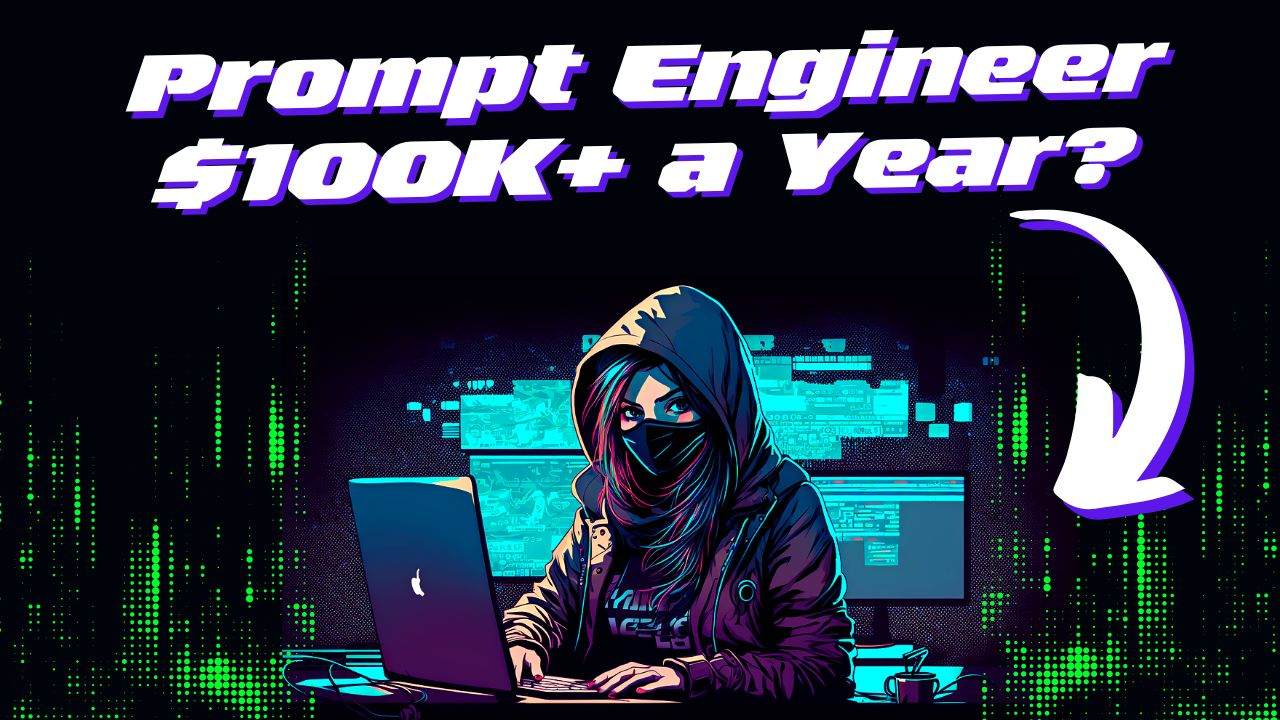
But that’s just for now. With all the big AI stories lately, my perceptions have been repeatedly shocked, and I’m not sure if the profession of wizard will last long in the future …… Our column will launch an AI Feature next Monday, with the help of a couple of new books dedicated to talking about recent developments, so we’ll talk about it then.