Q&A: will 'AI mates' lead to more singles?
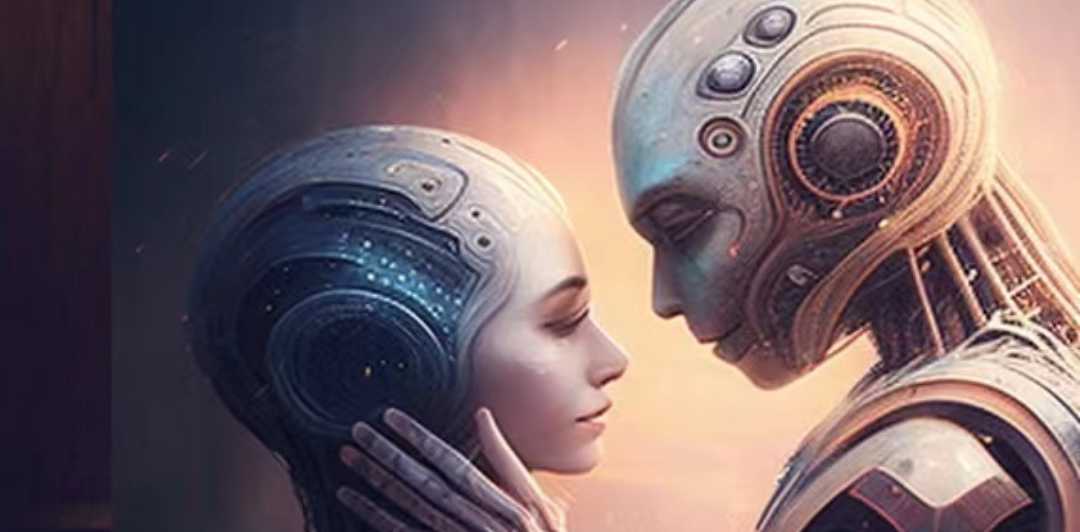
Q&A: will ‘AI mates’ lead to more people being single?
From Day Class: what leadership skills are needed in the age of AI?
Reader Situyg: We talked earlier about how one of the most needed services is to input a book to GPT and learn it with a quiz. As a result, there are now several such apps, the hottest of which is called ChatPDF, so isn’t it similar to the “listen to a book every day” service we got, the FanDeng book app, and so on? What is the difference between machine-assisted reading and human interpretation?
Wagner replied…
I’d like to correct my assessment of ChatPDF, which is not ideal right now. Yesterday there was a 150-page paper that I specifically signed up for a paid account with ChatPDF to have it read it for me, and while I can’t say it wasn’t helpful, it got a lot of the details wrong, especially a couple of places where it got the logic of the original text all wrong, and made up some of the content. Looks like I’ll have to read it myself.
It’s only a matter of time though. chatGPT has just launched a plugin system, one of which is a plugin that allows you to train your own local knowledge, and it’s definitely still usable and will become more and more accurate.
But no matter how good GPT gets in the future, I think human interpretation will still be needed. Because human interpretation provides more than just a synopsis of the content, it carries the subjective perspective of the interpreter. The book is right here, and everyone has their own opinion about which parts of it are important and which parts are not, and which parts of it are right and which are wrong. When you listen to a reading you often don’t just want to hear a synopsis of the content, you also want to know something personal about the reader. This subjective stuff can be good or bad, but it has a huge amount of room to play with how bad it can be and how good it can be.
A publisher recently asked me to write a foreword for a book, and I kept putting it off because I was too busy writing my column. When the deadline came, I told the publisher that I could write a testimonial instead …… and they agreed. In order to write this testimonial, I had to read the book first. As a result, I read it carefully and found that, first, it was a good book that spoke an unusual truth; second, if I didn’t speak about it, most readers probably wouldn’t be able to appreciate that truth. I ended up writing a preface.
I don’t think GPT can do this in the short term. But even if in the future GPT writes better than I do, to the point where the reader understands it on first reading, I think you may need interpreters. Because you want to hear what another person has to say about it. It’s like when we watch a TV show and go on Douban to read the reviews: even if those reviews say what you think, you’ll find it comforting.
Reader BianYu: May I ask Mr. Wan: Musk speaks highly of WeChat, saying it can do anything; also, I’ve seen a famous investor say that WeChat’s experience and business development capabilities are much better than FaceBook. I haven’t experienced FB, so what does Mr. Wan say about the two? Is it possible that Zhang Xiaolong is the one who has mastered the kind of unique capabilities described in the article?
Mr. Wan replied -
Zhang Xiaolong is undoubtedly a genius of product experience and business development, but WeChat’s position today is definitely not only because the product is well made and full-featured, but more because of the historical opportunity of China’s development and the cultural habits of Chinese users.
At a time when smartphones were becoming more popular, China was charging by the minute for phone calls and 10 cents per text message, and many users didn’t have e-mail addresses, computers, or even landlines at home. When WeChat came out, all these problems were solved, and of course everyone welcomed it. Together with the later WeChat payment function, it can be said that WeChat pulled China into the information age.
But when smartphones became popular, the United States was already in the information age. Every house and every person had a phone, the phone bill was monthly, it was a social custom to leave a voice mail message if you couldn’t find someone on the phone, text messaging was free, adults had credit cards, and work exchanges were all email. In this environment, you don’t have a strong incentive to install a chat tool.
China and the U.S. started out on different development paths …… but are now converging. The U.S. is getting into e-payments, and the Chinese are starting to resent the “always-on” work situation.
Musk said WeChat “can do anything”, in fact, functional things AI is very good at. The real lesson from this is that you have to consider the current environment and user habits. This is the ability of people, not AI.
From the Daily Lesson: People need to be more like people.
Reader Li Hang: Is it possible to understand that in the future, fewer people will be needed in science and engineering fields, and most of the work will be done by AI. Will the humanities field need more people to deal with interpersonal relationships and emotions? Perhaps there will be no distinction between arts and sciences, and it will be directly AI field and non-AI field?
Viva Steel replies -
Let’s not talk about science and engineering for a moment, but let’s talk about liberal arts students. After using and observing AI for a period of time, I am now very sure that AI will not only not eliminate liberal arts students in the foreseeable period of time, but will also greatly empower them.
Doing things in the modern world, in fact, anyone needs a certain degree of science and engineering ability, including processing data, quantitative thinking, a little “digital sense”. Can you talk about economic development without calling up statistics? Can you talk about economic development without calling up statistics? Can you study psychology without analyzing experiments? Even if you are a kindergarten teacher, you need to grasp the data of students.
It’s not that liberal arts students didn’t need these things in the past, but they were limited and couldn’t get their hands on them. Because in the past, you need to have a certain machine thinking to manipulate the data: even if it is to get an Excel table, draw a statistical chart, you have to know a little bit of functions, variables, you have to do some not intuitive operation, you have to remember some “not human language” command syntax.
In the past, liberal arts students were limited by these skills, so they could only engage in some empty things, say some big words, in fact, their own hearts are not the bottom. This is just like some old professors who have been engaged in literature, history and philosophy all their lives, but because they cannot read and write English, they read limited Chinese materials all day long, so they can’t show off their great skills.
Now ChatGPT is revolutionizing all this, and the key here is “natural language programming”. In the future, if you want to draw a data graph, fiddle with statistical results, or program for automated analysis, you can just use human language. All the dirty work do not need to do it yourself, AI help you get it done. You only need to understand the simplest principles on the line. Your task is to provide ideas, AI will help you realize. Old professors don’t need to be afraid of English anymore, not only the quality of translation is close to perfect, but also there is no difference between human and ChatGPT conversation in Chinese and English. Next week there will be a lecture, I will demonstrate the experience of programming with ChatGPT.
So AI removes the obstacles for liberal arts students to do things, and AI liberates them.
Then for science and engineering, it’s a bit of a problem.
If you’re a true master and expert in a certain field, or if you’re exceptionally good at learning and adapting, and you’re able to readily master new tools to enter new fields, then you don’t have to worry about occupational safety in any era, you’re the leader of the times.
But if your skills are limited to a very narrow field, and you are supposed to do things according to the needs mentioned by others in your work, and you are a tool person, then you are actually more vulnerable in any era, and it is even more dangerous in the AI era.
My advice is to be a generalist rather than a specialist at all times, and even more so in the age of AI: with AI, it’s very, very easy to learn new things and get up to speed, so you have to get out of your comfort zone quickly and proactively.
AI brings surprises: more “happy” for liberal arts students, and perhaps a lot of “surprise” for science and engineering students. However, S&E students don’t have to be too pessimistic. Let’s think of it this way, the reason why liberal arts students are happy is because they simply don’t understand: they don’t know how hard it is for machines to do this, and they can’t appreciate the thrill behind it. You’re surprised because you get it, and if you get it, you at least have a head start: you’re supposed to get up to speed with AI faster. But people have other skills in the liberal arts.
From Day Lesson: How to Brush Up Your Presence in the Age of AGI
Reader Zhang Yang: If we really get to the point of strong AI, will it further lead to more people being single? When choosing between a “perfect” but inauthentic partner and a real person who is full of “flaws”, who should I choose?
Reader Xiaotiancai: Now that the marriage rate is low and the divorce rate is high, and AIs are becoming more and more capable of knowing what’s hot and what’s cold, the need for a real partner will decrease dramatically, and will this have consequences?
Wei Wei Gang replies -
Neither AI mates nor AI nannies are available yet, but we can draw an analogy.
Ancient China practiced monogamy and multiple concubines, and big families had very good servants and nannies. The concubines were definitely prettier than the wives, and the servants and nannies were definitely more obedient and submissive, so didn’t those people develop more dependence on their concubines and servants?
It should be no. Su Dongpo was able to write “Ten years of life and death”, how deep his feelings were for his wife. His personal character was definitely considered a humanist in ancient times. However, he could give away his concubines casually, even including the two pregnant ones.
The reality is that concubines, like servants, are bought, people who have been objectified to a considerable extent, people who are unequal, with low human rights and low personality. Of course there have always been people in ancient times who loved their concubines more than their wives, and then there was Ming Xianzong Zhu Jinxuan whose favorite person was a milkmaid who was 17 years older than he was - but those were exceptions, and were frowned upon by the dominant culture.
We can also draw an analogy between AI and modern electronic entertainment information. Ancient people didn’t have TV or internet, they needed the company of real people, and probably a lot of people got married just to find a companion; modern people can have a fun time by themselves, so is it because of the entertainment information that makes the marriage rate go down?
Let’s look at the graph below, which depicts the change in the marriage rate in the United States since 1960. Indeed it has basically gone all the way down.
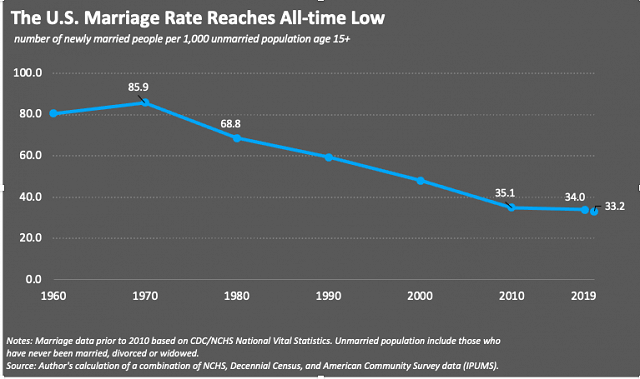
But note that the US marriage rate has stabilized since 2010. It stands to reason that this was a time when smartphones and online entertainment programs were just taking off and it was easier for people to get electronic companionship, so why didn’t the marriage rate drop further?
In fact the decline in marriage rates since the sixties is probably more due to women’s increased work participation, financial independence, and independence of character, and less need to get married - not because of the availability of electronic entertainment for companionship.
So equal, real-life companionship should be irreplaceable. There are actually a lot of otaku these days who claim to love secondary animated characters more than real people, but they may not be serious, and they’re in the minority.
The point is that AI or not, concubines and servants or not, are all replaceable. Tradable means replaceable, replaceable means upgradable, and you can always get a new one when there’s a better one. Human emotion is very interesting, irreplaceable can not be changed, obviously a kind of bondage, but deepen the emotion.
I can’t say exactly how this works, but the historical data doesn’t support the presumption that people will fall in love with AI over real people.
You and your beliefs about the world
Reader Pan Biao: It’s wrong for parents to tell their children that the world is dangerous and there are bad people everywhere, but it doesn’t seem desirable to tell them that the world is full of love and everyone is a good person, so that they can live in a fairy tale world. May I ask Mr. Man, how do we know where to draw the line between the two?
Mr. Wan replied.
If you live in a normal, enlightened and safe social environment, such as a big city in China, I think parents should not tell their children what the world is like “all day long”. Children should be allowed to experience the world on their own, through trial and error. Indoctrination is not conducive to growth.
But if you are temporarily living in a less favorable environment for whatever reason, then you should tell your children that life doesn’t have to be like this, and that there is a better life in the world.
The Italian movie La vita è bella tells the story of a father who was in a Nazi concentration camp with his son. The father, not wanting to let the harsh reality take away his child’s innocence, tells his son that everything around him is a game. He said that those who played the game and followed the rules would end up with a real tank. The child was in a concentration camp but enjoyed his father’s sense of humor and imagination and was not traumatized by the horrific experience. Isn’t that a great father?