Q&A: do the rich rely on perception, or luck?
Q&A: Are the rich by perception, or by luck?
From Day Class: Big Data on Marriage
Reader David Tam: Mr. Wan, from this book, I found that in social sciences, there is a big difference between foreign scholars and domestic scholars in terms of governance. Foreign scholars are more likely to elaborate an argument through data, while domestic scholars are at most engaged in questionnaires, and many of them even skip the questionnaires, just citing the classics. In Liu Yu’s view, it is “from theory to theory, from concept to concept”. My understanding is that domestic social science scholars, more liberal arts students, have not yet mastered the thinking and tools of various data research. So will GPT change this situation when it becomes popular?
Wan Wansteel replied -
GPT will definitely make it easier for liberal arts scholars to use data, but I think the fundamental change is not yet brought about by these tools, but by the younger generation, who return to China to teach after studying abroad, bringing in a new ethos. In fact the younger generation of scholars in China is still quite OK, and they are doing some quantitative, complex data-based research. For example, Prof. Chen Zhiwu is leading a group of people to do research on ‘quantitative history’, and other scholars are using AI to help recognize oracle bones and so on.
But the older generation of liberal arts scholars do have a problem with their way of thinking. This may be due to the fact that Chinese people are traditionally educated to learn and apply, or at most explain, a certain theory, rather than to question it. Now there are still some scholars a speech is because of this theory said ……, I have the following example ……, so it is ……. Not so much about finding data evidence and using the scientific method to illustrate your point. So it is often a long speech quotes say very lively, but the overall logical structure is not too hard.
There is another problem worth noting. I recently got in touch with Mr. Shang Changbao, an expert in modern history, and we talked on the phone for a long time. He told me about a particularly interesting phenomenon.
For example, you have been brought up to believe that so-and-so theory is good and unquestionable, and that everything should be explained by this theory, and you are convinced of it. Later you grow up and have your own opinion, you have examined a lot of historical materials, and you realize that so-and-so theory is wrong in all these places. So did you just give up on so-and-so theory?
No. You may become adamantly opposed to so-and-so theory. You will specifically go against this theory: it turns out that so-and-so theory says that it is “east,” so you want to argue that it should actually be “west.
Mr. Shang Changbao said that this is exactly the same as being swayed by that theory. You are working against it, but your frame of mind is still provided by that theory.
What is even more frightening is that you may not even be able to speak without that theory, because all your thinking was taught to you by that set in the first place. You consciously, unconsciously, can only speak within that framework.
That’s probably the scariest thing about the steel stamp of thought. That’s why there’s a saying among the younger generation nowadays called “spitting out the milk of the wolf”: you have to abolish the martial arts that you learned before and free your body before you can learn real kung fu. It’s an immensely difficult process because you don’t even know which of the things you’ve defaulted to are wrong - it’s better to just learn real kung fu from the start.
This is why old professors who have undergone scientific training may not be truly competent, and halfway academics like Mr. Shen Zhihua who engage in historical research are instead more powerful.
Reader The Only Favor: Mr. Wan, a question about ChatGPT. Besides Plugin, did you get the other internal testing features later? Is there no good way to do anything other than to die waiting after the Waiting List is currently added? Also, will the recent gesture by European countries, led by Italy, to turn on disabling ChatGPT cause OpenAI to delay further opening of other features?
Weiwei Steel replies –
I just got all the internal test features of ChatGPT the day before yesterday, in addition to the previous Plugin, and now the web browser and programming environment (Code Interpreter). OpenAI opened these features to a larger group of users in the past two days, but some users still haven’t gotten them. It may indeed be just a matter of waiting. Like I applied for the GPT-4 API a long time ago and still haven’t gotten it, and I also use a lot of GPT-3.5 API traffic, which doesn’t help.
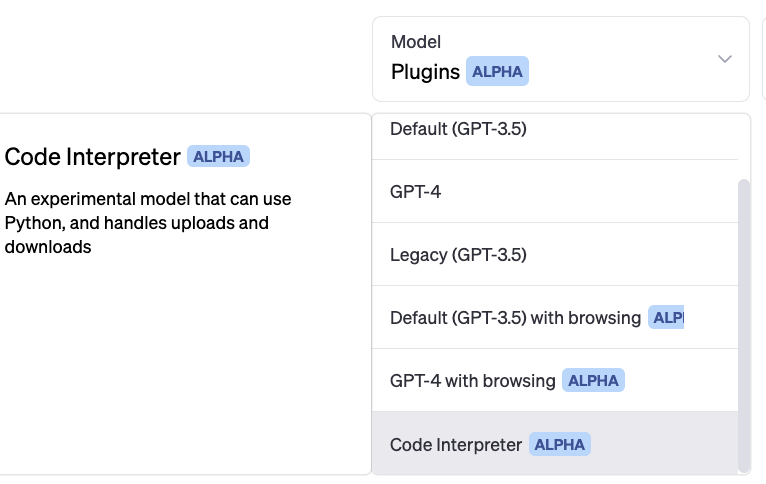
I think the main reason for the slow opening now is the arithmetic resources. I’ve been testing GPT with web browsing capabilities and it’s not working very well. It knows to go searching, but each search consumes a long time without moving; I give it a direct link to a web page and it fails to click on it. This seems to be caused by too many users.
On the other hand, these features are still in Alpha testing and far from perfect. Like the problem with GPT and Wolfram working together incorrectly that we talked about in our previous column, I tested it again and got a partial solution, but it’s not ideal yet.
GPT with its own programming environment was a pleasant surprise, though. It allows you to upload a file, say data, or a PDF, or a media file, and it can program itself to operate on that file according to your requirements. For example, it can use the data you upload to draw a picture for you. There are so many things that can be done here.
If you don’t want to wait for OpenAI to perfect the functionality of ChatGPT, the best way is to download and install several third-party developed, by calling the API to achieve various functions of the program, such as Auto-GPT.
There’s also an interesting recent app called Call Annie, which lets you have a video conversation with an OpenAI GPT model-based, AI-generated character – the
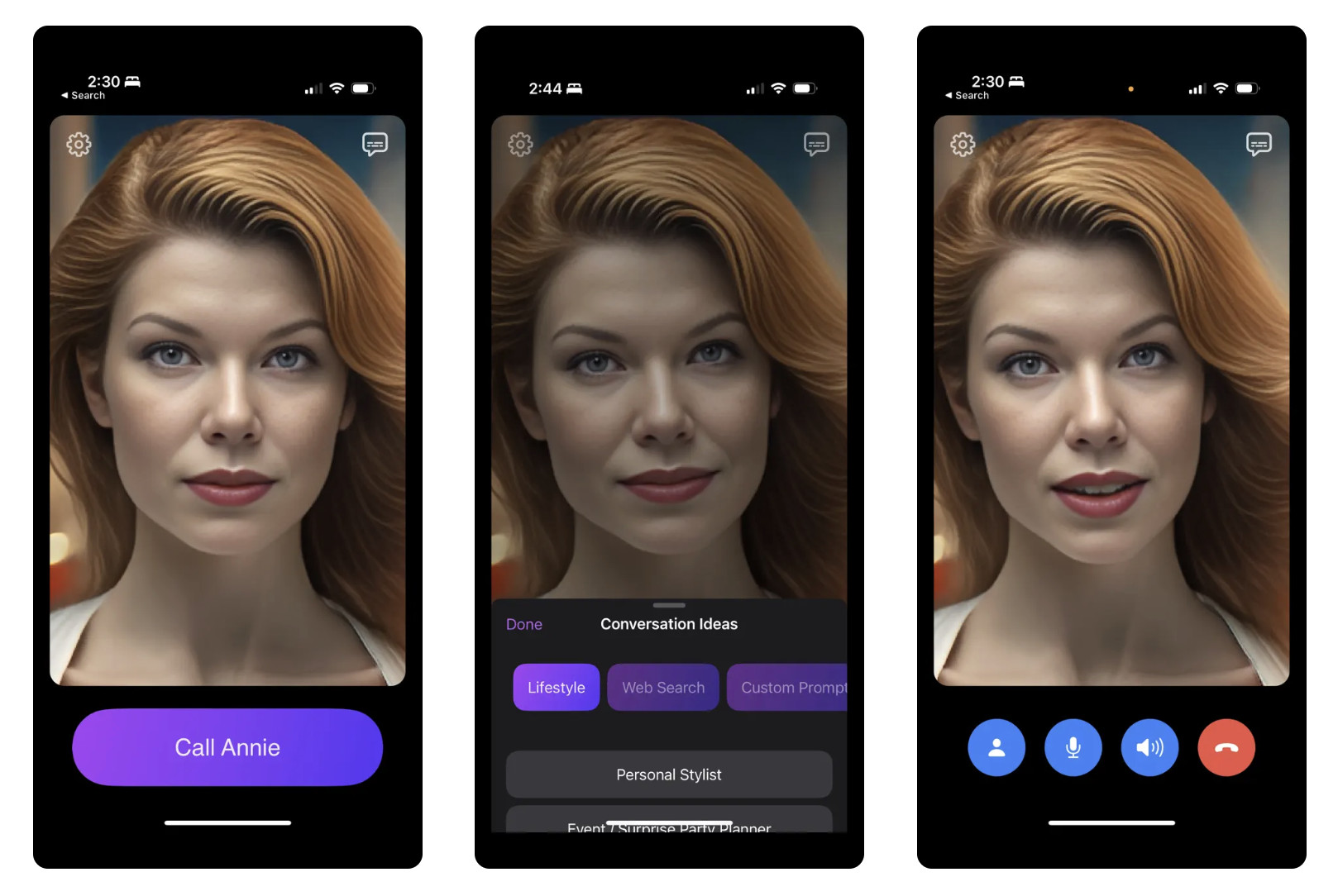
I used it and it was amazing. It’s a “live” ChatGPT with quality content and, crucially, fast response time. Even if I don’t speak English very well, she understands me perfectly. She also has some web browsing capabilities, so if you ask her about the latest news, she can do some simple research before answering you. Her expression, demeanor, and tone of voice are also very good, and can be described as atmospheric without losing substance. You can discuss physics with her, talk about your daily life, or even practice your spoken English.
I feel like this is a step up in the use of language modeling. The APP is currently free, though Chinese users may need to set the app store to US. You can even call her directly without installing the app: +1(640)-225-5726.
From Day Lesson: The Structural Opportunity to Become Rich
Reader Yuxiao Gu: Curious if these structurally wealthy people got into these industries through their own perceptions, or if they got into these industries through luck? Can this data be analyzed?
WVG replied -
The data in this book is a cross-section and doesn’t analyze how people all got into these industries. If you look at those celebrity biographies, with all the how-to tips, it’s definitely perception that’s more important - probably because if one achieves enough to produce a biography, there’s definitely a role for perception; on the other hand, perception is the only thing that’s easy for the average person to learn.
But if you look at the ‘invisible rich’, I would guess that their achievements were not primarily due to perception, but rather to chance and luck, or rather their perception was altered by luck. We don’t need to talk about the case of family connections and mines, but let’s talk about one thing: the opportunity of the environment.
As we all know, after the reform and opening up, Wenzhou this place appeared a lot of rich people. As a Wenzhou people, you may not have any business mind, but your relatives and friends are in business, these people will take the initiative to call you to do, you go with the flow, followed by doing it will do, and finally got rich. That Wenzhou this place why so cow?
British economist Ronald Coase - that is, the Coase who put forward the “Coase Theorem” - was extremely interested in China’s economy in his later years, and collaborated with his student, Wang Ning, to come out with a book called Changing China: The Road to Market Economy in China (2013) . One of the interesting observations of this book is that the Chinese reform was actually a ‘marginal revolution’ that took place four times, and that the changes were all generated at the margins.
Wenzhou, for example, was mainly engaged in handicrafts before 1949, with no unique local resources. After the founding of the People’s Republic of China, the state did not pay much attention to Wenzhou, and there was not a single state-run enterprise in the city. This made Wenzhou one of the poorest areas in Zhejiang Province before the reform and opening up.
In 1979, a large number of intellectual youths returned to the city, adding great employment pressure to the city. In order to ease this pressure, the central government had to allow self-employment. However, the regions were actually still very conservative in their thinking and held discriminatory attitudes towards the self-employed.
Wenzhou, on the other hand, had no state-owned enterprises, so the government was very tolerant of self-employment. As a result, in November 1979, the country’s first officially registered “individual business”, was born in Wenzhou.
In other words, the reason why Wenzhou people are so rich today is because Wenzhou’s private economy had a head start. And the reason why Wenzhou can run, because other regions did not run in the first time. Other regions did not run because they either had very good state-run enterprises or their geographical location and handicraft capacity were just too poor. Like the Northeast, before the reform and opening up called “the eldest son of the Republic”, get a lot of national resources to engage in industry, the result has become the least reformed place.
Wenzhou’s opportunity was that it was on the fringe of China’s economic map at the time. But what kind of knowledge could make a northeasterner go to Wenzhou in 1979 as a self-employed person? It simply didn’t work out that way. Often things change people, not people change things.
From Day Lesson: Sam Altman’s Systemic Ambition
Reader Jianfeng Hu: Qian Xuesen’s question from 18 years ago, “Why do our schools always fail to produce outstanding talents?”
Over the past 20 years, the pioneers from 0 to 1, the cowboys who have benefited the world and changed the world: Steve Jobs, Musk, Altman, the stars have been brilliant and overwhelming. This kind of super talent, the great country of China, wrenching hand index, it is difficult to spell out one. The so-called national self-confidence, should be down-to-earth in this regard.
20 years later, we can have this kind of super-class talent, we need to wait and see.
WAN WAN Gang replied -
This is not a question, this is a sentiment. The reality is that since the Qin system, or let’s be generous, since Zhu Yuanzhang’s Great Ming Dynasty, the cultural climate of ancient China has not allowed for any world-changing superb talents to emerge.
In this part of China, there should be no other big names besides the Emperor; no other organizations besides governmental organizations; no other ideas besides national orthodoxy. If there is, it must be a leakage. The ancient tradition of imperial power was to restrict private capital, private organizations and private thought, not to mention any more big names from your folk.
There’s an interesting fact in Wu’s book, “Economic Change Gains and Losses Through the Ages”–
In the 14th century in the countryside of Jiangnan, China, every farmer had a textile machine, and after farming, the whole family did the weaving and exchanged it for some money, which was quite good. But from the 14th century until the 1880s, there was not a single artisanal cotton mill in China!
Why? Because the government did not encourage you, and no one in the private sector was willing to engage in any large-scale industry.
Ming and Qing merchants made money, only to do three things - “one is to build an intricate network of government and business, the second is to cultivate the children of the same clan to study for the imperial examinations, the third is to rebuild the clan family,” to put it bluntly, it is to return to the family to live a good life, and it is best to train their children to become officials.
Instead of saying that I want to be bigger and stronger, to engage in a business empire - what a joke, ancient China can only have an empire.
The good thing is that reform and opening up has changed this culture. In order for China to continue to grow, we must adhere to this change.