Is the whole universe a brain?
Is the whole universe a brain?
For this talk let’s talk about a conjecture about this universe of ours - a conjecture that’s probably the boldest one I’ve ever heard of: that this universe we live in, the whole universe, could be a brain, and that it might even be able to think. And this is not a metaphor.
I actually heard someone say that a couple years ago, but I gave it a pass because I thought it was so implausible. I can list many reasons on the spot why referring to the universe as a brain is an absurd analogy.
But it’s been said, and it’s been said by some serious academics on the front lines of scientific research, and in particular I’ve recently come across some arguably quite startling evidence for it, so I thought it was important to report it to you.
Let’s be clear: this is just a conjecture. Astronomers have discovered some very important facts that make the conjecture seem particularly interesting - but so far, the conjecture has inspired more questions than it can answer. So you’d better not get on top of it, but don’t scoff at it either, as I did before; you need to keep an ‘open wit’.
✵
Let’s start with the large scale structure of the universe. The Sun is an ordinary star, it’s not alone, it’s with hundreds of billions of stars that make up the Milky Way, which is just one of hundreds of billions of ‘galaxies (galaxies)’ in the known universe.
Large galaxies usually have a supermassive black hole at their center around which all the stars in the galaxy rotate, so galaxies are usually flat spirals. The picture below shows our Sun in the Milky Way galaxy–
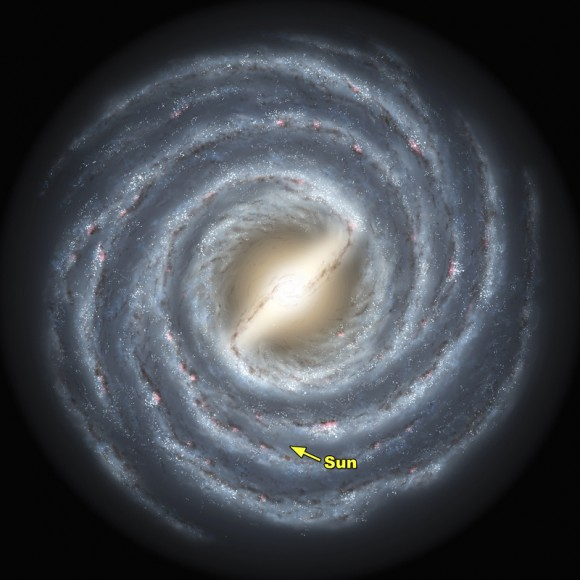
The Milky Way has a radius of more than 50,000 light-years, a scale that is small in cosmology. Galaxies are not alone, they cluster together in “galaxy clusters”. The picture below shows a cluster of galaxies, where each of the large patches of light is a galaxy-

The individual galaxies will rotate along the cluster, but this rotation is not caused by a black hole at the center of the cluster, but by the common gravitational pull of all the galaxies and dark matter within the cluster. The scale is so large that gravity won’t pull the many galaxies together into a flat structure, so galaxy clusters are three-dimensional. There may be tens to thousands of galaxies in a cluster.
Clusters of galaxies can then form ‘Superclusters’. If you think of a star as a home address, a galaxy is a neighborhood, a cluster of galaxies is a small town, and a supercluster is a big city. Our place in the universe is pretty much “Virgo Supercluster → this cluster of galaxies → Milky Way galaxy → Orion Arm → Sun.”
This place is hard to find because there are about 10 million superclusters of galaxies alone in the observable universe. So sometimes thinking about the universe can make you feel a lot better.
So what do you think superclusters of galaxies make up again, and how are they distributed in the universe? Are they like galaxies forming clusters of galaxies, getting together with some of their kind at random all over the universe, hugging and spinning?
*No. *
✵
The following graph shows the distribution of galaxies within a radius of 500 million light-years, centered on the Earth -
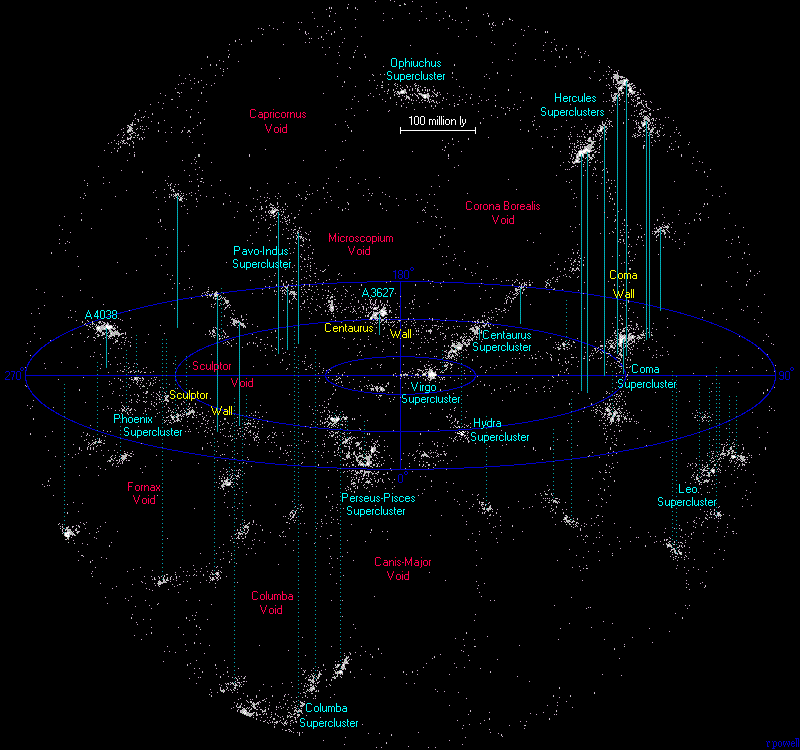
Each point of light in the diagram is a galaxy, and each area of clustered points of light is a supercluster of galaxies, which is the area marked in cyan letters in the diagram. We see that the distribution of superclusters of galaxies is not uniform, and that there are huge voids in between them. This may remind you of looking at the surface of the Earth from the night sky, where each point of light is a neighborhood, and the connected points of light are a mega-city, with the vast expanse of wilderness in their background. Astronomers only saw such a structure in 1987.
Now I’d like to draw your attention to an interesting phenomenon. Clusters of superclusters of galaxies are not isolated from each other, they’re connected by a network of galaxies that form long, corridor-like structures. Those corridor-like structures are called “galaxy filaments”, and sometimes they’re so flat and wide that they’re called “Great Walls”.
If you think of superclusters of galaxies as big cities, those filaments are the equivalent of highways between cities. Galaxies can follow these highways from small towns into big cities [1]. I must remind you that this is a relatively large scale, and each highway is hundreds of millions of light years long.

Together, these superclusters and fibrous structures form the “Supercluster Complex“. Countless numbers of these complexes are connected to each other by the fiber structure, which is the basic structure of the entire universe.
The scale of those pictures is still not big enough. To get a feel for it, you should take a look at the following picture–

In the figure [2] each particularly bright region is a supercluster of galaxies, each filament is a fiber made up of galaxies, and each light pixel is a galaxy. We usually look up at the stars and see a sky full of stars, but that’s only because we don’t look deep enough. The length of the white line segment in the picture is about 400 or 500 million light years, while the radius of the observable universe is 46.5 billion light years.
So the whole universe is like a big ball of cotton wool, with a lot of dense areas in the middle of the cotton wool, like cotton seeds; the cotton seeds are connected by thin threads; and beyond the cotton seeds and the threads there is a lot of empty space.
“Cotton wool” is an unimaginative metaphor. To the educated eye, it is not cotton wool.
*It is the nervous system of the brain. *
✵
The neuron cells in our brain, aren’t they the same way? There’s a big nucleus in the middle that’s the equivalent of a supercluster of galaxies, and there’s a long fiber out there, the axon, and then there’s a lot of little fibers that go out there, the dendrites and synapses-
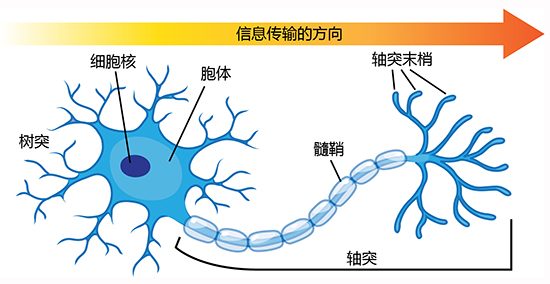
The connections between neurons in the brain also resemble the Supercluster complex [3]:

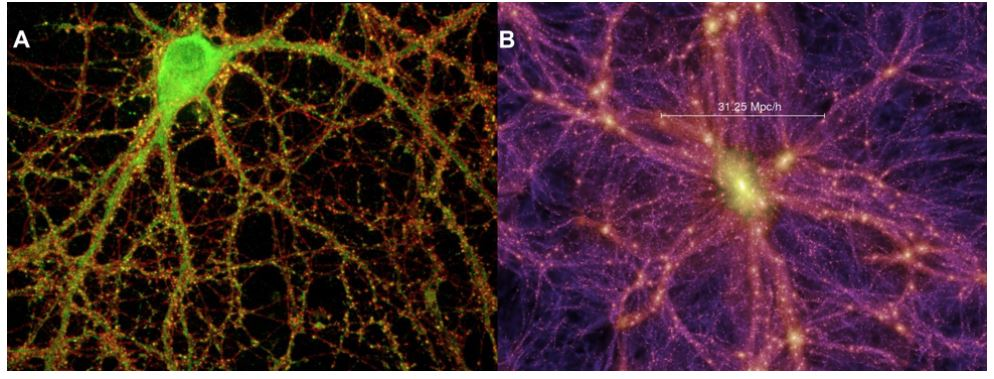
In particular, here’s [4], a slice of the cerebellar portion of the brain under an electron microscope on the left, and the structure of the universe on the right–

It’s really quite similar.
That’s why some people believe the entire universe is a brain.
When I first saw these diagrams, I thought the similarity was purely coincidental. Are you kidding me? The mechanisms involved are completely different, OK? Brain neurons transmit electrical signals, cosmic galaxies are connected by gravity. Furthermore, as we said earlier, a single fiber is hundreds of millions of light years long. If even light takes hundreds of millions of years to travel from one neuron to another, and the universe is only 13.7 billion years old, how can the various parts of your cosmic brain be coordinated and how can the whole brain think?
I think this analogy is like people being able to see faces on Martian terrain, purely finding patterns where there are none.
What I didn’t realize is that new discoveries in the last few years have made things serious.
✵
In 2017, astrophysicist Franco Vazza and neurosurgeon Alberto Feletti took a serious look at the analogy between the brain and the universe [5]. They consider both the fiber network of the universe and the neural network of the brain as complex networks, and since they are networks it is possible to compute statistical relationships in them from small scale fluctuations to large scale structures. They compared the cosmic web, the neural network, and the turbulent networks of clouds, branches, plasma, and water, and found that the network that most resembles the cosmic web is precisely the brain’s neural network – the brain’s neural network, the brain’s neural network, and the brain’s neural network.

That’s more than just looking alike, it’s directly very similar in structural relationships at all scales. You imagine all of these networks as fractal structures, then the cosmic web and the neural net are most similar in a fractal way.
In 2022, the pair published another paper [6] that found two other similarities between cosmic nets and neural nets – the
The radius of a neuron’s nucleus is much smaller than the length of the connecting axons and dendrites, and the radius of a supercluster of galaxies is much smaller than the length of the connecting fibers;
The clustering coefficient (clustering coefficient) of a neuron, that is, how well it is connected as a node, is also very similar to a cluster of supergalaxies.
Simply put, a sample of the brain on a 1-millimeter scale is a lot like the universe on a 300-million-light-year scale. *
But that’s all it’s like. Maybe it’s just a particularly coincidental coincidence. Maybe neurons and superclusters of galaxies, while having completely different physical mechanisms, have some sort of intrinsic similarity, mathematically, that just remains to be explained.
So the universe really is a lot like the brain. But you can’t get around that limitation I just mentioned; on such a large scale, the universe can’t think at all.
But there was a woman physicist who was resigned to this, and she probably thought there must be something wrong with such a coincidence. She came up with a bold speculation.
✵
Sabine Hossenfelder is a female physicist with a somewhat hard-edged style, and I used to watch her on her YouTube channel for a while. She has a book out in 2022 called Existential Physics: a Scientist’s Guide to Life’s Biggest Problems, which talks about analogies between the universe and the brain, and has some bright ideas.

Hossenfeld admits that expecting light signals to coordinate the thinking of the universe is indeed too slow to make sense. So what if FTL signals?
After all, you know, quantum entanglement [8], that is, an instantaneous, non-deterministic coordination, a ‘ghostly superdistance action’. Is there a possibility, says Hossenfeld, that the individual neurons of the universe are coordinated by quantum entanglement?
In an article for Time [9], Hossenfeld says she and her colleagues have discussed a lot of things, including the possibility that there are lots of instantaneous ‘wormholes’ or some other kind of amorphous window of connectivity throughout the universe, forming hidden connections that allow the cosmic brain to think.
Hossenfeld says all of this coordination is pure speculation without any evidence. But recently a neuroscientist, Bobby Azarian, wrote an article [10] about possible evidence, focusing on the fact that it has been found that there is some kind of strange coherence between certain things that are very far away and seemingly shouldn’t have coordination.
A 2014 study [11] examined 93 quasars formed by supermassive black holes in a large complex of supercluster galaxies. They are billions of light-years away from each other and are linked by galactic fibers, as shown below-
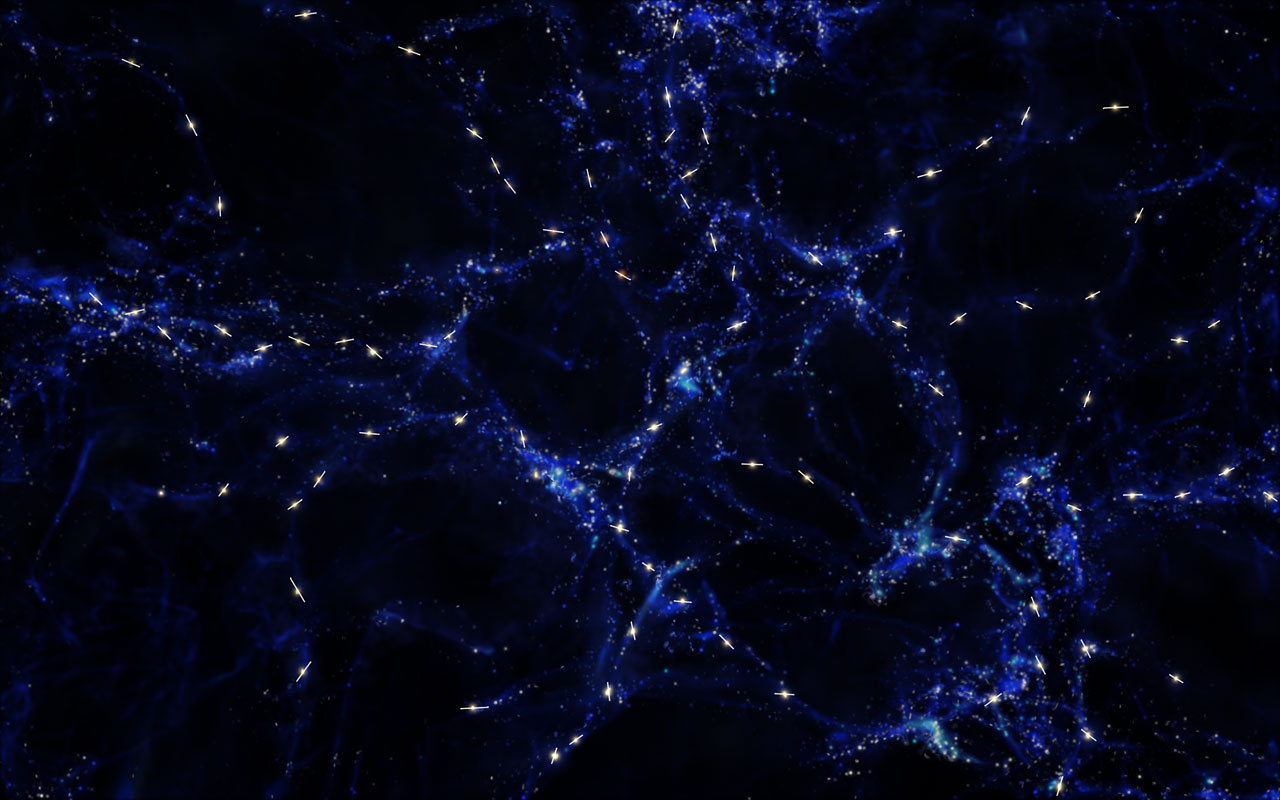
Strangely enough, the axes of rotation of the neighboring quasars are, in fact, aligned with each other! Look at those short white lines in the diagram, almost all of which happen to be parallel to the large scale fiber structure in which they are located. Why is that? How do you reconcile this at such a distance?
Could it be that galactic fibers really do transmit some kind of information faster than the speed of light? Of course this is still a mystery and we need more evidence.
✵
Why is the large-scale structure of the universe so much like the human brain? Maybe it’s because they’re all the result of some kind of evolution, maybe superclusters of galaxies and brain neurons have some kind of self-organizing ability. Maybe the “universe can think” conjecture is just entertainment and conversation value.
But maybe, it leads to something bigger…… Can the universe be conscious? Does it have a mission too ……
Either way, now you know there is such a thing. A hundred years ago, in the 1920s, physics was really on the rise, and people’s ideas were constantly being updated. Now that we’re in the 1920s again, it would be a triple whammy if our generation could also witness a few disruptive discoveries.
Annotation
[2] The unit of the length labeled in the figure, Mpc/h, is the “million-second gap”. Image from https://www.universetoday.com/151553/the-largest-rotating-objects-in-the-universe-galactic-filaments-hundreds-of-millions-of- light-years-long/
[3] Image from [7]. The image below is from https://www.universetoday.com/148966/one-of-these-pictures-is-the-brain-the-other-is-the-universe-can-you-tell-which-is-which/
[5] https://nautil.us/the-strange-similarity-of-neuron-and-galaxy-networks-236709/ Paper by Vazza, F. On the complexity and the information content of cosmic structures. Monthly Notices of the Royal Astronomical Society 465, 4942-4955 (2017).
[6] https://www.frontiersin.org/articles/10.3389/fphy.2020.525731/full
[7] Sabine Hossenfelder, Existential Physics: a Scientist’s Guide to Life’s Biggest Questions (Viking, 2022).
[8] Quantum Mechanics 13: Ghostly Superdistance Action
[9] https://time.com/6208174/maybe-the-universe-thinks/
[10] https://bigthink.com/hard-science/the-universe-may-be-a-giant-neural-network-heres-why/
[11] https://earthsky.org/space/spin-of-quasars-central-black-holes-is-aligned-over-billions-of-light-years/; https://www.science. org/content/article/black-hole-blasts-align-cosmic-web
Getting to the point
A sample of the brain on a 1 millimeter scale is a lot like the universe on a 300 million light year scale.
Maybe that’s because they’re all the result of some kind of evolution, and maybe superclusters of galaxies and brain neurons have some kind of self-organizing ability. But maybe, it leads to something bigger ……