If you're lenient, you'll compete, but if you're strict, you'll be in the dirt.

Loose and you’re fighting for color, harsh and you’re dusty
There’s a lot of conventional wisdom that’s been summarized in various proverbs that you’d see nothing wrong with on their own, but when put together it’s easy to see the contradictions. For example, there is a saying in the comedy world, “If you don’t take one handsome, you take one strange”, which means that either you are exceptional in every aspect, or you have a strong character in one aspect, you have to be recognizable in order to attract the audience, and you must not be mediocre. However, we usually often say that “the gun hits the head”, what “wood show in the forest wind will destroy it”, suggesting to keep a low profile to avoid attracting attention. So which one of these is right?
In this talk, we use statistics and experimental research to analyze the underlying principles. It’s not enough for you to know these principles, you have to know under what circumstances they work.
We’ll get some useful lessons and some emotions.
✵
There used to be a dating site in the US called OKCupid, and Christian Rudder, the site’s CEO, liked to get into data analysis. He published a blog in 2011 [1] that explored the relationship between the attractiveness scores of female users of the site and the number of private messages they received.
Each dot in the graph below represents one woman, for a total of five thousand. The horizontal coordinate of the graph is the attractiveness score and the vertical coordinate is the number of private messages received in a month. The general trend, unsurprisingly, is that women with higher attractiveness scores receive more private messages -
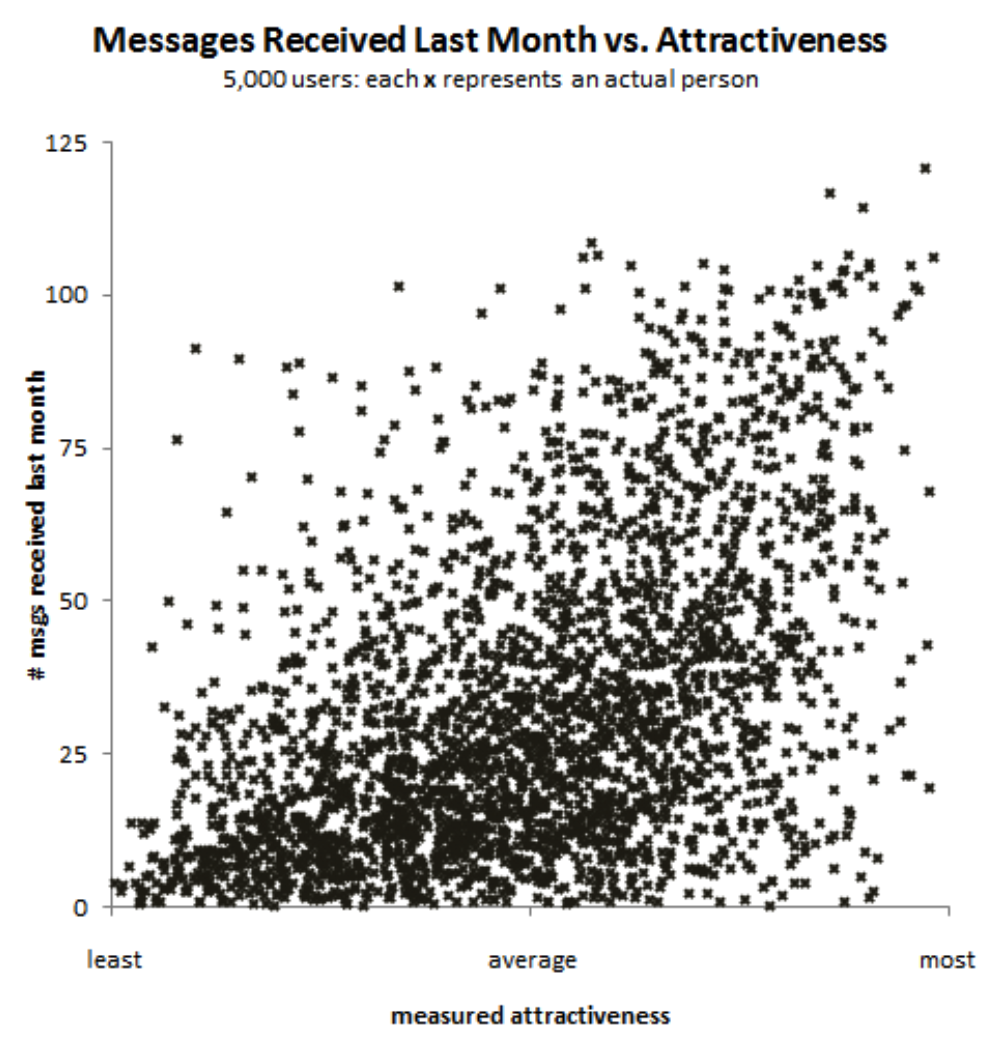
But this pattern isn’t very strict. For the same attractiveness score, some women receive a lot of private messages and some receive very few. For example, let’s look at the woman below, who is one of the dots marked blue in the graph–
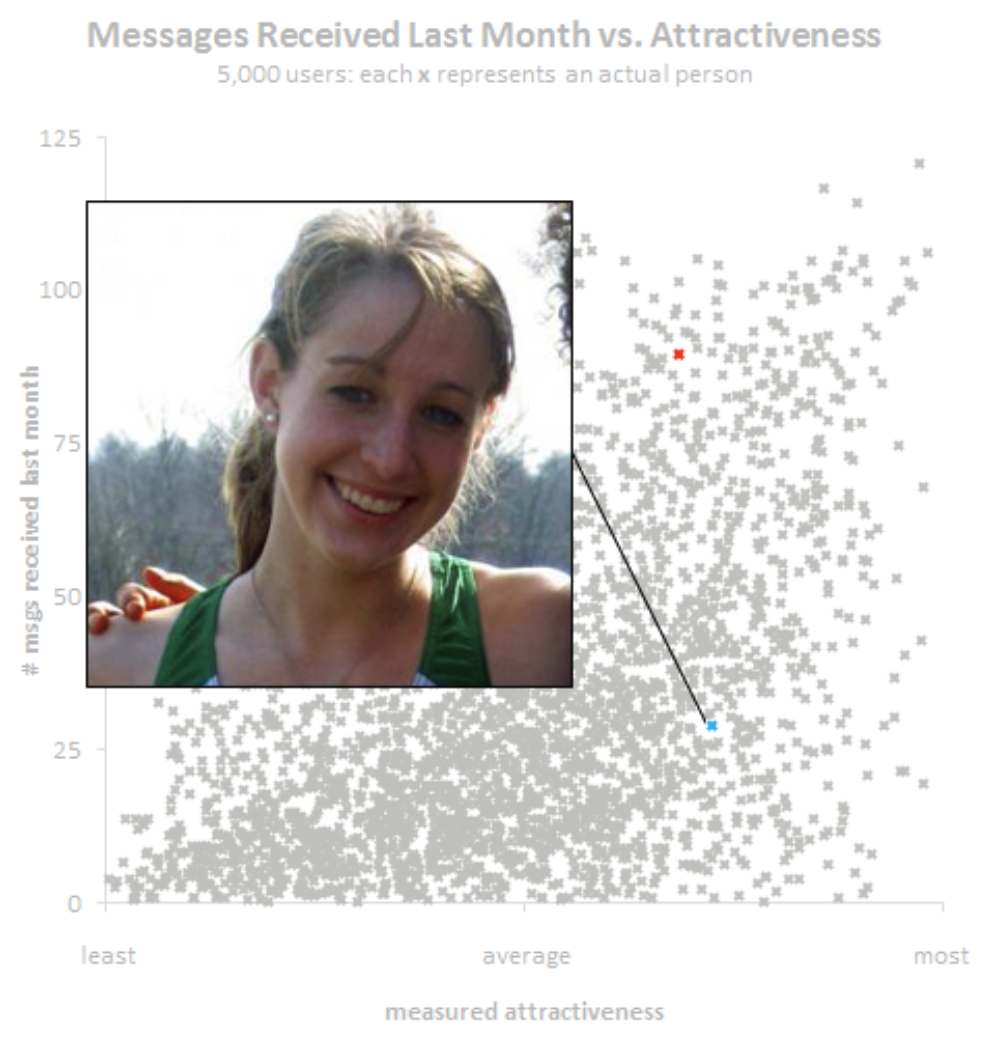
Her picture is shown in the graph. Her attractiveness score is considered medium-high, with a score of 3.4 out of 5. She received 0.8 times the number of private messages than the site average. In contrast, the woman represented by the red dot in the chart below has a slightly lower attractiveness score of 3.3, but receives 2.3 times the site average number of private messages–
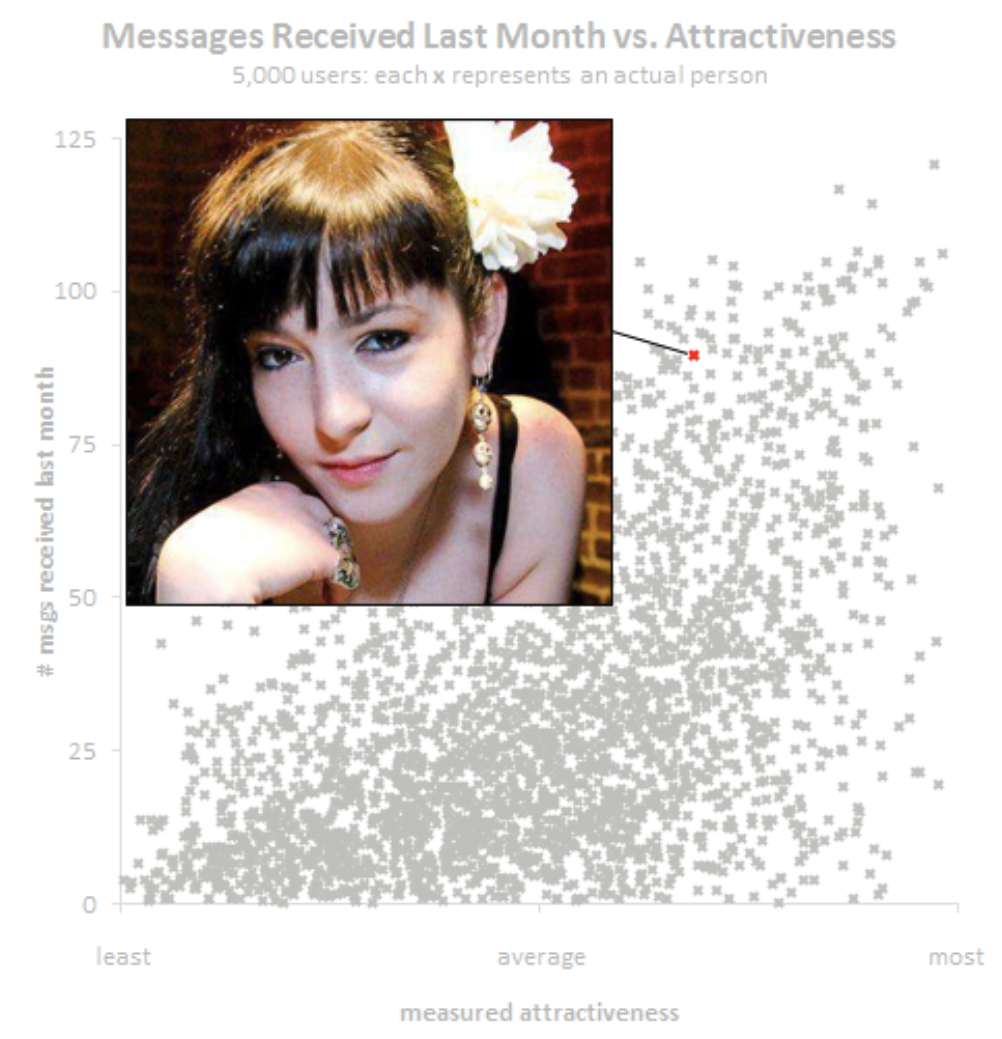
What accounts for the difference in treatment between these two? Let’s put them side by side and you’ll see–
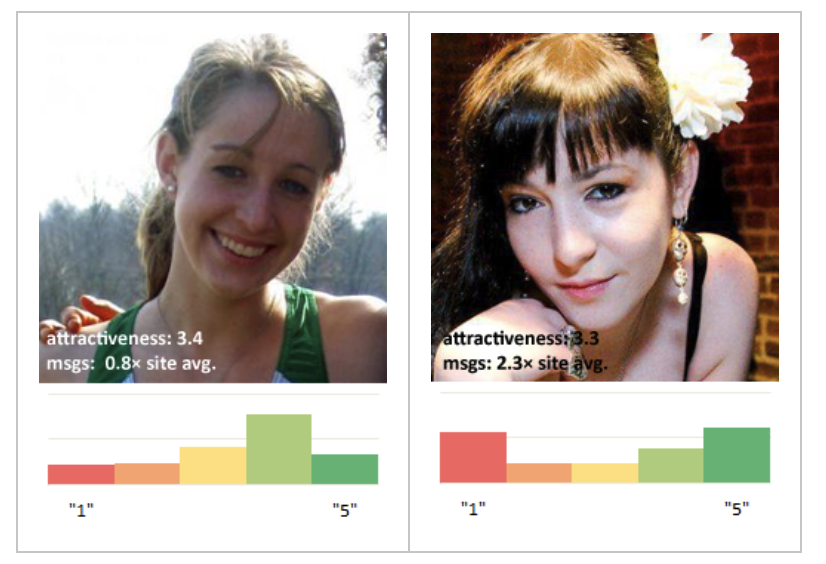
Did you get the feeling? The bottom of the graph shows the distribution of their attractiveness scores.
The average scores of the two people are about the same, but the distribution of the scores is very different. The distribution of scores for the woman on the left is more concentrated, mainly three and four points, indicating that people generally think her appearance is “okay”, not particularly stunning or offensive, a good woman. The distribution of scores for the woman on the right is polarized, with many scoring one and many scoring five. Her looks are not perfect, but she carries a special kind of charm, which some people particularly like and others express disgust.
This is the secret of the success of the women on the right. People who rate one point certainly won’t send you a private message, but neither will people who rate two, three, or four - it’s not the average score you care about, it’s how many people rate you five.
This law is so universal that Rader also found the following two sets of examples that illustrate the same phenomenon.
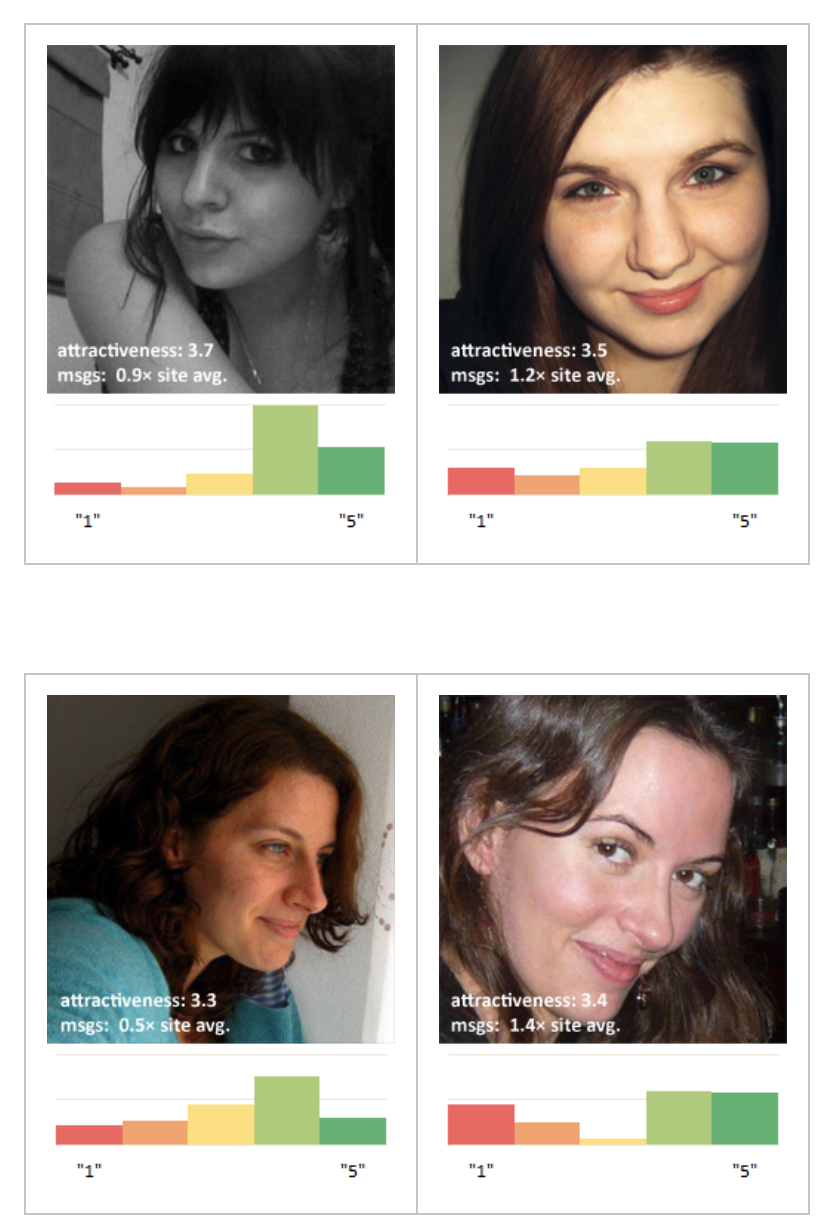
*It’s always the extremes that win. Average scores mean very little. What you should really care about is how many people specifically like you - even at the cost of a lot of people specifically disliking you. *
Rader and the researchers even fit an empirical formula [2] – with this data.
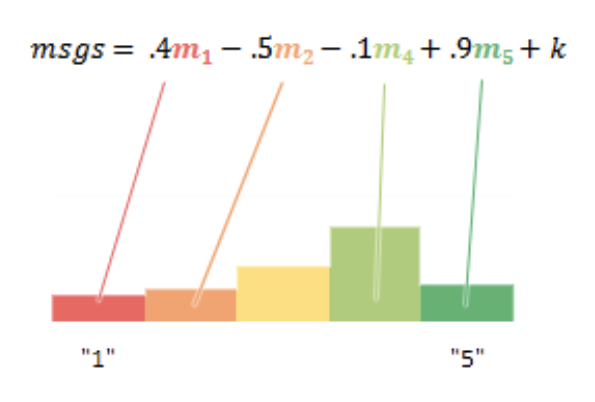
This formula predicts how many private messages a woman will receive from the number of people who score various points. Of course you want as many people to hit five as possible, and that’s fine. The formula tells us that a high number of people scoring fours and twos is bad for you because it means you’re mediocre. And in order to stand out, a higher number of people who rate one point is a good thing instead.
It’s called “one handsome or one weird”. “Awesome” is when everyone gives you a five, and that’s hard. If you can’t do that, then you need to make a strategic choice between being mediocre and being special. The right choice is “weird,” which means that some people give you a five and some people give you a one.
I came across this study many years ago, and I’m sure you’ll remember it many years from now. Don’t be mediocre, be unique, and have the courage to be hated.
✵
In business, this is very clear; it’s a matter of market positioning. No product can be upscale and cheap and rugged enough to please everyone, you can only garner the support of one segment of consumers, even if it comes at the cost of being hated by another segment.
Apple’s cell phone is positioned at the high end of the market and has a large number of loyal users, so it’s not afraid of being told that it’s too expensive. Some airlines position themselves as low priced and cultivate a sophisticated consumer base where no one complains about the service experience. Some stars perform in a style that is enough to infuriate the average viewer, yet at the same time gain rabid fans. Trump very boldly spouts nonsense and doesn’t care that liberals all hate him because the base vote is enough to get him elected president.
Tech thinker Kevin Kelly once gave advice to entrepreneurs and startups [3]: * “Don’t strive to be the best, be the only.” * (Don’t aim to be the best. Be the only.-)
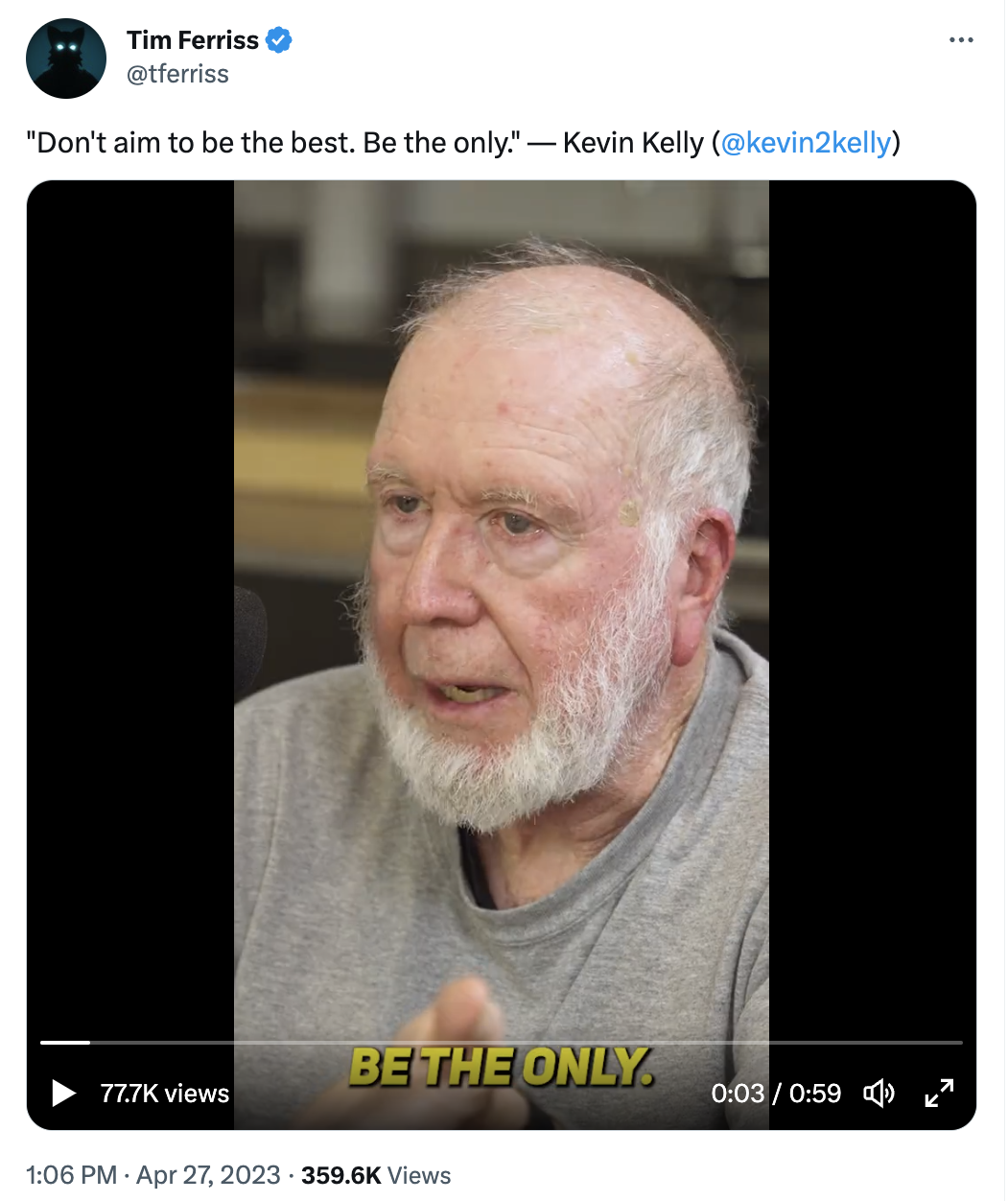
He says you have to find something to do that only you can do well and that is hard for others to reach. It’s not easy, you have to know yourself deeply, and it can take you years to find it, and it takes a lot of exploration and the help of others …… But once you find that niche, you’ll never need a resume again. There’s no one there to compete with you, and you’ll feel easy about doing things.
It’s hard to be “good” at a popular program, but you’re comfortable being the only one at a unique program. Your persona is attractive and demand will come to you.
This brings us to revisit the old saying, “It’s better to be the head of the chicken than the tail of the phoenix”. Many people understand this saying to mean being comfortable in a leadership position in a relatively weak group, a bit of a non-thinker - but you can also understand it to mean finding a unique niche in the market.
So if positioning is so important, why do so many people prefer mediocrity? Why is it that society is so full of homogenized competition, that everyone loves to follow the crowd, and not many people dare to be unique? Don’t they understand the truth that “if you don’t take advantage of a handsome one, you take advantage of a strange one”?
Let me tell you another story.
✵
In the 1970s, there was an evolutionary biologist named John Endler who discovered an interesting phenomenon on the Venezuelan island of Trinidad. There was a river on the island that contained a small fish called a peacockfish that was only two centimeters in length. Endler noticed that in the pools downstream of the river, the peacockfish were all monotonous in color; whereas in the pools upstream across a small waterfall, the peacockfish were very colorful. Endler wondered if this had something to do with the presence of predators downstream.
So Endler conducted an experiment [4]. He got ten fishponds for peacockfish, and the bottom of each pond was covered with a pattern of pebbles and gravel. He put a strong predator of the peacockfish, a large fish, in some of the pools, a weaker predator in some of the pools, and no predator in a couple of the pools. After 14 months, the peacockfish reproduced for ten generations and the results were in.
In the pools with no predators and with only relatively weak predators, the peacockfish grew very beautiful patterns; in the pools with strong predators, the peacockfish all grew very mediocre, with colors as similar as possible to the pattern of pebbles and gravel on the bottom of the pools, amounting to a kind of protective coloration.
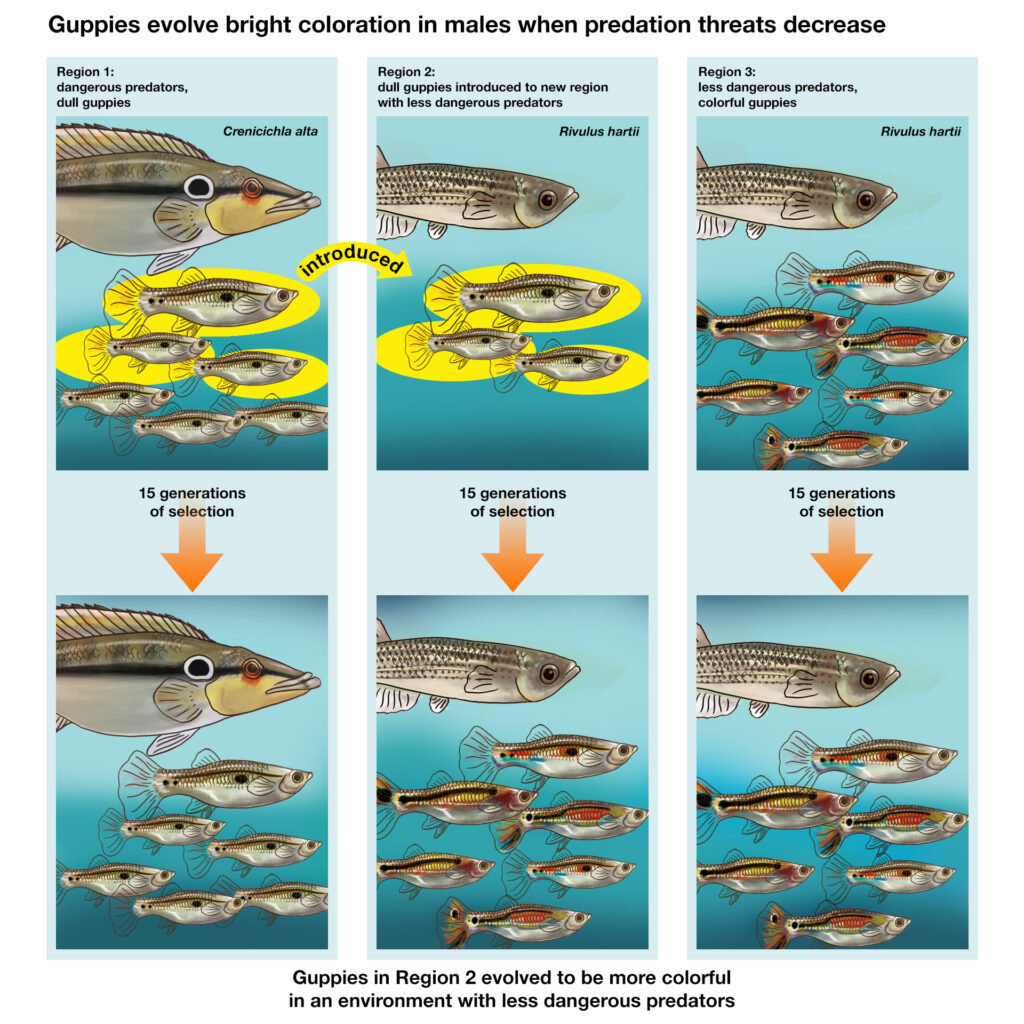
Peacock fish adapt quickly to their environment. If the environment is safe, you can go for beauty and character, as this is very attractive to the opposite sex; however, if there is a predator in the environment and you do not wish to attract its attention, mediocrity is the safest strategy.
Being distinctive makes you easy to notice, and sometimes you don’t want to be noticed.
✵
Our column about Nick Chater’s book Thinking is Flat mentioned this study [5]. Let’s say there was a couple going through a divorce, and the subjects had to choose between the following two types of parents to whom the children should be awarded – the
The first type of parent is the “extreme type”, which has obvious advantages, such as a close relationship with the children, a rich social life, and a high income, but also obvious disadvantages, such as traveling most of the time and having health problems.
The second type of parent is the “mediocre” parent, who has no obvious advantages or disadvantages, but has a good relationship with their children, a stable social life, and a good income and health.
Who would you award your child to? Most people choose the extreme type. You see, it is indeed good to have character.
But wait. The researchers modified the experiment a bit and got another group of subjects to do it again. This time, the question asked was not “Who should be awarded the child?” but “Who should be denied custody?” – and most of them chose the extremes, too!
It’s really a matter of perception. Whether you agree or disagree, the extreme type gives you reasons, while the mediocre type does not. That’s what “gunning for the right” really means: you’re easy to notice, and you give people reasons.
There’s another study in the book Thinking is Flat. Suppose there are now two gambling options with the same average return, but one is risky and one is less risky. The high risk means that it could bring a high return, but it could also bring a big loss. You ask the subjects, “Which option do you choose?” Most people will choose the risky option; but then you ask, “Which option do you exclude?” Most people also choose the risky one.
If your strengths are more prominent and your weaknesses are more prominent, you’re going to be seen: sometimes people see the strengths, sometimes they see the weaknesses.
In that spirit, I’d wager that if that dating site we talked about at the beginning had asked users to first eliminate some of the people who were determined not to have her as a girlfriend, those distinctive women would have borne the brunt of that as well.
✵
So, *whether you want to strive for distinction or would rather be mediocre depends on the current context. *
If it’s a ‘selection’ environment, such as college admissions, company hiring, or an internet celebrity trying to make a name for themselves, you should establish distinctive characteristics to stand out from the crowd. You need to play to your strengths, you have to be noticed to do so, and there is no future in the mediocre route.
But if it’s an ‘elimination’ environment, such as a company that’s not doing well and is considering laying off a bunch of employees, then you don’t want to be noticed. You have to hide your shortcomings well and for that reason would rather be mediocre than meddlesome.
If the environment is more relaxed, where there are only positive rewards and no negative dangers, people will compete for attention, while if the environment is quite harsh, as if there is a monster biting people everywhere, then people will actively dress up in a grimy manner and prioritize the principle of not drawing attention to themselves.
Since the founding of the United States are basically in a peaceful environment, never experienced major wars and disasters, so Americans are very bold to play individuality, to be different as a matter of pride, the social culture is quite relaxed.
Thus, if you find that the young people in the community in the bold pursuit of new things, some of the foreign festivals, some play the Chinese dress all kinds of foreign appearance, the street is full of strange buildings, you not only should not look at inappropriate, but also should be for the times to cheer. On the other hand, if everyone follows the rules, young people are honestly listening to their parents do not dare to cross the half step, and even dress are low-key conservative, then there must be dangerous predators in this environment.
Commentary
[1] Christian Rudder, The Mathematics Of Beauty, January 10th, 2011. http://blog.okcupid.com/index.php/the-mathematics-of-beauty/
[2] The m3 term is dropped because its p-value was very near 1.
[3] https://twitter.com/tferriss/status/1651664135724171264 This advice also appears in his new book Excellent Advice for Living: Wisdom I Wish I’d Known Earlier (2023).
[4] For more details on this matter, see [English] Tim Harford, The Power of Trial and Error: How Innovation Can Come from Nothing (Zhanlu Culture, 2018). In the latter image is another version of the experiment, from https://evolution.berkeley.edu/lines-of-evidence/experiments/
[5] [US] Nick Chater, Thinking is Flat (CITIC Press, 2020).
Underline
- If the environment is safe, you can pursue beauty and distinctiveness because it is very attractive to the opposite sex; however, if there is a predator in the environment and you do not want to attract its attention, mediocrity is the safest strategy.
- Whether you want to be different or would rather be mediocre depends on the current environment.