How modern people should cultivate themselves

How the modern man should cultivate his body and mind
Leonard Mlodinow is one of my favorite science writers. He has a knack for thoroughly researching the latest advances in a field over a period of two or three years and writing a book that is both popular and edgy.
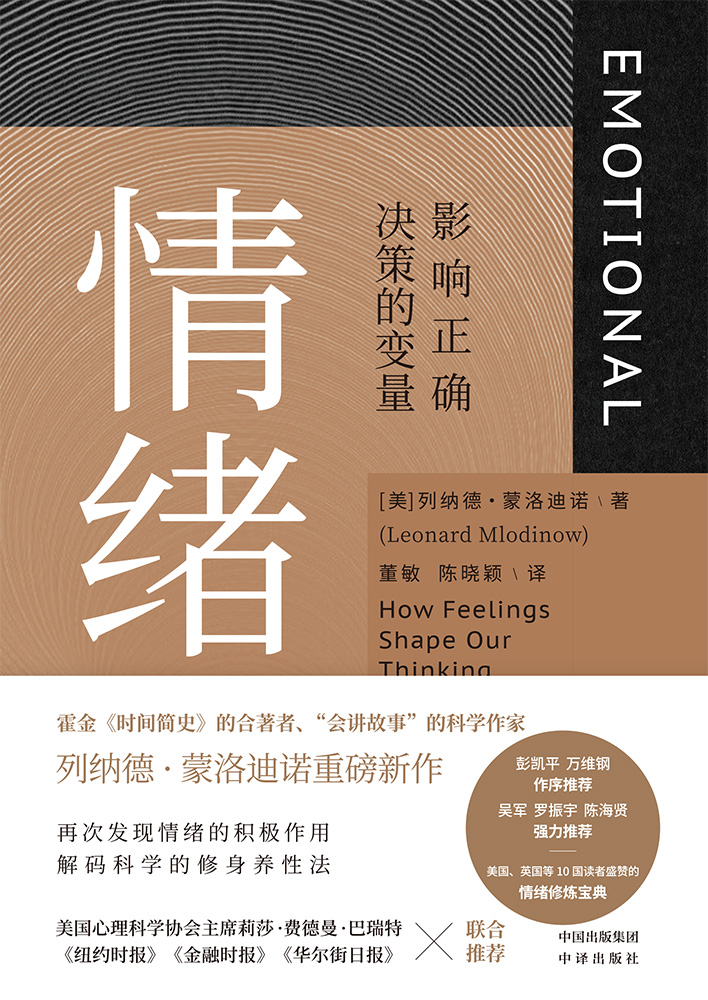
This book, Emotions: the Variables that Influence Good Decision Making, speaks to the latest understandings scientists now have about human emotions. The best way to understand these realizations may be to compare them with the ancients.
How do you become a person who has a way of doing things and living an interesting life? In the past, those Chinese scholars advocated “inward seeking”, and emphasized the cultivation of the body and mind, such as finding a place where no one to meditate for a long time, as the so-called “my day three introspection of our own body”; while the modern elite tend to “outward looking”, to find out from their peers, to find out from their peers. On the other hand, modern elites tend to “look outward”, seeking information from peers, consulting with experts, convening meetings, collecting all relevant information, seeking help from friends and relatives, and seeking knowledge, resources and solutions.
It’s easy to understand modern logic. Decision making or evaluation is supposed to be the input and output of information. You have to have new information coming in, do some math – a step that usually takes very little time – to come to a new conclusion. Everyone is a node in the flow of social information, and we seek information before it is too late, so how can we actively disconnect from the Internet and work behind closed doors?
This of course has something to do with the convenience of seeking information, after all, Zeng Guofan did not have a smart phone, on the other hand, we take the ancient advocates of meditation and introspection as moral behavior. Why do I always have to reflect on myself? Is it an obligation to others and to society to always find fault with myself when things go wrong? Does being a good person diminish my competitiveness? Why do I have to look so old-fashioned? I’m still a teenager at heart!
What I’m saying is that the practices of the ancient greats are not only not outdated, they are still very advanced.
I’m not going to advocate meditation either, but the introspection of the ancients was not a moral act, but a cognitive one. They were examining information within themselves.
Socrates said “know thyself”, Plato said “to learn is to recall”, Mencius said “he who is able without learning is his conscience; he who knows without considering is his conscience”, Huineng said “what period of self-nature is there, it is self-sufficient”, Lu Jiuyuan said “the universe is my mind, and my mind is the universe”, Wang Yangming said “there is nothing outside the mind, and there is no reasoning outside the mind” and “to the conscience” … … all mean that everyone has an extremely rich inner world that deserves to be properly developed.
This is absolutely true and definitely useful. Let me give you a few simple examples.
Ms. Wang’s son is very well off and wants to go to a big city after graduating from college. Ms. Wang knows that her son can find a high-paying position in places like up north, Guangzhou and Shenzhen, but she can’t help thinking, “What if he loses his job? What if he encounters a dangerous situation? She threatened to break off the mother-son relationship by asking her son to stay in the local area as a civil servant or secondary school teacher.
That day after work, Mr. Zhang received an impromptu call from his wife asking him to go to the supermarket to buy some food. He went to the supermarket and saw that there were a lot of things that the family happened to need, and bought a whole lot of food and drinks, only to be strongly criticized by his wife when he got home.
Ms. Zhou’s new job didn’t go too well, but what made it more difficult for her was that she often felt stomach pain in the past few months, and recently it developed to the extent of continuous constipation.
Ms. Wang should have researched the unemployment rate in the North, Mr. Zhang should have asked what the family needed, and Ms. Zhou should have gone to see a gastroenterologist, right? Not necessarily.
Ms. Wang grew up in a poor and turbulent family environment, which led her to develop anxious habits of thought. Anxiety is an emotion that inclines people to make pessimistic judgments and always think that things will go in a bad direction. When Mr. Zhang was shopping in the supermarket, he was already hungry. Hunger not only makes people want to get food, but also subconsciously wants to get other things. Ms. Zhou’s stomach aches because she feels scared every time she talks to her boss, and the stress and anxiety of her job seriously affects her digestive system. The human intestinal nervous system is called the “second brain”, and can directly form feedback with emotions.
They have to learn to look inside themselves and carefully distinguish between the various emotions in order to know what’s going on. Otherwise, they will be in a state of confusion all day long, and when something goes wrong, they won’t even know how it went wrong, and they won’t even know that it was a mistake. Is it possible for people not to cultivate themselves?
You need to know precisely what you are really thinking in that moment, what you really want, and why you are really thinking that way, in order to be able to improve your body and mind. What you lack most right now is not information from the outside, but information from your heart. Zhuang Zi said, “My life has an end, and knowledge has no end, with an end with no end, it is almost impossible”, which means that from a cost-effective point of view, you have chased too much external information, and the marginal utility has long since been diminishing, and it is time to intensify examination of the information within.
Self-knowledge is not an obsolete or lost art, but it is now in vogue. And where the cultivation movement is trending right now is the United States. From Stephen Covey’s Seven Habits of Highly Effective People, which called for self-creation from the inside out more than 30 years ago, to the recent trend of Buddhist meditation among intellectuals and white-collar workers, to the revival of Stoic philosophy in Silicon Valley geeks, and combined with scientists’ latest experimental research on human emotions, I am afraid that those who look most like Wang Yangming and Zeng Guofan are now some Americans.
This new generation of scientists can scan brain activity directly with a functional MRI machine, they can insert electrodes into the brain for experiments, and they can combine brain neuroscience, genetics, and intestinal colonization to study emotions. The result is a whole host of new results and new ideas. These new results and new ideas in turn led to a whole bunch of new books, new sayings and new ways of cultivating the body and mind. Monolodino’s book, Emotions, is the latest report.
Along with explaining the various emotions, this book introduces several scientifically proven ways to take control of these emotions. Among these methods like cognitive reappraisal, meditation, empathy, body influencing emotions, expression, and Stoic philosophy have been quite well researched by academics and deserve a lot of promotion. These are scientific methods of cultivating the body and mind.
Here I’d like to borrow a trope from fairy cultivation novels and categorize the scientific view of body cultivation into five levels. Take a look around you to see which tier people are at–
- The first layer is “ignorance. * This is the layer closest to the average mammal. People at this level do not have any awareness of their own emotions, and are always “on top” of things, doing whatever they can when they are in the mood. Ignorance can be well-intentioned, have a passion, and even this person is also proficient in a certain specialized skills, but emotions limit their development. They are always kidnapped by their emotions without realizing it, and are slaves to their emotions. They don’t care what trouble their emotions cause others because they simply don’t see them as a problem.
A distinguishing characteristic of ignorance is reflex reaction, which means that one reacts immediately to the corresponding stimulus, as if flipping a switch. Monolodino describes a woman who immediately lashes out whenever her husband enters her office while she is concentrating on her work. There is no thought or pause in the process, it’s as if it’s pre-programmed to blow up at the slightest moment, and that’s a reflex. Viktor Frankl, a psychologist who survived the Nazi concentration camps, must have had something to say about this, and one of his famous admonitions was that “between stimulus and response, we have the freedom and the ability to choose how to respond” – but ignorance doesn’t have that freedom and ability.
It is the fact that there are so many of them in the world that has convinced many wise people in the past that emotions are inherently bad.
- The second level is ‘helplessness’. * The helpless person up top knows that they are being emotionally disturbed, and even knows that they may have long-term emotional problems, but they can’t do anything about it. If they do something wrong because they are emotionally impulsive, they regret and beat themselves up a lot. They want to feel better emotionally and may seek help from a therapist, but often unsuccessfully.
Many people can’t understand the helpless person and say why don’t you pull yourself together? Why don’t you think better of yourself? Why don’t you think better of yourself? I’ll count to one, two, three and you’ll snap out of it! In fact, it’s not that easy. You have to realize that the brain is a piece of hardware, and emotional problems are often caused by damage to the hardware. Maybe the person grew up in an unfortunate environment, maybe he just experienced a strong shock or trauma, maybe he has a genetic problem. You can’t ask a chronically anxious person to immediately become optimistic, just as you can’t ask a disabled person to box.
People say that only good people get depressed …… This impression actually means that the level of helplessness is higher than ignorance.
- The third level is ‘positive’. * This level of people can regulate their own negative emotions, encounter things will take the initiative to “open up a little”, such as love lost to find someone to drink a cup of wine, confide in some. They have an optimistic and sunny image, full of positive energy. If there is also a plus point of outgoing personality, it does not matter whether it is a lively girl, a social big brother or a neighbor’s aunt, they are all very attractive.
But they hadn’t experienced great things. Just like Qin Maoyang, who was good and brave on his own street, but shook like a sieve when he came to the King of Qin, the positive energy of positives is a mental opiate. Their little techniques for regulating their emotions, such as distraction, imagining beautiful scenes, and setting short, easy-to-accomplish goals for self-encouragement, are worthless in the face of a real test. They realize their childishness once they take on heavy responsibilities. Why is this grandpa happy all day long? Because he is retired. Their so-called quiet years are nothing more than a small fortune under shelter.
If you think speculation is a lot of fun, you must not have mobilized big money.
- The fourth level is “acumen”. * It’s not just a matter of being bold. A bold man may be able to “keep his face unchanged when a mountain crumbles in front of him,” and a slow man - there’s an expression that seems to be called “obtuseness” - may be able to “keep a deer in the headlights. - A slow person may be able to do “the moose rose in the left without a glance”, but it is not easy to do “suddenly without surprise, no reason to impose without anger”. How can you maintain the ability to act normally if every decision you make affects the interests of others, even the lives of others, if you are constantly faced with unfair accusations and unwarranted appreciation, and if all sorts of information streams are hitting you emotionally like tidal waves and sharp arrows?
This is why people who do great things must cultivate their bodies and minds. One of the biggest differences between modern scientific understanding and the ancients is the realization that those emotions are not bad. Emotions are tools for the brain to do complex calculations. If you’re scared of a certain statistic, you need to savor that sense of fear; it’s the brain reminding you to consider that factor. What you need to do is not to block out emotions, but to unify those emotions. A stock trader who has just lost millions of dollars and has to get back on track immediately for his next trade has to practice using advanced methods of regulating emotions like reassessment and Stoic philosophy in his day-to-day life. The prerequisite for regulating emotions is recognizing them, and scientists have a lot to say about that; you need to learn about emotions.
A master trader will treat himself as a system, always monitoring the slightest change in mood and dynamically adjusting to the optimal state.
- The fifth level is ‘Master’. * Masters are not only able to cope with emotions, they are also able to mobilize and even create emotions in themselves and others. They know not only how each emotion will work, but also why those emotions are created. They even design scenarios and behaviors to bulk influence others’ emotions and even behaviors.
When we feel warm we are more likely to make solid choices, when we feel cold we will tend to gamble. Low blood sugar may increase a person’s aggression, and unpleasant odors tend to mobilize hostility. If you want a group of people to be happy to give of themselves to the collective, the best way to do it is not to give them a moral lesson, but to create awe in them with something like a magnificent view …… And there is also a supreme cognizance behind all of this that making emotions is not engineering but art, because emotions are subjectively constructed by the human brain stuff.
But a true master does not manipulate people with this knowledge; instead, he empathizes with them. In his book, Monodino tells an allusion to the fact that if you see a man abusing a dog, you should not only pity the dog, but also the man. What kind of unfortunate experience has turned this man into such a state?
This is the understanding of compassion. Those who are kidnapped by their emotions are not bad people, but weak people who need to grow. And we need knowledge.
Some of this new knowledge about emotions is implicit with the ancients, and more of it is unknown to the ancients. We have superior conditions that Zeng Guofan could only envy.
I bet Wang Yangming would be so brainwashed if he could read this book that he would even be moved by it.
Get to the point
The scientific view of the cultivation of the body and mind is divided into five levels: ignorance, helplessness, positivity, acuity, and mastery.