How do I use ideas?
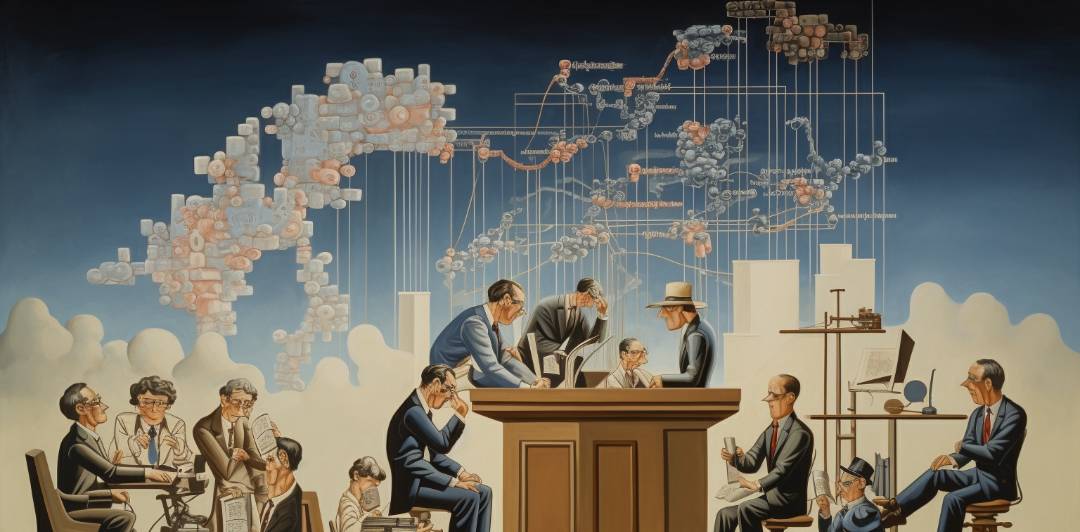
How does “thought” work?
In this lecture, we will recommend a book by Ms. Xu Jin, who is the main manager of the course “30 Lectures by Masters of Economics”, and the title of the book is “A Liberal Studies Course by Masters of Economics”. I wrote a preface for this book, and today is the full text of this preface.
Xu Jin’s A Liberal Arts Course from the Masters of Economics is a dry collection of the best of economics. The book includes classics by grandmasters like Adam Smith and Keynes, but the vast majority of the books are recent and new. The book covers a range – perhaps dare I say a full range – of ideas from macro to micro, from social life to the psychology of investing. These are not the things you can read in a high school textbook or a general science book. These are the mind tricks of the masters and the weapons of the newest members of the jungle.
I greatly admire Jane Xu’s scholarship. She is the editor-in-chief of the finance and economics section of the Chinese website of the Financial Times, and she has held a course called “Masters of Economics” on the “Get” app, and she is also doing knowledge services and a self-publishing media. She knows a lot of things, has an amazing speed of thinking, and often consults with masters of today’s academic world. Xu Jin has a keen sense of judgment on real things, so much so that she is sometimes banned on Weibo.
Books like this one are best read with questions in mind. For example, this book is all about ‘ideas’, so what is the use of ideas? For physics that’s not even a question, but for economics it’s a big question.
✵
Far away, for example, is the global financial crisis of 2008. Its impact was so far-reaching that it all but changed the international political landscape to some extent. But on the eve of the crisis, as of late 2007, hardly a single economist in the world had predicted that crisis. And of course afterward they all explained the crisis as if it was bound to happen. If you didn’t guess such a major danger, what is economics really about?
Nearby, for example, is the debt crisis in China’s real estate industry at the end of 2021.In 2017, Evergrande Real Estate Group hired Ren Zeping as its chief economist at an astronomical annual salary of 15 million yuan. Ren Zeping had optimistic predictions about China’s property market at the time, making aggressive statements, and Evergrande’s debt ratio was already high at that time. In the next few years, Evergrande expanded even more aggressively, reaching astronomical debts, and eventually the bubble burst on the verge of bankruptcy. At this time Ren Zeping was carried out by netizens, said you this chief economist in the end played what role?
Ren Zeping also wronged. He once advised to reduce liabilities, he is from the economist’s basic knowledge against the blind diversification of the group, only Evergrande did not listen to it. And this just shows the status of economics: Imagine if an engineer with an annual salary of one million dollars said that you have a problem with the design of this building covered soon will collapse, I believe Xu Jiayin will certainly listen.
Economics is not a hard science, economists are known for speaking unreliably. That’s because economists can’t bring all the relevant parameters into a formula like engineers can, to give a precise judgment – there are simply too many factors affecting the economic system, and many of them are uncertain and difficult to quantify. An economist can usually only select a few factors that he thinks are important and happen to be examinable, and output a vague conclusion.
✵
Simply put, economists, when confronted with real things, tend to think not in terms of formulas, but in terms of ‘ideas’ .
Free trade is good, governments can use fiscal policy to stimulate the economy, inclusive systems are more likely to lead to prosperity than extractive systems …… These are ideas. Ideas are like the fables and idiomatic allusions of the past, now popularly called ‘thought models’. In fact, things like Go set-ups, soccer tactics, and business strategies …… are all ideas as long as they are vague summaries of the laws of things.
- Thoughts are, essentially, pattern recognition. * The critter in this photo is a cat or a dog, you can hardly say it clearly with a quantitative indicator, but you know what it is when you see the photo. To what extent does a system have to be “inclusive”? How much prosperity can inclusion bring? It’s impossible to say, but if you’ve seen the history of many economies, you know very well that inclusiveness is good for prosperity, just as you know that dogs are usually more willing to get close to people than cats.
Of course economists need to do some calculations, but those calculations are only informative for the final conclusion. The real power of soft learning is to apply ideas in a categorical and flexible way. If you think the situation is such that you should analyze it with idea A in conjunction with idea B, only to find out later that it’s actually such a situation that idea C applies, it’s your own pattern recognition that’s at fault, not those ideas.
Arguments between economists are often not about conflicting ideas, but about conflicting pattern recognition.
For example, in this book Jane Hsu talks about the argument between Keynes and Hayek. I believe that Keynes could never have opposed the idea that “the market is fundamental to the functioning of the economy”, and Hayek would have agreed with the idea that “government stimulus can bring about a wave of at least short-lived mini-booms”. The real difference between them lies in the size of the effect of these two ideas: if the government does not stimulate, how long does it take for the market to automatically come out of the depression? If the government does stimulate, does that small boom deserve its side effects? These are not questions that can be figured out by talking about ideas; they are determined by the specific situation at hand.
Economics is the study of economic ideas. Some economists specialize in inventing new ideas, and some economists specialize in applying ideas; the former may reap the accolades, and the latter may reap the high salaries.
✵
And readers may reap the grips.
In 2009, Paul Krugman, an economist who had just received the Nobel Prize, visited China. While the Chinese gave him a warm welcome, he gave a strong critique of the Chinese economy. Krugman said that China’s model of export-driven growth simply does not work, other countries will not tolerate you to keep doing so, you will soon have problems.
…… The result was that China’s economy continued to grow at such a high rate for a decade that the Chinese were convinced that it was the U.S. model that didn’t work. Krugman’s prediction was a failure, as were those of others who had been down on China’s economy.
But can we say Krugman is full of shit? Maybe he’s just not thinking about the model in a comprehensive way. China’s economy may indeed have the problems he describes, but because it has other strengths and dividends – such as the huge potential of the Chinese market and the fact that China has a lot of domestic savings to invest – those strengths and dividends far outweigh the problems, and so the Chinese economy can still grow at a high rate. China’s economy can still grow at a high rate.
It’s like saying that a soccer coach occasionally watches a team play and says, “You have a problem with your defense, and I’m afraid you’re not going to do well in the league. As a result, this team won the championship a year later! We can’t just say that the team’s defense is fine, because maybe it won the championship because its midfielders and strikers were too strong, and its opponents weren’t strong enough.
In fact the subsequent trade war between the US and China went some way to confirming Krugman’s view …… Fortunately in 2021 because of the success of the pioneering fight against the epidemic, China kept its exports.
Since 1984, the Chinese government has engaged in banking reform and wage reform in state-owned enterprises. These two reforms have led banks to do their best to grant loans, while state-owned enterprises have borrowed money to raise wages for their employees. In the eyes of economists, both reforms had a tendency to lead to inflation. And in the midst of this trend, in 1988, the Chinese government launched another price reform, intending to end the two-track system of state-run enterprises and to let the market determine prices completely.
Several Western economists warned against this, saying that price reform at this time would surely lead to hyperinflation. But the Chinese government was determined and was too eager to reform.
As a result, hyperinflation did occur in 1988.
Therefore, we had better listen to what economists say. What they say may not be accurate, but their ideas usually make sense. Especially if several economists say it, we better take it seriously.
In fact, Krugman not only criticized China, but also criticized Singapore in the past, saying that Singapore’s development model of relying on labor and capital inputs was unsustainable and that growth would slow down sooner or later. Lee Kuan Yew heard about it and was also very angry. Legend has it that he confronted Krugman once, saying that our return on capital hasn’t declined for decades, so how do you explain that? But please note that Lee Kuan Yew said, back to really take Krugman’s criticism seriously. Lee Kuan Yew asked Singapore must be based on capital and labor to improve the level of total factor productivity, the results of Singapore really out of the middle-income trap.
Conversely, if many economists say that many of the policies of an economy in recent years have been directed towards suppressing growth, and that economy does not listen, is this not dangerous?
✵
Before the 2008 financial crisis, economists knew, based on common sense, that the practice of subprime lending in the United States was problematic. They knew there was a bubble in the real estate and financial markets, they just didn’t know if the bubble would burst, let alone how harmful it would be. Ren Zeping of course knows that high corporate indebtedness is a problem, and of course he knows that China’s real estate won’t grow forever, but he doesn’t know what the result of the battle between these two trends will be.
There are three things we need to understand about economic thought and economists.
First, economics ideas are almost always right, it’s just that the situations in which they fit vary. * You need to have common sense, and you need to learn as many economic ideas as you can. Being able to consider one more layer than others may give you an extra chance of being right.
Secondly, knowing a truth, and knowing how effective a truth is in this situation are two different things. * Often the effect can only be assessed by feeling, but you have to have an assessment. If two ideas pointing in opposite directions both seem to apply, you’d better be able to analyze which one has more effect. That’s where the experts come in, they have quantitative models, they have a history.
Third, the controversy among economists is actually quite small. * Sometimes the arguments may seem heated, but when you ask what exactly should be done next, the differences between economists and economists are certainly much smaller than the differences between politicians and politicians. Especially after these last few decades, economists have seen so much history that they usually advocate a less drastic move, not so much that they move to try to overthrow the system altogether.
And the reality is that the choices people make in the real world are far from following the economist’s ideal. This is probably because economists only do economic math, and politicians always do something else. That’s why things don’t always go in a direction that favors economic growth.
But we should still read a little more and try to think of another layer. Not necessarily that you’ll be able to come up with any magic tricks, but you’ll definitely be able to make fewer mistakes …… or, when others do, see the doorway.
I used to despise economists when I was young and ignorant, but now I can appreciate their difficulties and admire their thinking even more. If you carefully read through these generalizations in Hsu Jin’s book, the good news is that you will become a humble person. The bad news is that you’ll be a humble person. The bad news is that you’ll be uncomfortable with some things – and a learned person should be a bit uncomfortable.