Hidden mechanisms of social order
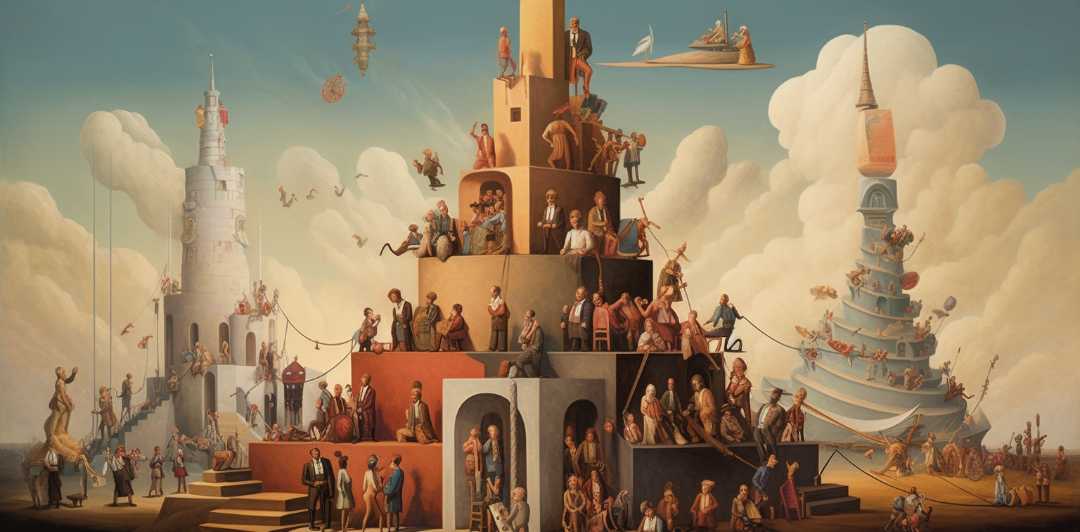
The hidden mechanisms of social order
This lecture, updated today by Van Wagenen, is the preface I wrote for the book Imitation of Desire to help you understand it better. The preface will be slightly longer than our daily lessons. Here is the full text.
Luke Burgis’ book Wanting: The Power of Mimetic Desire in Everyday Life (2021) is so profound that you’d probably bury it just by reading the title and synopsis. This book is not a motivational sermon on abstinence from desire, nor is it an ordinary popularization of science, but it is a big secret of the mechanism of society. In order to let you fully understand this mechanism, I deliberately write this preface as an introduction.
✵
Zeng Zi, a disciple of Confucius, was very sick before he died. A child servant in front of his bed, probably without words, said, “Oops, the mat you laid is really gorgeous, this is a mat that only a great doctor can use. Zeng Zi was very frightened, said this is indeed Ji Sun sent me the mat, how did not change ah, hurry to change! Let people help him up to change the mat, the mat has not been replaced, Zengzi died.
This is a story from the Book of Rites, and you can interpret it differently. If you are coaxing a child, you can say approximately that Zeng Zi was a person who advocated frugality …… then the child will think he is also too pedantic.
The adult interpretation of this is that Zengzi was upholding a social hierarchy. The essence of “propriety” is hierarchy. Confucianism believes that rank must be respected, and that you use items of whatever grade you are: if Zeng Zi was not a great doctor, he could not use that mat.
This is the standard way of thinking in Confucianism. When Confucius said, “Eight rows of dancers dancing in the courtroom is tolerable,” he also meant that he was against overstepping one’s rank: you are not of a high enough rank to enjoy that kind of dance.
From a modern perspective, isn’t it too reactionary for Confucianism to defend feudal hierarchies in such a way? Shouldn’t everyone be equal? Can this be done without revolution?
What if I tell you that Confucianism’s desperate attempt to uphold hierarchy is actually not to flatter the aristocracy, but to safeguard social order?
What if having hierarchy is right and advocating equality is condoning envy?
What if people are in fact a very violent animal, and if we don’t control them hard enough, they will become chaotic?
Read this book by Kashiwagi Kōkō and you will probably be able to understand Confucianism.
There is a very troublesome thing in human nature called ‘desire’.
✵
*Desire is not NEED, it’s WANT. you don’t NEED this thing, but you just WANT it. *✵
This book by Berryukon is a modern take on a set of doctrines summarized and played out by the French philosopher René Girard. One of Girard’s key insights is that we’re not born wanting something, we learn it from people. Why is your dream to go to Harvard? That’s because everyone thinks going to Harvard is an honor.
Kilar studied literature for a while and realized that the main character in classic novels who pursues a thing of some kind is never the one he wants to pursue, he’s told to by someone else. Including in the Bible, why did Eve want to eat the apple? Because the serpent told her to. * Desire comes out of imitation. *
Our various pursuits, from wanting to go to a prestigious school to wanting to study in a popular field like finance, law, medicine, or counseling, to showing off all sorts of things in our circle of friends, not to mention wanting luxury items, are all social imitations.
Taoists will of course say that mimicry of desire is bad, and that the escalating desire to climb up the ladder is not a desire that cannot be filled. But capitalist societies think this is good. It is precisely because we all have desires and you catch up with us that the economy grows and the world progresses.
Is desire good or bad? The book, Berryukon, says that there are two kinds of imitations of desire.
One is vertical, looking upward and imitating people who are higher in status than you. Look at what the stars, the celebrities, the big shots are doing, and you want to be like them. This kind of imitation is honorable and there is nothing wrong with it.
The other kind of desire is horizontal, looking around and imitating people who are similar to you. This kind of imitation is covert and competitive. If you see a coworker wearing a nice outfit today, you won’t wear the same thing tomorrow; you want to wear something similar, but better. Sometimes it depends on what kind of things she likes, you will deliberately like the exact opposite in order to prove that your vision is higher, this deliberate non-imitation is actually a kind of imitation, you are still being influenced by her.
According to Marx, conflict occurs because people have different attributes and positions, but the reality is that fights happen between people who are similar. Competitive mimicry makes us very concerned about the small differences between us.
The man of letters despises not the roughneck but the man of letters who is similar to him. It is not the infidel but the member of another sect of the same religion that the religious hate most. It is not the foreigner who clashes with you most, but your neighbor. The essence of these rivalries is really jealousy, and it always takes place within the community.
How can you fight all day long? The community must maintain order.
✵
The best way to maintain order is a hierarchy. Divide people into three, six, nine classes, each class has a corresponding treatment, everyone in their place, then there is no talk of jealousy.
Sociologist Nicholas A. Christakis, in his book Blueprint (2019), summarizes that there are eight characteristics of a good society, and one of the key ones is the existence of a moderate hierarchy, otherwise the society will be unstable. If we look at Confucianism, which advocates a system of “rites and music”, rites are hierarchies and music is moderation, and rites and music are in fact meant to maintain stability.
In every generation, there are people who express dissatisfaction with the hierarchy, saying why can’t everyone be equal? One of the latest examples of displeasure is Tse Ka Wah, the original CEO of Zappos.
Tse Ka Wah had a successful business and published a book called Delivering Happiness. He sincerely wanted to build a better society. To that end, he often made things happen.
Meijerbu once adopted a new management style called the ‘Huddle System’. It eliminated the traditional titles of all people in the company, including the CEO, and there was no permanent leadership structure; things were done by ad hoc groups, and management was completely flattened to eliminate hierarchies.
This reform was a sensation, and I also wrote an article about it …… Later, Xie Jiahua used the same concept to pull a large group of friends to engage in a new type of urban construction in Las Vegas, which was also a sensation.
However, a few years passed and Tse’s experiment in equality proved to be a failure. The morale of Meijiebu’s employees was low, and there were countless internal fights. There was a succession of suicides among partners and executives in the Las Vegas program. Kashiwagi Kon witnessed these changes firsthand, and he believed that the key to the failure lay in the elimination of hierarchy.
The firm had hierarchy, and the employees’ main energy was spent on upward emulation. The executives were role models, and people knew which desires were worth promoting. This imitation is peaceful.
When Meijerbu eliminated hierarchy, employees’ focus became competitively imitating each other. We’re all the same. Why do you earn more than me? You call the shots in this group, you should listen to me in the next group! Desire becomes disordered, and disorder leads to conflict.
Meijerbu fell into a Hobbesian war of all against all, with everyone feeling insecure and wondering how to keep their jobs …… except for those who had a particularly good personal relationship with Xie Jiahua. The reform of the Hopping System ended in failure, though the company had been bought by Amazon before - and the biggest misfortune was that Tse Ka Wah later died in a fire accident because he was living an unusually chaotic life.
This is why Confucianism is hell-bent on maintaining hierarchy. Sima Guang says at the beginning of the Ziji Tongjian, “I have heard that the duties of the Son of Heaven are not more important than rituals, that rituals are not more important than divisions, and that divisions are not more important than names.” The most important role of this Leviathan of yours is to make society hierarchical, and the key to hierarchy is to make clear distinctions, and distinctions require that each person be given a different name. When the names, or identities, are defined, the society is stable.
- The role of hierarchy is to maintain stability. *
✵
But many societies are not as Confucian nor as hierarchical, so how do they maintain order? Societies that are not very hierarchical do not easily maintain order and often fall into chaos. But these societies have a mechanism for quickly extricating themselves from a state of chaos to regain order, and that is to catch a scapegoat. That’s where Kilar’s insight comes in.
Wouldn’t it be distressing for a group of people who have lived together for generations to have violent conflicts that ripple through the entire society every so often because of competitive mimicry? The solution is to find a scapegoat. Some societies find an animal - perhaps a sheep - and capitalize on people’s superstitions by saying that all the chaos is caused by this sheep and it would be better to dispose of it; more societies simply find an individual to be the scapegoat. Maybe the weakest, the weirdest, maybe the person who used to have the most power. Everyone takes out all their hatred on him, and unity is restored.
Actually, that’s how it is now. The team’s performance is not good, then fire the manager, the economy is not good can be blamed on corrupt officials and capital, before World War II, all of Germany hated the Jews …… This is all to catch the scapegoat.
Obviously, it is the common cause of the whole society, but the culpability only needs to be borne by one person. The scapegoating mechanism is so effective and returns society to order every time that no one needs to reflect on it ……
Until that one time when Jesus was used as a scapegoat. Jesus died on the cross as a matter of course, but his followers remained. The religious came forward to say that Jesus was innocent, and even went so far as to say that he was still alive …… And so society continued to be divided. For the first time in history, Kiral argues, the scapegoating mechanism didn’t work.
That was a turning point in Western history. People have since realized that the practice of scapegoating is wrong.
You could say that it was only after the scapegoating mechanism was reversed that Western civilization came into being. Over the past 2,000 years, the West has slowly developed a tendency to protect the vulnerable in all aspects of human rights, law and public policy, and this is civilization and progress.
Nowadays, there is even an ‘anti-scapegoating’ mechanism developed, which means that once it is felt that someone is being persecuted by public power, everyone will stand up for him …… This is why a black man killed by a police officer can bring the whole of the United States almost into turmoil.
✵
The church-dominated West has retained an aristocratic hierarchy, and Christianity has been indoctrinated with ideas similar to Chinese Confucianism and Taoism. One of the Ten Commandments of Moses is called “Do not covet your neighbor’s house, do not be in love with another man’s wife, do not covet another man’s field, his servant or his ox or his donkey ……” It prohibits not behavior, but desire.
Do you see that this is not in line with what Lao Tzu said, “Don’t be virtuous, so that the people won’t fight; don’t be expensive, so that the people won’t steal; don’t see desires, so that the people won’t be disturbed ……”.
Allowing the people to moderate their desires is all about maintaining stability.
Simply put, in peacetime, we will use the hierarchy to maintain stability, and when it gets out of control, we will grab a scapegoat to take the heat, and combine it with ideological indoctrination at any time. If you want social stability, you have to control people’s desires.
✵
Then you say that the modern society, the rites and music, long gone aristocracy, the market economy is to encourage the people can also “watch plasma TV”, the social order and how to maintain it? The secret is called “systemic desire”.
There are no more natural aristocrats, but there is a hierarchical system in every trade and industry. In the education system, there are specialties, undergraduates, and prestigious schools; in academia, there are theses, academicians, and Nobel Prizes; journalists have Pulitzer Prizes, restaurants have Michelin ratings, and entrepreneurs have a list of the richest people in the world. …… The hierarchy provides order, so that people will look upward and put their desires into the right direction of endeavor…. …
…… In reality, it’s still stabilization. Think about it, when Li Shimin said “the world’s heroes, into my enough!” Isn’t it to try to replace horizontal desires with vertical desires, to turn strife into struggle, and to order and legitimize the lyricism of desires?
Because of the stabilizing mechanism of desire within the system, modern society has by and large been able to maintain order. Except for some times - like the civil rights and hippie movements in the United States in the 1960s - when people suddenly stop believing in hierarchy and horizontal desires erupt, causing unrest.
✵
Understanding the mechanics of desire, hierarchy and stabilization, you may feel a sense of transcendence and not want to participate in these games anymore. It’s true that there have been ‘hermits’ in China throughout the ages who have proclaimed their desire to withdraw from the system, and Adam Smith in The Theory of Moral Sentiments argued against falling into the endless pursuit of wealth, but counteracting desire with morality is difficult to operationalize. What are we moderns to do?
Berryukon says something about ways to do this at various points in the book, which I can summarize in about three points.
One is to replace jealousy with empathy. * If you can empathize with another person’s situation and say I understand why you are the way you are, then you can jump in and say I’m not like you, I don’t imitate you.
One is to replace in-system desires with ‘out-of-system desires’. * The so-called out-of-system desire is that I’m not going to compete in this circle anymore, I’m going to break the circle, I’m going to have bigger ambitions. For example, I want to create a monumental achievement, I want to change the world …… The method of breaking the circle is not to compare with others in the circle, it is better to compare only with yourself, and compare with the ambitious goal.
And the most fundamental way is to use ‘values’ to unify desires. * Values are a system of ranking desires. You want both the fish and the bear’s paw, but with values you know what’s less important, what’s more important, what’s more important, and what’s most important……. There will be a lot fewer things worth chasing after, and you’ll be much more frugal.
✵
Desire is a simple mechanism with a terrible truth about society behind it. That truth is that man is a very violent animal and must be governed. Feudal hierarchies or professorial awards really serve to keep you in check so that society can be stabilized.
Because people must be controlled, absolute freedom and equality do not exist……. This is a harsh realization, and I think you have a right to know.
Underline it.
- Desire comes out of imitation. There are two kinds of imitation of desire: one is vertical, looking upwards, imitating those who are in a higher position than you. The other kind of desire is horizontal, which looks around and imitates people who are similar to you.
- Because of the stabilizing mechanism of “in-system desires”, modern society can generally maintain order.
- There are three ways for modern people to avoid being manipulated by desires: replacing jealousy with empathy, replacing in-system desires with out-of-system desires, and using “values” to dominate desires.