Freedom comes with responsibility, dependence leads to control

Freedom comes with responsibility, dependence leads to control
There are many practices in the modern workplace that are very foolish in the eyes of educated people. Employees are afraid to leave at the end of the day, they have to wait for the boss to leave themselves before leaving. Is this not the same as children watching their parents and students watching their teachers? Accustomed to the state of being watched, only when they are not being watched will they dare to do something of their own.
When you look around, things like clocking in and out of work, attendance, fixed vacations, and a strict reimbursement system all reflect a relationship of distrust, like controlling children, potential criminals, or the mentally ill, rather than a group of adults getting together to do things properly.
We can’t help but envision how an organization should be managed if it is populated by gentlemen and dignitaries. I think those precautionary rules and regulations would be seen as insulting. You need adult ways of doing things.
We need to have big people working with big people, and we need adult companies.
✵
When you think of adult companies, Netflix probably comes to mind first, they have a cultural code that says ‘we only hire adults’. But it’s more accurate to say that Netflix wants super talented people, big people.
Reed Hastings, the CEO of Netflix, believes that the best programmers are not worth 10 times more than the average programmer, but 100 times more [1]. So recruiting must be for the best people, and then the management style must adapt to such characters.
Great characters speak of freedom.
In 2022, Hastings co-authored a book called No Rules Rules [2], which introduced Netflix’s latest management philosophy. At the core are three principles: one is to increase talent density and recruit only the best people; the second is to increase candor, with employees giving direct feedback to each other; and the third is to minimize, or even eliminate, controls on the basis of the first two, giving employees full freedom.
Netflix freedom to what extent? First of all, it only gives high salaries, not bonuses. Because paying bonuses means appraising performance, and appraisals are a form of control. Our column used to talk about the book “the courage to be hated” said [3], praise and criticism are essentially the control of people. netflix will use the highest level of the market wages to reflect your value, but will not use the performance appraisal to limit your actions, so that you can do the most worthwhile things according to their own judgment.
Netflix not only allows employees to deal with headhunters, it encourages it: it believes that employees should know how much they are worth in the marketplace.
Netflix has also done away with the fixed vacation system. You can take as many vacation days as you need each year; there are no hard and fast rules from the company. And Netflix doesn’t engage in reimbursement reviews for whatever travel expenses or various office expenses its employees have; you can spend as much as you think you should.
If you want to do a project, but upper management doesn’t approve, that’s fine: as long as you insist it’s the right thing to do, you can do it. You do things for the company, not to please the leadership.
Netflix even shares some confidential information with its employees, including key financial information. As a publicly traded company, there’s some danger in doing this, after all, if an employee leaks or engages in insider trading that’s a crime; but Netflix trusts its employees, and it believes that employees need to know what’s really going on in the company.
You see, this is gentlemanly management. You’re all heroes and heroines here, so let’s not get down to the nitty-gritty. The company respects you, you’re free, we trust each other, and we work well together.
In fact, this management style can not be said to be particularly special, good universities and research institutes are managed in this way: can be done here at least a doctorate, people are researching the most cutting-edge issues, you let people fill out forms all day attendance, eat a meal and still have to give the leader a toast or something is not nonsense? If you claim to be a talented person, you do not also want such management.
So the question is: why most companies do not give these freedoms? The fundamental reason is that freedom is risky. For example, what if the company eliminates the reimbursement audit system, employees abuse their freedom, and everyone travels first class wherever they go on business?
✵
*The secret of Netflix is that freedom is only one aspect, it has another aspect called responsibility. Its corporate culture is called ‘freedom & responsibility’. *
For example, you do have the freedom to criticize anyone in the company, but that criticism must be responsible feedback, not a venting of grievances. Specifically Netflix requires that criticism must meet two conditions: one is to help (aim to assit), have to be constructive; the second is executable (actionable), can not be empty to empty.
Then again, the reason Netflix doesn’t limit vacation time is because employees usually work extra long hours. A senior engineer catches up with a busy project and may have to work 70-80 hours a week, then he does need a good break when the project is done. Not only is it not a loss to the company for such a person to get 10 weeks of vacation a year, but it’s also a benefit because it’s been proven that creative work needs vacation time to brew inspiration.
So removing hard limits on vacations is a gentleman’s agreement to reduce bureaucratization and avoid suppressing creativity. The truth is that vacation freedom is not laissez-faire, and you should communicate with your superiors before you take a vacation if now is the best time to do so.
The same goes for the reimbursement system. Once, Netflix had to demonstrate 4K TVs in HD to the press, but out of the blue, the pre-prepared TVs were disposed of. As a result, one of the youngest engineers, too late to ask for permission, paid $2,500 out of his own pocket for a TV to help the company solve the crisis. No one would do such a thing under a strict reimbursement audit system, and the freedom was exchanged for ownership.
You do have the freedom to push a project forward, but Netflix requires first, that you consult widely with your colleagues before you take on a project, and second, that if the project you’re forcing fails, you need to publicly explain where you went wrong and what you learned from it.
The principle is that the interests of the company come first. Freedom is not a perk for employees, but a more advanced management method: * It is to allow people to do things with more flexibility, to make decisions based on the specific situation rather than based on hard and fast rules, and it is to trust more in ‘people’ rather than trust more in ‘process’. *
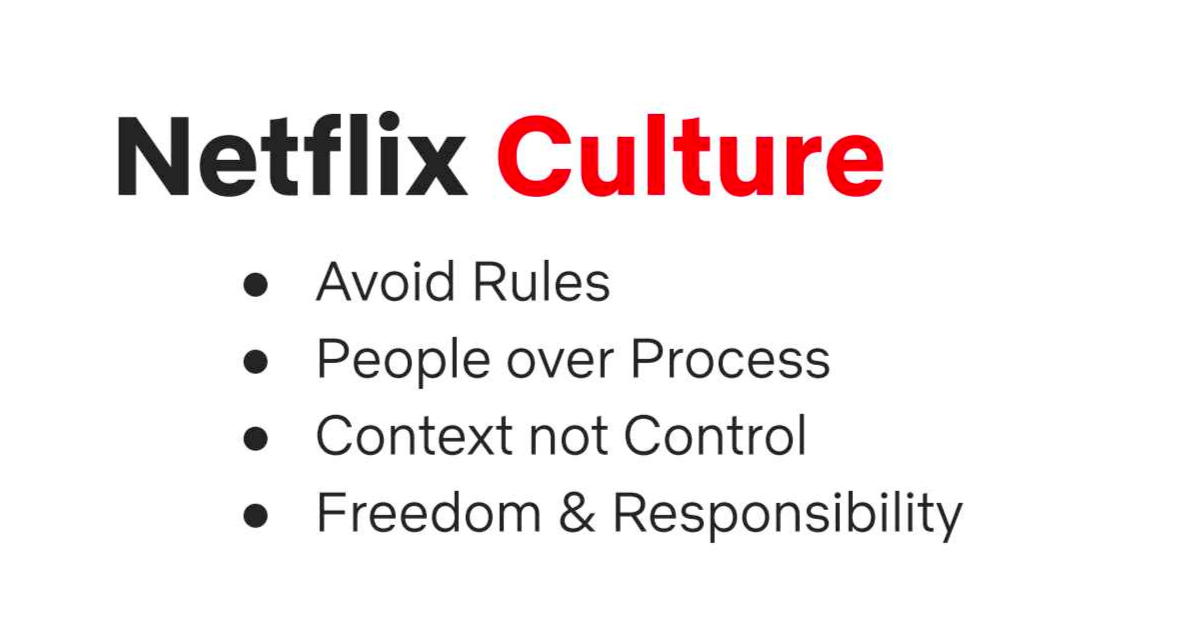
With all that freedom comes responsibility.
And all of this is predicated on the fact that you have to be talented.Netflix’s definition of talent is that you’re the best person for the job: the test is whether or not your superiors would fight tooth and nail to get you to stay if you were to ever offer to leave …… That’s a very high standard.
✵
It’s actually a universal law that you can have as much responsibility as you can enjoy as much freedom.
You say you can’t stand the 9-5, don’t want to be bossed around, and want to be a freelancer, fine - but freelance work can be even more stressful. Work can still touch fish and chat and socialize, freelancers have to manage their own work time and find ways to be more efficient, and that’s really responsible for the quality of work.
Then there’s entrepreneurship, where the company is yours and you call the shots, which is of course the greatest freedom - but entrepreneurs are the most exhausted. You simply do not have time off work, you have to deal with all kinds of trivial things, especially you have to be responsible for the success or failure of the company, have to be responsible for the staff, that is not the average person can withstand the pressure.
You say that schooling is for mediocre students, and I want to be self-educated, and self-education is of course the best - but by being self-educated you have to be responsible for your own progress. Can you honestly give yourself feedback?
In contrast, you can blame your boss if you don’t do well at work, but if you don’t get good grades in school you will have a teacher to control you, and that’s not a blessing.
✵
There are very few jobs in the world that have ‘more freedom and less responsibility’, or ‘less freedom and more responsibility’, most roles are either ‘more freedom and more responsibility’, or ‘less freedom and less responsibility’. You’re not choosing between more freedom and less freedom, you’re choosing between more freedom and more responsibility and less freedom and less responsibility.
There is a Self-Determination Theory [4] that argues that people have a core need for ‘autonomy’, and that there is an ‘intrinsic motivation’ to do things, in addition to extrinsic motivations like rewards and punishments. Our column just talked about Sam Altman’s argument that the intrinsic motivation to do something is to do it right or wrong for oneself, not for others, and that I only care about my own evaluation.
Intrinsically motivated people demand more freedom and are willing to take responsibility for it. They are more confident, willing to accept challenges, like to look for new opportunities, want to innovate, and can take risks. They show a high degree of independence, solving problems on their own rather than relying on others.
It is human nature to seek freedom …… but it is also human nature to be dependent. Some people love freedom more than others, while others love dependence more than others.
If you are strongly dependent on others materially, emotionally, or in your actions, then you will also be willing to give decisions to others [5]. You don’t want to take responsibility, so you’d rather have less freedom.
It’s best if others organize everything for you and you just get down to doing what needs to be done. You like clear guidance, as long as you meet the target, everything is fine, and you don’t care about anything else. You like stability, you resent risk, and you want to just keep ageing ……
We can think about which kind of people are being produced by education nowadays.
✵
- Freedom is linked to responsibility, and dependence is linked to control. *
People with a strong sense of dependence grow up under the tight control of their parents, don’t dare to go against the will of their teachers and elders in every move, and are so instinctive to please others that they don’t even think about what their ideas are. Their parents arranged for them to go to college, choose a major, get a job, and get married. They are full of fear of private enterprises and the market, and regard the entrance examination as “going ashore” - in fact, they have never been to the sea. Their ideal job is to have their whole life organized by the organization.
They do gain security and stability, but they have long lost the freedom to tap the table and leave.
Individuals may be able to resign themselves to such a situation, but at the corporate and national level, if they are caught in such a relationship, they will not even dare to sleep. The modern world wants to be completely independent and autonomous is impossible, the best way out is I rely on you but you also have to rely on me …… Instead, individuals need to learn to be less dependent and more autonomous.
✵
Freedom and responsibility are qualities that modern adults should have. But if most people in a society are used to dependence and have difficulty adapting to freedom and responsibility, and the people are not used to deciding some things for themselves, then the modernization process of this society will encounter corresponding problems.
In today’s world, there are universities that are run by professors, companies like Netflix that treat their employees as adults, and small developed countries like Finland and Sweden that can be called “gentlemen’s countries”, but those are still a minority. Most people would probably rather trade their freedom for security, or, in Wang Xiaobo’s words, “be comfortable with the life they’ve been set up to live”.
But growth can happen at all levels, anytime, anywhere.
Annotation
[1] Reed Hastings, Netflix CEO on paying sky-high salaries: ‘The best are easily 10 times better than average’, cnbc.com Sep 8 , 2020; Elite Day Class, Season 4, One Man’s Job, Nineteen Men’s Huddle.
[2] [US] Reed Hastings, [US] Erin Meyer. Unconventional: Netflix’s Freedom and Responsibility at Work (CITIC Press, 2020);
Reed Hastings and Erin Meyer, No Rules Rules: Netflix and the Culture of Reinvention (Penguin Press, 2020).
[3] Elite Day Class, Season 3, The Courage to Be Hated 2: What True Freedom Is
[4] https://psychcentral.com/health/self-determination-theory-explains-behavior
Getting to the point
With all that freedom comes responsibility. How much responsibility can you take on, how much freedom can you enjoy.