Evolutionary Ideas 8: Experience Design Studies (end)
Evolutionary Ideas 8: Experience Designology (END)
We finish Sam Tatum’s book Evolutionary Ideas.Today’s focus is on expectation management and sense of control.
I’ve been reading some new claims about self-awareness lately. There is now a popular school of neuroscience theory that considers the brain to be a predictive machine, saying that we have a continuous sense of self because we are always making predictions about our environment and getting feedback, a theory called “predictive processing“ [1].
Predictive processing theory suggests that perception is, in fact, a function of two signal streams: one from the inside out, where the brain is predicting what will happen around you, and the other from the outside in, where things around you are giving you feedback on what is actually happening. If these two streams of information are consistent and the error is relatively small, it means that things are in line with your predictions, and you have a continuous feeling of “I live in the world”, you feel that you have a place in the world, and you have a sense of security, belonging and control.
This is actually an illusion, because the world is not just the way you think it is, and many of your predictions are wrong, but you just don’t know it. …… But that’s okay, some philosophers believe that it’s this illusion that gives us self-awareness. But this speaking we are not talking about philosophy.
What I’m saying is that * how much this illusion is disturbed determines how good or bad your experience is. *
✵
You know how big shopping malls have those escalators. Sometimes that escalator breaks down and is stopped, but you don’t know it. You walk up, thinking it’s going to move, but it doesn’t, causing you to almost fall, possibly accompanied by dizziness. There is a discrepancy between your conscious mind and your body’s reaction, and your prediction fails - this is called the “broken escalator phenomenon”.

You expect it to, and when it doesn’t, you don’t feel good. And when the world specifically meets your expectations, you feel better.
Cheese can actually be white, but it’s generally accepted that cheese should be yellow - and so when it’s yellow, you feel better about it. Red ketchup makes you taste more like ketchup. When you drink Coke, you’ll feel like it tastes more authentic if you drink it from a cup with the Coca-Cola brand logo on it.
Anticipation works by focusing your attention on the element you anticipate. If you anticipate that the thing is supposed to be good, you will focus on the good side of it.
This is why going to live comedy and stand-up comedy shows makes you think the bits are funnier. You already expect to be funny as soon as you go. Especially if the opening couple of shows are really funny, you’ll find the later ones funny even if they’re not that funny. The atmosphere is already set.
So we need to manage consumer expectations. For example, not only should the food be good in high-end restaurants, but also the entire environment, the image of the waiter, the customer’s demeanor should be good - and then you will feel that the food is also more delicious.
The variable rewards we talked about earlier, the way to attract people to gambling addiction, can also be said to be a kind of expectation management. We know that the uncertainty in reward expectations doubles the pleasure.
So the question arises, what happens if bad expectations are also variable?
✵
The answer is that bad expectations, if variable, double the pain.
There’s a study that goes like this. A computer simulated a rock-flipping game in which some of the rocks had snakes under them. If you flipped the snake, you suffered a single electric shock. The control group had no such uncertainty, it was simply one electric shock. It turned out that the pain of a definite shock was much less than that of an uncertain one: the feeling of “not knowing which will come first, tomorrow or the accident” was too painful.
So, *Good things can give surprises, bad things should give certainty of expectation. *
When you go to the hospital, if the receptionist tells you that the doctor will see you in 15 minutes, you won’t feel bad about waiting 15 minutes. And if there’s no certainty, every minute you wait is agitated.
Some people think that one of the important things that makes online taxi so successful is that it manages your expectations of waiting for a ride. When you take a cab, you’re not sure when the car will come, and you don’t know how long you’ll have to wait. But with online taxi, the app clearly tells you where the driver is right now and how far away he is from you, you know exactly when the car will arrive in a few minutes, and you have a great experience.
There’s also a phenomenon called “the return trip effect”, which means that when you go out of town for a trip or an errand, you feel that the return trip will take you less time than when you went there - some studies have shown that it can be up to 22% shorter. Why? Because when you go, even by train or airplane, you already know how long it will take beforehand, and the specific experience of the trip is still a bit uncertain for you; while when you come back, because you have just traveled this road, you know very well what’s going on, and your expectations are much clearer.
The clearer the expectations for a difficult experience, the better it feels. This is why long-haul flights must give travelers clear expectations, not only the flight time, some airlines even explain in advance what time the lights will be turned off and what time the meal will start.
✵
What we have a harder time with is having expectations but not realizing them. For example, if you go to a restaurant, the general default should be about 15 minutes from ordering to serving, so you’re relaxed for the first 15 minutes. But if you haven’t been served after 15 minutes, you might start to get antsy.
Based on this then, some businesses will intentionally extend your expected time. For example, there’s a roadside insurance assistance company that you call when your car breaks down on the road, and they tell you that the technician will be there in 45 minutes - in reality, he predicts that he’ll be there in 30 minutes, but he purposely says a little bit more, partly to have wiggle room, and partly because he’ll surprise you by arriving early.
Disney understands this very well. You get in line at Disney, and there are signs at several points in the line that tell you that say roughly how much longer you’ll have to wait from here.
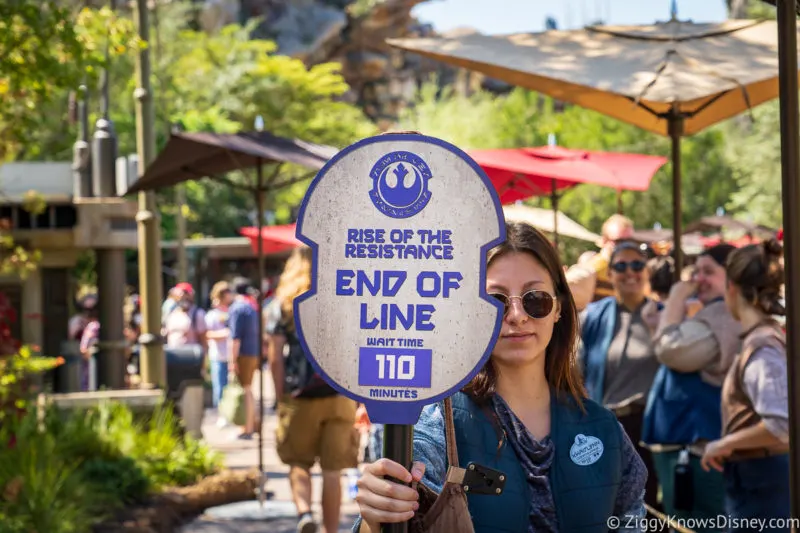
Here’s a little secret. There’s a study that suggests the time written on that sign is intentionally inflated: you actually have to wait only 65% of the marked time …… However, I suggest you don’t take the findings of this study too seriously, otherwise you modify your expectations and your experience will be worse in case it’s longer at that point.
✵
The fundamental reason why uncertainty is stressful is that it’s uncontrollable. If the merchant can give you an even illusory sense of control and make you feel that the situation is under control, then you can accept even if something goes wrong.
As we just said, the core advantage of online taxi is the predictability of the taxi time. uber has a carpooling service that allows drivers to pick up other passengers in the middle of the ride, and this brings a lot of uncertainty. many people get impatient and cancel their orders in the middle of the ride. Then Uber came up with a solution. the app gives you a real-time indication of what you’re doing, like being on the lookout for another passenger or something, step by step. In fact, you still have to spend more time waiting for a carpool, but this attitude of reporting at any time gives you a sense of control, so the order cancellation rate decreased by 11%.
So it’s right that you report more midway through a task given to you by your leader. The operational transparency we talked about earlier, you receive a courier at any time to tell you where to go, is also the same meaning. Obviously, it took four days to get there, but because you can always hear the front report, you feel that the defense is solid.
Why do some athletes have to have a little ritual before a race, like wearing special clothes, having to set out two bottles of water, doing a few special moves, or whatever? Because those are things he can do 100% well. Doing those things gives him an added sense of control.
We have spoken before, New York’s traffic lights, you wait for the red light when you can press a button to notify the signaling system to give you the green light …… In fact, later to engage in digital management, those buttons have long been bad …… But the buttons are still there, because it can give people a sense of control.
Tatum’s book tells a more interesting one. You know the elevator have a close button, but do not know that as early as 1990, the United States passed a protection of persons with disabilities act, requiring all elevators must remain open for at least three seconds, so those close buttons in fact have long been bad …… their real role is to make people feel good.
✵
It’s often not how the thing itself is, but how it makes you feel that matters. Tatum’s book also talks about the ‘Law of Peak and End’, which you’ve long been familiar with so we won’t go into detail - just one point, it’s not just services that are messing with the Law of Peak and End nowadays, it’s a lot of products too.
For example, if you eat an egg roll ice cream and find a piece of chocolate at the bottom at the end of the meal, it’s like watching a movie and seeing a surprise ending as good as …… In fact, that’s a deliberate design.
Some people have suggested accordingly that healthy foods don’t actually have to be made with all healthy ingredients - you can put healthy ingredients in the middle and people’s favorite fats and sugars at the ends. The first bite is delicious, which makes people want to eat it; it’s okay if the middle isn’t quite as good; just make sure that the last bite is exceptionally good, and according to the law of peaks and ends, people still think the thing is just delicious.
✵
With that, we’re done with the various set-ups in the Evolutionary Ideas book for you. We’ll end with two more pieces of advice and an insight.
- The first piece of advice is to read more. * Once you understand the routines, especially the names of the routines, you need to look for them by observing more in your life.
There used to be a quiz question about why someone suddenly noticed an increase in pregnant women on the street. The answer was that she herself was pregnant, or his wife was pregnant. Once you have that awareness and vision, you realize this stuff is everywhere and you think to yourself why didn’t you notice it before.
This also has an official name, the Baader-Meinhof phenomenon, also known as the frequency illusion.
You’ll have to read and think about it more to realize the beauty of the various uses.
*The second piece of advice is that they don’t always work well. *
Take for example the default value effect. One example that used to be talked about was that setting consent to organ donation as a default would get more people to consent to organ donation. Then the Netherlands messed with it once and the people quit. The people said whether to donate or not is my freedom, you engage in the default consent is a challenge to my freedom, people have to go specifically to register to say I refuse to organ donation …… The result is that the government lifted a stone and smashed its own foot.
Behavior is not an exact science. You have to decide which tactic to use in a complex environment, and there may be a chance that something will have an impact, and a slight change in the consumer’s psyche, and the tactic will not only be ineffective, it will be offensive. The key is that you know what you are doing and you have to know why you are doing it, and you have to grasp the principle behind it rather than the routine itself. Change a good set of tricks, using the same behavioral principles, but perhaps another principle.
Finally a little insight that I hope will leave you with a good impression.
Qian Zhongshu begins his novel Siege with this paragraph -
There are only two kinds of people in the world. For example, when a bunch of grapes arrives, one kind of person picks the best and eats it first, while the other kind of person saves the best for the last. As a rule, the first kind of person should be optimistic, because every grape he eats is the best of the leftovers; the second kind should be pessimistic, because every grape he eats is the worst of the leftovers. In fact, however, the opposite is true, because the second man has hope, while the first man has only memories.
There’s been a lot of discussion over the years about what’s going on in this passage, and whether or not Mr. Qian was right about that reasoning. Can you think about why you should eat the best grapes last based on the knowledge in this book ……
Isn’t that the law of peaks and ends?
Then let’s assume that there are big and small grapes, good and bad grapes, and neither of the two ways of eating grapes that Qian Zhongshu said is the best, can you design a better experience of eating grapes.
(The End)
Notes
Highlights
- good things can give surprises, bad things should give certainty in expectations.
- rewarding uncertainty in expectations doubles the pleasure, bad expectations, if variable, double the pain.
- The fundamental reason why uncertainty stresses people is that it is uncontrollable. It is important to give people a sense of control.