Evolutionary Ideas 7: Time, Fast and Slow
Evolutionary Ideas 7: Time, Fast and Slow
We continue with Sam Tatum’s book Evolutionary Ideas, starting with a real-life example.
There was a time when the Houston airport in the United States continuously received a lot of complaints from travelers that their luggage came out too slowly, and they had to wait for a long time at the baggage carousel when they got off the plane before they could get their luggage. The airport thought of a lot of ways to improve the baggage handling process, and did its best to reduce the baggage arrival time by 8 minutes. But travelers were still not satisfied and still complained.
Then someone had an insight. Passengers on some flights walk from the exit as soon as they get off the plane to the baggage carousel in 1 minute. So no matter how you optimize it, they must be waiting for their luggage most of the time. The airport then came up with a “genius” solution: rearrange the locations of the exit and the baggage carousel so that the time it takes to get out of the baggage is the same, but the passengers have to walk a long time to get to the baggage carousel. …… So their pure waiting time is reduced dramatically – and as a result, the passengers complain about how much time they spend waiting for their baggage. So the time they had to spend purely waiting was greatly reduced - and as a result the passengers’ complaints disappeared.
Don’t you see how this is a bit like the Chinese fable “Chao San Mu Si”? Actually the total time you spend doesn’t change, but you feel much better mentally.
The truth of this is that “experience” is subjective. Our experience of time is very subjective. The topic of this talk isHow to improve the experience without changing the length of time.
✵
Let’s start with one of the most basic theories, from the famous Daniel Kahneman. Human beings have two selves, one is the “experiencing self”, which lives in the present moment and is responsible for feeling whether the feeling is good or bad at this moment; the other is the “remembering self”, which is responsible for generating stories and storing the memory of this experience. As we said in our column “Don’t Trust Your Intuition” [1], the happiness experienced in the present moment of an experience is different from the happiness assessed afterward.
And Kahneman’s theory [2] is even more straightforward: your evaluation of the experience afterward is determined solely by the memory self. You then make decisions based on that story told by your memory self.
It doesn’t really matter what you experienced in the middle of the whole service you received. What matters is what kind of story the memory self tells when you think about the service later. How you will rate the service online, whether you will buy the service again in the future, and whether you will recommend the service to your friends and family, depends entirely on your memory self.
Memory self storytelling measures emotion, which is determined by the changes, significant moments and endings in that experience. This is the ‘Law of Peak Endings’ that we’ve talked about many times: we all evaluate an experience based on the most extreme moments and endings of that experience ……
We’ll return to the Law of Peaks and Ends in the next lecture, but for now we’re concerned with how the remembering self, experiences time.
✵
The length of time you feel, and the real length of time, are two different things. It’s easy for you to understand, for example, there’s a popular legend that says that Albert Einstein once explained the theory of relativity to someone like this, “When you sit with a nice girl for two hours, you feel like it’s only two minutes; but when you sit on a hot stove for two minutes, you feel like two hours have passed.”
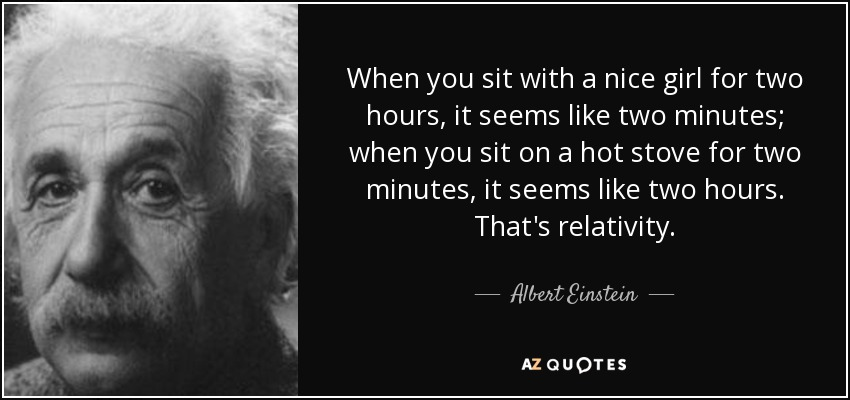
Einstein didn’t actually say this [3], and it isn’t the correct interpretation of relativity. But the statement does capture the essence of temporal experience: it’s contextually relevant. A more scientific statement, though, is that *the subjective perception of how fast or slow time is depends on how often things change. *
Let’s say you have a mechanical clock in front of you, and the second hand is ticking away. In the eyes of a tortoise, this second hand is moving twice as fast as in our eyes. If you could experience the turtle’s perception, you would see the second hand as if you were watching a video played at double speed. This is because the turtle’s frequency of movement is slow, so it looks at everything as if it were moving fast, and it feels that time is flowing at high speed …… So although the turtle has an objectively long lifespan, it doesn’t actually experience a long life.
And in the eyes of a fly, the ticking of the second hand is four times slower than we feel. When you try to swat a fly, as if it were a martial arts movie, the fly feels like you’re doing it in slow motion. So the fly’s objective lifespan is short, but the lifetime it actually experiences is not.
The speed of time perceived by an animal depends on the frequency of its movements, which is an adaptation that has evolved. Since the tortoise doesn’t have the same quick reflexes as the fly, there’s no point in wasting its energy in perceiving the variable details of the world; it chooses to fast-forward through the playback.
The same is true for people. When things around you are changing rapidly, you feel that time passes more slowly, and a day seems to pass through a long time; whereas if nothing is changing around you, and you’re just going about your routine, you feel that time passes quickly.
The more fundamental reason is that the frequency of change is stimulating a shift in attention. With a high frequency, your attention is constantly aroused, one moment you pay attention to this, the next moment you pay attention to that, and your perceived time is slow.
There are experiments that prove this claim. If you are shown a series of pictures, if those pictures are repeated, you will feel that the time passes quickly if you look at them for a while; if you add a few unexpected and different pictures to the series, you will report a longer perception time. This phenomenon is called the “oddball effect“.
Confronted with an angry face, you feel that time passes longer than looking at a calm face. A minute with a spider feels longer than a minute with a butterfly. This is because threatening signals, like novelty, stimulate your attention to a greater extent.
✵
This is why people feel like the days go by the slowest when they’re teenagers. Between the time you go to elementary school and the time you go to college, every year is new to you, and you’re always doing things you haven’t done before. But after work, if you’ve been in the same environment for twenty years, it feels like it really goes by in the blink of an eye.
But even in adulthood, if you experience a big fall in one fall, people lament that it’s been such a long season. But most of the time we go to work for a routine and leave work for an uneventful day, and before we know it our hair is gray.
For example, if you think about the recent AI wave.ChatGPT only came out in November 2022, and it’s only been more than half a year since then; GPT-4 was only released on March 15, 2023, and it’s only been a little more than three months now……. But because of the endless stream of new apps, papers, and tutorials that accompanied them, it feels like we have already been a long time.
So if you want your days to be slower and more fulfilling, you should add some wonder and adventure to your life and explore new things more often - it’s a waste of life to live by the same rules for decades.
✵
Here’s the key question: does time go faster or slower when you’re standing in front of the baggage carousel, bored and waiting for your luggage?
It stands to reason that it’s a static environment and you have nothing to do, so it should feel like time is getting faster, but it’s not. There is another mechanism at work here.
When you’re routinely doing something, you feel like time is going by pretty fast, and that’s because you at least have something to do and a place for your attention to rest. But when you have nothing to do and are purely waiting and bored, you are actually in a state of high arousal on a physiological level. The brain can’t stand to be bored and commands you to find something to do. Your attention is constantly being aroused, you want something to do and you can’t find anything to do, so you’re ruminating as if you’re going through a lot of things, and you feel a kind of pressure. It is very difficult for you! Not only is it not a quick time, but it feels extraordinarily long. That’s probably why Kevin Kelly says, “When you make people wait for you, they start thinking about all your flaws.”
Statistics show that you overestimate your time by a third when waiting in line. If you’re waiting for the bus at work and it doesn’t show up when you get there, for every minute of delay, you feel the equivalent of sitting in the car for two or three minutes. In a café, the time you feel like you’re waiting for your bill is longer than the time it takes you to actually drink your coffee.
Waiting makes time feel like it’s going by slowly, and perceived wait time is a better predictor of customer satisfaction than actual wait time, so we must improve the waiting experience.
✵
The idea is actually pretty intuitive - don’t make customers wait, find them something to do that distracts them and immerses their attention, rather than changing it around.
The earliest design for waiting appeared in the 1950s, when a floor-to-ceiling mirror was placed in an elevator so that people could look at themselves as they went up and down without having nothing to do.
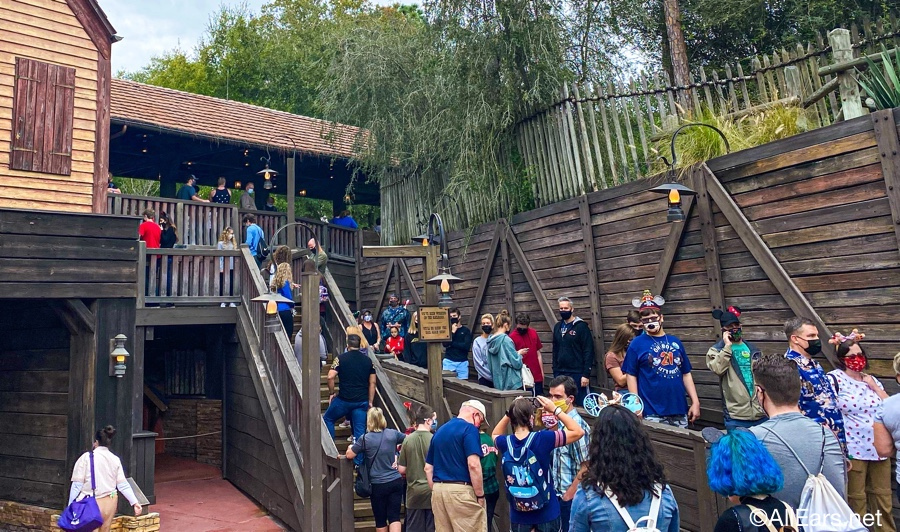
The contemporary ‘wait time design expert’ is Disneyland. You will definitely have a feeling when you visit Disney parks that most of the time you are actually not playing those items, but queuing up. Some of the popular rides have queues of over two hours. Just listening to this number you would think, who would want to go to Disneyland? That’s why Disney has to address the queuing experience.
The way to do this was to turn the lines into some sort of game as well. Disney mandated that every one of its employees had to be an actor at the same time, possibly playing an animated character of some sort, to interact with visitors at all times. While you’re in line, the story actually begins; you’re participating in a story, not just standing in line. Disney has also designed the queue route beautifully so that you are already in the scene; the line visually feels shorter. The queue discharges the sense of amusement, discharges the entertainment value, and that time is not as uncomfortable.
Similarly, the Eurostar high speed railroad takes the ride and makes an experience out of it. It has a section of the road is through the English Channel undersea tunnel, the window was originally no scenery, passengers dry sitting. 2017, Eurostar came up with a project called “Odyssey (Eurostar Odyssey)”, passengers wear virtual reality glasses, the train immediately became in the underwater world through, you while enjoying the scenery of the seabed can also be done at the same time a game! –
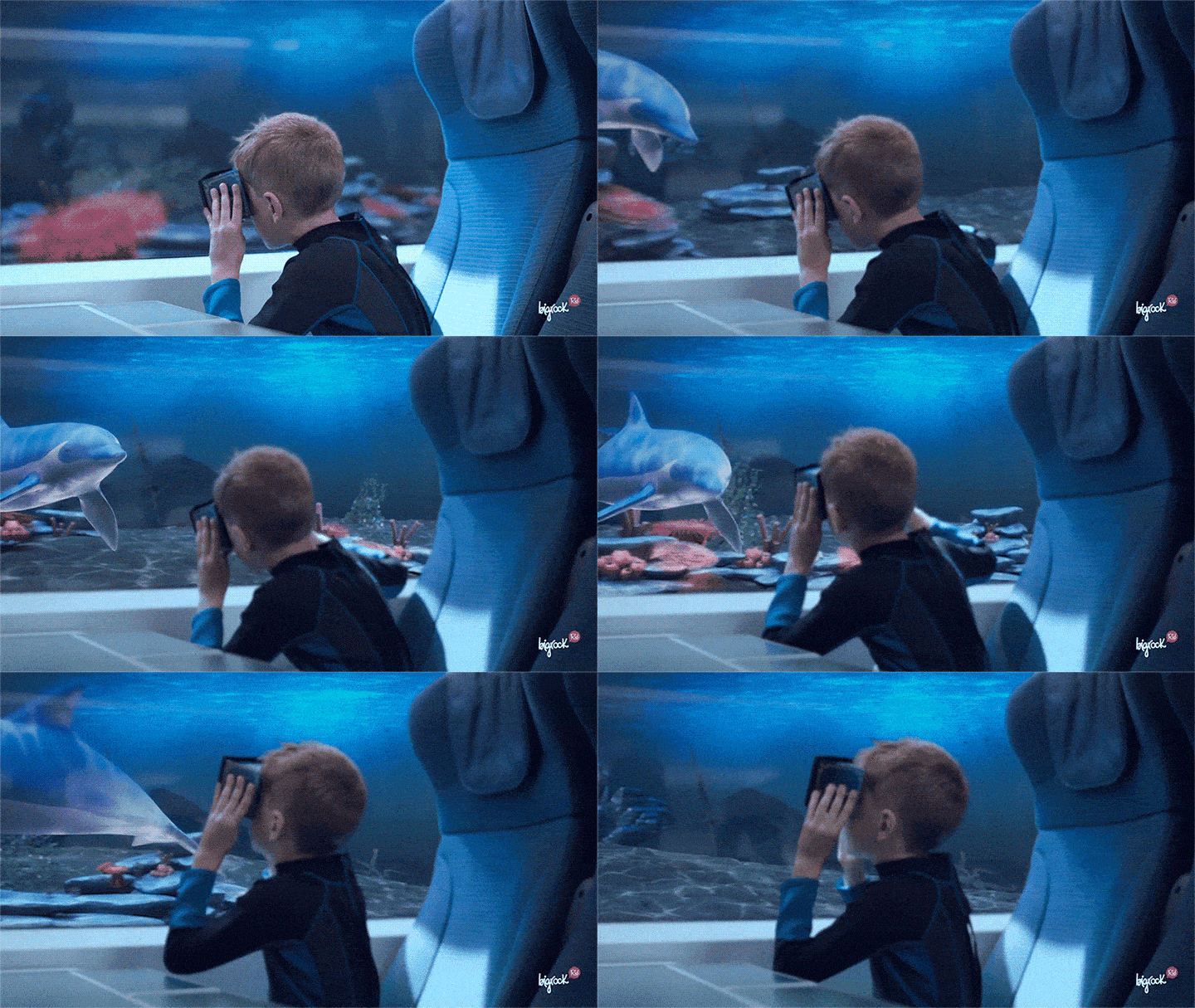
The law is that staying idle, doing nothing, drying out, etc., is the most intolerable experience for the brain; converting idle time into occupied time improves the experience without changing the length of time.
✵
Of course now that everyone has a cell phone to play with, our tolerance for waiting has probably increased as well. I remember a few years ago when the US Tea Party staged a protest sit-in in DC, and the government found that an effective means of calming the protesters was …… providing free WiFi.
In summary: *Modern consumers are buying experiences in everything they buy. The key to business is experience, and the key to experience is memory. People don’t care much about objective facts, people care more about subjective feelings. *
Annotation
[1] Don’t Trust Your Intuition 6: Engineering Happiness (End)
[2] Kahneman, D., & Riis, J. (2005). Living, and thinking about it: two perspectives on life. the Science of Well-Being , 284-305.
[3] https://www.history.com/news/here-are-6-things-albert-einstein-never-said
Highlight
- the subjective perception of how fast or slow time goes depends on how often things change.
- Waiting makes time feel like it’s going by slowly, and perceived wait time is a better predictor of customer satisfaction than actual wait time, so we must improve the waiting experience.
- The key to business is experience, and the key to experience is memory. People don’t care much about objective facts, people care more about subjective feelings.