Evolutionary Ideas 6: No Money for Loyalty

Evolutionary Ideas 6: No Money for Loyalty
In this age of total information and socialization, not only do consumers know merchants very well, but merchants know consumers very well. You better know who is buying your product.
A large portion of the sales of branded products is contributed by ‘loyal customers’. For example, Coca-Cola has a statistic that found that 1/4 of its annual sales are contributed by 4% of its customers.
There is also a law of two or eight: most people will buy once in a while, but a small number of people will buy a lot and keep buying your product, and these are your loyal customers. You don’t want a one-shot deal with your customers, you want them to come back next time, and you want them to make a habit of it, preferably. Brands need to have their own loyal customers, the so-called hardcore fans, if they want to stand.
So how do you have more loyal customers? One common approach is membership. In the past, when we say “subscription”, we mean subscription to newspapers and magazines, but now you can subscribe to an online video service, or even to a certain kind of goods, such as a certain brand of milk powder. Hairdressers, cafes, gyms all want you to become a member and offer you some kind of discount.
But Sam Tatum, author of the book Evolutionary Ideas, argues that handing out monetary rewards to customers in exchange for loyalty out of thin air isn’t very effective. People aren’t going to be more loyal to you for so little money. Loyalty, it’s a psychological phenomenon.
**The topic of this talk is how to increase loyalty without increasing rewards.****Loyalty comes first from sunk costs.**You continue to be loyal to a brand because you are already loyal to that brand. For example, why would someone with an Apple cell phone stay with an Apple cell phone? Maybe it’s become an identity for you, or maybe it’s because you’ve gotten used to it: all your various data and frequently used tools are on Apple’s system, and it would be a pain in the ass to replace them.
Using behavioral science and evolutionary psychology, we can start with sunk costs to increase customer loyalty. Let’s talk about three methods in this talk: commitment, goal gradient and variable rewards.
✵
- The first approach is ‘commitment (commitment)’. *
The Republic of Palau is an island nation in the Caroline Islands. It is very small in size and has the seventh lowest GDP in the world, and its main industry is tourism. Palau is indeed a very beautiful place, but tourists from all over the world often do not pay attention to protecting the environment or respecting the local culture, and the government of Palau has no ability to enforce the law, which is tantamount to exchanging environmental pollution for a little income ……
Later, they came up with a way to let every tourist who comes to Palau sign a pledge as soon as they land: I promise to protect Palau’s environment and respect the local culture. It had to be signed in person. This initiative cost next to nothing, and Palau lacked the capacity to monitor it, but it worked.
That’s because people do demand commitments they have paid for. Our column has spoken before about what David Brooks, The Second Mountain, says about promises [1], that they give you an identity: fulfill them and you are still yourself; break them and you feel a sense of pain.
Studies have shown that having students sign an honor code before the test begins, signing a promise not to cheat on the test, can really reduce cheating significantly. The act of “signing” is especially effective because people value their handwritten signatures - typed ones are not as effective as handwritten ones. The closer you are to yourself, the more powerful your commitment will be. In ancient times, there were blood oaths, and that kind of commitment is certainly more effective.
In fact, the word “commitment” does not only mean verbal assurance, but also means “to commit to something”, a kind of “dedication”, “I will do it”, “I will do it”, “I will do it”, “I will do it”, “I will do it”, “I will do it”, “I will do it”. It is a kind of dedication, the energy that I must make this happen. Commitment does not have to be a big thing, businessmen can use some means in the daily small things to create a sense of commitment to you.
For example, you go to a coffee shop in the morning to buy breakfast and coffee, there are a lot of people in the queue, and you feel that the queue is moving very slowly after a while, so you may want to leave. Well there is a coffee shop that has come up with a solution for this.
As soon as you see a lot of people queuing outside, the store will send a waiter to write down what each person in the queue wants to order, and give you the lid of a coffee cup as a voucher. Note that this is just a note, and does not charge; when you get in line, take the lid as a voucher to pay the bill.
The cafe doesn’t actually need to use this to speed up the order process, it’s perfectly fine to take orders in the store - the real purpose of handing out cup lids is to get you to make a commitment. You take someone’s coffee lid, you have a strong desire to get this done, and you’ll have a hard time leaving.
Someone did this in India. Some families don’t pay much attention to vaccinating their children, especially since some vaccines require two shots, and many people don’t come back after the first shot. The organizer came up with a solution: give the vaccinated children gifts, some small animal toys.
But there was a catch: the toys were divided into two halves. After the first shot, only one half was given; to get the other half, you had to come back for the second shot. It’s also a commitment: you want to get this done.
✵
- The second approach is called ‘goal gradient’. The psychological mechanism for this is that we always think something is more important the further back we go. *
For example, there’s an experiment that goes like this. Two people play a coin toss game. If they both toss heads or tails, they share a $1,000 reward; but if they toss differently, there is no reward. The two people flip in order of precedence. By definition this is purely random, and it doesn’t matter who flips first or second.
However, the experiment found that when the two people tossed out different results and could not get the bonus, people tended to blame the person who tossed the coin after them. He had already flipped a heads, so why couldn’t he have flipped a heads as well? People instinctively feel that the later toss is more important.
The simplest example of this is the 4×100 meter relay run in track and field. Think about it: do you always feel that you should put the best in the team, the star athlete, on the last leg. This does not really make sense, because everyone running is definitely giving it their all, and it has nothing to do with which baton. But psychologically, we feel that the last baton is the most important. Maybe you feel that the more you get to the end the more you can reach your maximum potential.
One year in the Olympic Games, world record holder Bolt was placed second by the Jamaican team and people were very surprised.
We tend to think that things should be done the further back and closer to the goal the harder we work - this is called the goal gradient.
How do you utilize this mechanism? That is, to make someone work harder, you have to make him feel that he is approaching the goal.
As we said earlier, many cafes have reward programs like buy 10 get 1 free. You’re issued a loyalty card, you buy a cup of coffee the clerk puts a stamp on the card, and when you collect all 10 stamps you get a free cup of coffee. Studies have found that the further back the card is punched, the more often the customer buys! Do you see how this is like running, where people speed up when they are nearing the end.
Then someone took advantage of this and did an experiment. A car wash customer was given 300 loyalty cards, half of which were for 8 car washes in exchange for a free car wash, and the other half were for 10 car washes in exchange for a free one - but the card had been stamped twice for you first. So in theory, both cards are buy 8 get 1 free, it’s just that the second card is nominally two steps in the buy 10 get 1 free process already.
It turns out that 34% of the people in the buy 10 get 1 free plus two stamps group ended up completing the process of obtaining the rewards; while the buy 8 get 1 free group only had a 19% completion rate.
This is known as “the endowed progress effect”. Making people feel like they’ve made progress - even if it’s a false one - gives them a stronger incentive to get things done.
A more common use of the goal gradient is to remind people of the progress they’ve made, i.e. to give them a ‘progress bar’. For example, if you’re flying, especially internationally, the screen will often tell you how long you’ve been flying and how much longer you have to go before you get to …… A progress bar can bring you comfort. Any software product manager understands that actions like downloading must be given a progress bar – in fact, that progress bar is often inaccurate, but it doesn’t matter, we get comfort.
Commitments and goal gradients both use your past to influence your decisions about the future, and are essentially sunk costs. You could actually turn around and walk away regardless of how much you’ve already done ahead of you, regardless of the lid the cafe gives you – but you usually don’t do that because you want to be a person who has a beginning and an end.
The next method, instead, is to make you not want to leave because you’re so caught up in the thing.
✵
- The third approach is called ‘variable reinforcement of rewards (VARIABLE REINFORCEMENT)’. *
Our column has talked about ‘Behavioral Design’ and ‘How to play the God of Destiny’ before, and we know that the secret of gambling addiction is to randomize the rewards. One point of hard work and one point of reward will make you stick to one thing, but sometimes hard work with no reward, and then no hard work with a big reward in the next second, will make you addicted. Here’s why.
The area of the brain responsible for feeling reward is the nucleus ambiguus. Research has found that the maximum activity in the nucleus ambiguus is not at the moment of getting a reward, but at the moment of expecting a reward. Variable rewards lead to the anticipation of surprises, and you enjoy that anticipation immensely.
For example, if you’re going on a vacation to a distant, exceptionally beautiful place, and it’s scheduled a month in advance, then you look forward to it for the rest of the month. But if you are told today that you are going on vacation tomorrow, you have less fun with anticipation. And the most fun to look forward to is a reward with some uncertainty.
PepsiCo has a brand of potato chips called Doritos, and it comes out with a chip called Roulette, which is especially good for eating with friends at a party-
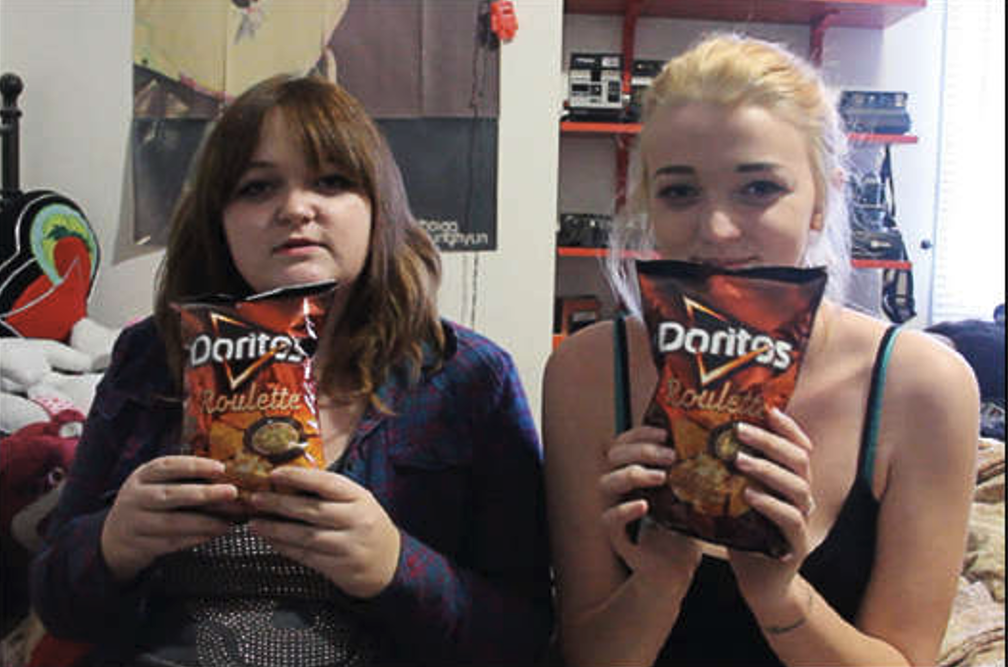
Because it the chips in this bag all look the same, but a few of them are super spicy. You guys are eating this bag of chips like you’re playing Russian roulette, and you don’t know when someone is going to suddenly eat a super spicy one and make a fool of themselves. The Doritos Roulette bag became an internet sensation as soon as it came out.
There are businesses that make flat chocolates in the shape of irregular chunks, so you can break them randomly, sometimes you can get a big piece, sometimes a small piece. Not to mention that kids’ snacks nowadays often come with random little toys, such as placed in chocolate eggs, and children are looking forward to opening the egg to what’s inside. There’s also a coffee shop that changed its buy 10 get 1 free loyalty program to have employees randomly give customers a hot drink …… Some people decry the practice as unfair, saying that in fact it’s the more attractive-looking people who get the free coffee, but I think it just makes people want to go to the store and gamble on their attractiveness even more.
In fact, all of these have the connotation of gambling …… and it just shows that “gambling” is a human nature that is older and more basic than gambling.
✵
Overall, these methods are more interesting and probably more effective than just giving you a few percent off a reward.
An interesting question is, are these behavioral and evolutionary psychology effects contradictory to traditional economics? Economics assumes that people are rational and should be more profit-oriented; is it irrational for a consumer to be loyal to a brand because of sunk costs or something like that? I don’t think so.
Tatum’s book doesn’t say, but I think all of these behavioral tools have a default premise, which is that the product or service itself has to be up to par. Consumers have already recognized the quality and price, now it’s just a matter of whether they can prioritize you, buy more, and come back for more next time. If your product quality and price, these means can not overcome the rationality of consumers.
It is because the market is highly developed, the quality and price of each brand is good, the traditional competition space is no longer very large, businessmen began to think in the ‘user experience’. At this time, consumers are not only buying a product or a service, but also buying an experience.
This seems very rational to me. This is the advanced stage of business competition.
Annotation
[1] The Second Mountain 2: A Thousand Pieces of Gold
Highlight
- consumer loyalty comes from sunk costs.
- there are three ways to increase loyalty without increasing rewards: promises, goal gradients, and variable reward reinforcement.
- There is a default premise for using behavioral tools: the product or service itself has to be up to par.