Evolutionary Ideas 2: Checklist of Sets
Evolutionary Ideas 2: A List of Sets
We move on to Sam Tatum’s book Evolutionary Ideas, and this talk is going to set the theoretical framework for the entire book.
If you have a good eye, you will find sets everywhere in all kinds of everyday economic behavior.
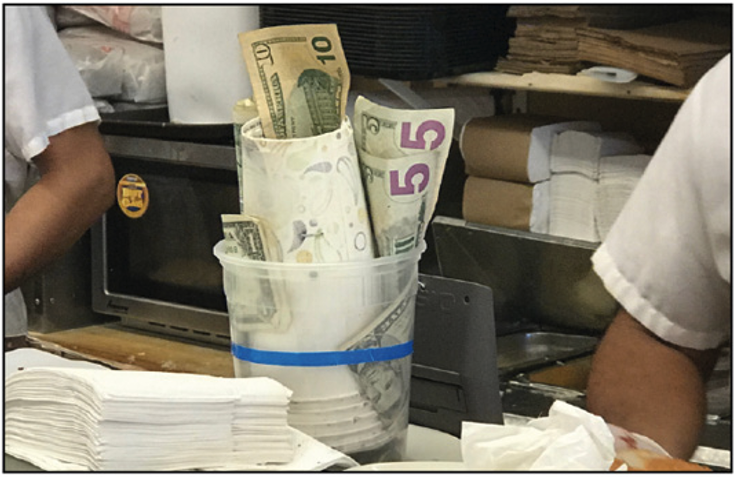
The picture above shows a tip jar from a deli in New York City with a few dollar bills in it, a $10 one and a $5 one and a $1 one. It’s a reminder that you can tip while you’re with us.
Please note that these bills on the tip jar are not randomly placed. The person who placed them purposely used a couple of paper cups to place a $10 bill at the highest point, and the whole visual effect is to direct you to look at them from the top down, with two upright $5s in the center, and then finally two $1s stacked on top of each other. This is the use of the psychological “anchoring effect (anchoring)”, suggesting to you that giving 10 yuan is the most honorable and giving 5 yuan is the most common ……
Look again at the picture below of a cafe in Sydney that has a customer loyalty card plastered all over the walls. With this card, you collect one point for every coffee you drink, and when you collect 7 points, you get a free coffee. This cafe puts the loyalty cards of their regular customers right on the wall so you don’t have to worry about forgetting your card. This thoughtful service is all about taking care of customers, right?
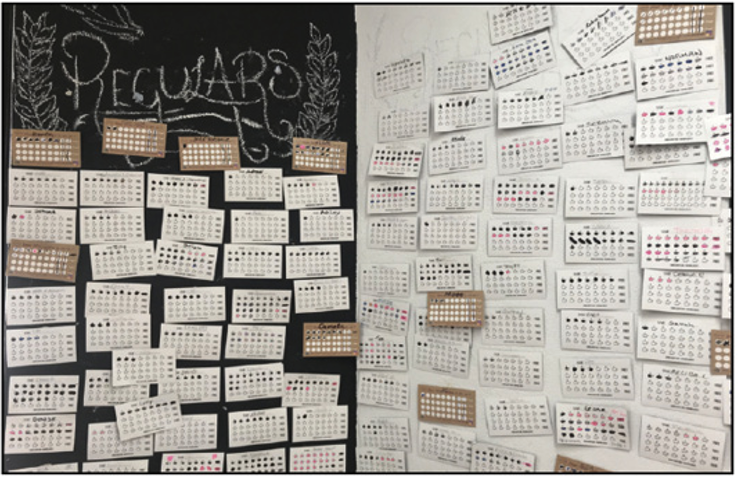
This trope is called ‘Social Proof’. The message the coffee shop sends by displaying a loyalty card is look, I have so many loyal customers, we are popular.
These routines have been played so skillfully that psychology has become an engineering discipline.
✵
Traditional psychologists care about why you’re depressed, some of the newer generation of psychologists care about how to change people’s perception of the value of this product without changing the price of the item. The thing is still the same thing, how do you make it more worthwhile?
Two ways. One is to emphasize scarcity and have limited purchase, or limited time sales. The other is the social recognition we just talked about: emphasize that this is something everyone is buying now. If you can convey a message like scarcity and social identity to consumers, people’s perceived value will increase.
Someone once called Campbell’s soup canned goods (Campbell’s soup) to engage in a limited purchase promotional test, in different stores randomly divided into three groups: a group is not limited to buy casually, a group is limited to 4 cans per person, a group is limited to 12 cans per person. The result of the experiment was that the 12-can limit approach sold the most.
This may be because canned goods are good for buying more than one at a time, and the number 12 also acts as an anchor, making consumers think that buying that many is the most appropriate.
Don’t look at this method as old-fashioned, but it’s very effective. Tatum has done a consulting project to help a client with a promotion, he simply made a strategy of limiting the number of cans to 4 per person, and the product immediately sold very well, with sales rising by 56% over the entire promotion period.
The reality is that even if you know it’s a merchant’s scheme, you’ll probably still get hit. Why?
✵
The human brain contains roughly 100 billion neurons that are intricately connected to each other, so it’s safe to say that the brain is a very powerful thinking machine, and it receives 11 million messages at any given time ……
Note, however, that the maximum amount of information we can consciously process at any given time is 40. This means that we have to pre-process and compress the information we receive before we can become aware of it. This compression and pre-processing process is actually very intelligent - for example, when your hand touches a hot stove, it rushes to pop off on its own, right? This process is automatic, solved at the preprocessing stage, and does not require, nor should it require, conscious judgment by the brain.
This is called fast thinking. Daniel Kahneman’s “System 1” in his book “Thinking, Fast and Slow” is this kind of fast, intuitive, automatic thinking judgment, also called “heuristic”. System 1’s judgments are sometimes wrong and are called ‘thinking biases’. System 2, slow thinking, on the other hand, is conscious, more deliberate thinking, suitable for logical reasoning.
You might think that the ideal situation would be for System 2 to command System 1, which in the words of social psychologist Jonathan Haidt would mean that System 1 is the elephant and System 2 is the rider, who directs the elephant forward. But in fact the elephant has its own ideas, for example, if the elephant sees a tasty treat next to it, it may go straight there without listening to the command; the rider rides the elephant to the edge of the cliff, and the elephant will automatically keep its distance from the cliff.
The key perception here is that it is the elephant, not the rider, that really controls our daily lives, and that our days go so smoothly thanks to System 1.
:: When you hear a loud bang, you jump because there’s a good chance there’s real danger;
Seeing everyone else going for it, then you go too, because there’s a good chance there’s a real benefit;
If you see that there is just one of a certain item left on the shelf, you will be tempted to rush to get it, because it is likely to be really in demand;
There is a Chinese saying “if you want to take something, you must first give it”, psychologically this is called the principle of reciprocity: if other people are nice to you, you want to be nice to other people, and that’s really the way it should be, otherwise how are you going to live in a group?
There is an English proverb that says “a bird in the hand is better than two birds in the bush”, we prefer the certainty of immediate benefits to the uncertainty of the future, which makes sense because there is no concept of property in the long history of mankind, food goes bad and can be robbed if it is left for a long time, the best thing to do with a good thing is to eat it yourself first ……
These heuristics are really just various thinking shortcuts that the brain has developed over the course of evolution, adaptations, good ideas that have evolved, things that are built into the brain as soon as it leaves the factory. So of course you’re going to eat this up. Behavioral science, that is, uses these ingrained minds to set you up.
Of course, in the modern world, these heuristics may work against you, because the modern environment is very different from the primitive environment to which our brains have been adapted throughout our evolution. The most obvious is that now you can save money, and saving money can make your tomorrow better, so the old mindset of just-in-time enjoyment is problematic.
But the big picture of this is that the heuristics of System 1 are far more helpful than wrong. And we can use those heuristics to make better choices. There used to be a very famous book called Nudge that talked about this.
And the point of Tatum’s book is that *all these heuristics can be compiled into a TRIZ-like system into checklist, manual, systematic solutions. *
✵
To skillfully invoke this system, you first have to know the names of the various mental phenomena. There’s an interesting pattern to this; when you don’t know it’s a psychological trope, you don’t see it; but when you know its name, you realize it’s everywhere. And it affects your thinking and your actions.
It’s important to be able to name it.
For example, in Chinese and English, dark blue and light blue are both blue, and we don’t think they’re strongly different; whereas in Greek and Russian, dark blue and light blue are two completely different words for two different colors. Then experiments show that Greeks and Russians are much more sensitive to dark blue and light blue than English speakers.
What’s more, we know that English has ‘tense’, which expresses the future and the present very differently; whereas Chinese has no tense, and both the future and the present are spoken of in the same way. Reflecting this, people in the English-speaking world are less likely to save money and more likely to want to have fun in time, because for them there is a clear difference between the future and the present. Why do Chinese people love to save money? Maybe it’s because linguistically the future and the present are equally important ……
Therefore, the TRIZ system of psychology should firstly name the various psychological phenomena, and you will recognize them, and then do things in order to have the rules.
And it’s very important to have rules and regulations.
✵
In 1999, Israel ran a print advertising competition that was so successful that 200 ads won awards. Researchers found that 89% of those 200 successful ads could be explained by six creative templates: they all used one of six fixed advertising routines, consciously or unconsciously.
For example, one trope is called ‘Setting Extreme Circumstances’: to prove that a Jeep has all-weather driving ability, have it drive on snow …… Many of the successful ads used this trick.
The researchers also looked at the unsuccessful ads, and found that only 2.5% of the unsuccessful ads matched one of the sets in the template.
This finding is very, very important. Successful people are similar and have rules to follow; failures have no rules and are each failing in their own way. This is particularly good news for us, showing that success can be learned!
An advertisement is not good, a promotional tool is not useful, not random, not patting the head of heavenly inspiration, there are rules to follow, there is learning. Because of this, your learning is meaningful, your experience and expertise is valuable.
- Do not pursue the whimsical, to pursue the rules. *
As we’ve said many times, there is a ‘hero’s journey’ template for storytelling and writing, and even academic papers can be written as hero stories [1]. So you’re saying it doesn’t feel trite? The key is that you have to be able to package it.
Some people have deconstructed the novels of Agatha Christie, the famous British detective novelist, and found that she almost always uses a fixed formula - a dead body is found, detectives come to examine the crime scene, collect clues, interrogate the suspects one by one, and finally find the murderer, who is the one you suspect the least in the beginning.
But Christie puts a different spin on the template each time, so you still find it fresh.
Creation may be able to go beyond chapter and verse, but not out of it.
✵
Tatum lists a variety of routines in her book, all utilizing some sort of bionics or thought patterns inherent in the mind.
There is the owl butterfly, which has evolved a pair of predator eyes on its wings. When the predator sees the eyes, it mistakes the butterfly for another predator and is deterred from attacking it.

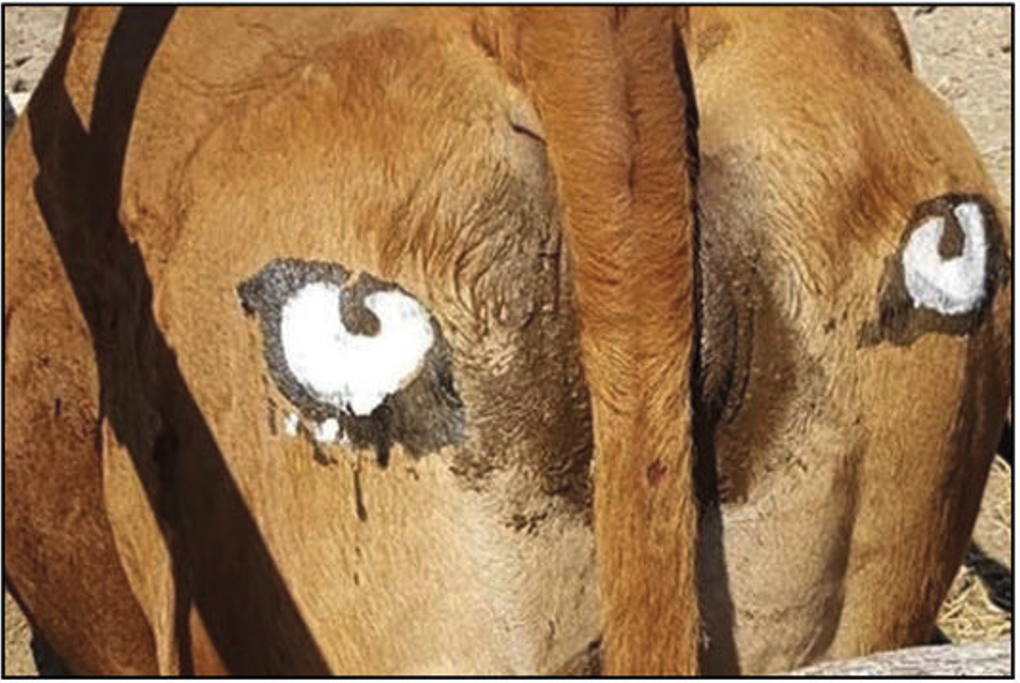
In 2020, there was a project in Botswana to paint a pair of eyes on the buttocks of cows raised by local herders in order to prevent them from being eaten by lions and leopards …… As a result, those predators really did come to eat the cows even less.
Have you noticed? Eating Delta Pizza and buying a BMW have two things in common. One is that both are customizable; you tell the store what toppings you want on your pizza, and you can specify the configuration of the car beforehand. The other is that you can track the entire process of when the order is placed, when it’s made and when it’s delivered.
Both practices are perfectly in line with behavioral science. Customizing the product yourself is the ‘IKEA effect’, the IKEA furniture store that is IKEA, and studies have shown that allowing customers to be involved in the making of the product increases the perceived value of the product. And allowing you to track the progress of the product throughout the process is called ‘operational transparency’ ……
✵
It seems like the lessons of sales have been everywhere for a long time. There’s even an argument that these psychological effects are more important than the technology of the product, because in today’s day and age, sales are more important than product performance.
Think about whether that’s true or not. Sometimes you really have a hard time saying just how much people buy things for practical purposes and how much for emotional needs ……
What follows is a book that teaches you how to use behavioral science in five ways -
strengthening trust without changing the facts;
helping to make decisions without limiting choices;
Trigger action without forcing a response;
increase loyalty without increasing rewards;
improve the experience without changing the timing.
Let me explain each of these.
Commentary
[1] Elite Day Class Season 1, Answer to Reader’s Question 丨How to tell a good story?
Highlight
- The routines used by merchants have been evolved built into our brains.
- All System 1 heuristics can be compiled into a TRIZ-like system into checklists, manuals, and systematic solutions.
- Successful people are similar and have rules to follow, while failures have no rules, and each has its own failures. This shows that success can be learned, do not pursue the whimsical, but the pursuit of the rules.