Don't Trust Your Instincts 6: Engineering Happiness (End)

Don’t Trust Your Intuition 6: Engineering Happiness (End)
This is the final talk in Seth’s book Don’t Trust Your Intuition, where we talk about pleasure.
Let’s start by identifying the concepts. The words “joy” and “happiness” are often used interchangeably, and both correspond to the English word happiness, but they can be differentiated in certain contexts. The word “happiness” we are talking about in this talk is also the word “happiness” in Seth’s book, which refers to the feeling of pleasure and fulfillment that doing a specific thing brings you. The question that asks if you are happy is whether you feel happy at this moment.
Happiness, which is different from happiness, is more accurately known as well-being, which refers to a sense of satisfaction that lasts for a period of time, and is a comprehensive evaluation of your quality of life. When you ask if you are happy, you are asking about your life as a whole.
The key for research is that happiness is a stable variable: ask you now, ask you again in an hour, ask you again in two days, and you’ll give the same answer. Happiness, on the other hand, is a variable that changes from time to time. Maybe you were happy just now when you were talking to your friends and telling jokes, and then you’re not happy an hour later when the Chinese team loses a game.
Okay, the concept is clear. We are not going to study happiness in this lecture, we are only going to study joy.
What are the things we do that make us happy? How do we increase our happiness? There is a lesson here.
✵
There’s a multi-person collaborative mega research project called Mappiness that used objective methods to count the extent to which doing various things made people feel happy. Subjects had an app installed on their phones that would pop up randomly a couple times a day and ask you three questions:
what are you doing at this moment in this matter?
who are you with?
how happy do you think you are right now? Score on a scale of 0-100.

And so it took a couple years for the researchers to collect more than 3 million measures of happiness from more than 60,000 subjects. They divided all the activities into 40 categories and counted exactly how much pleasure each category brings us. Let’s look at the results–
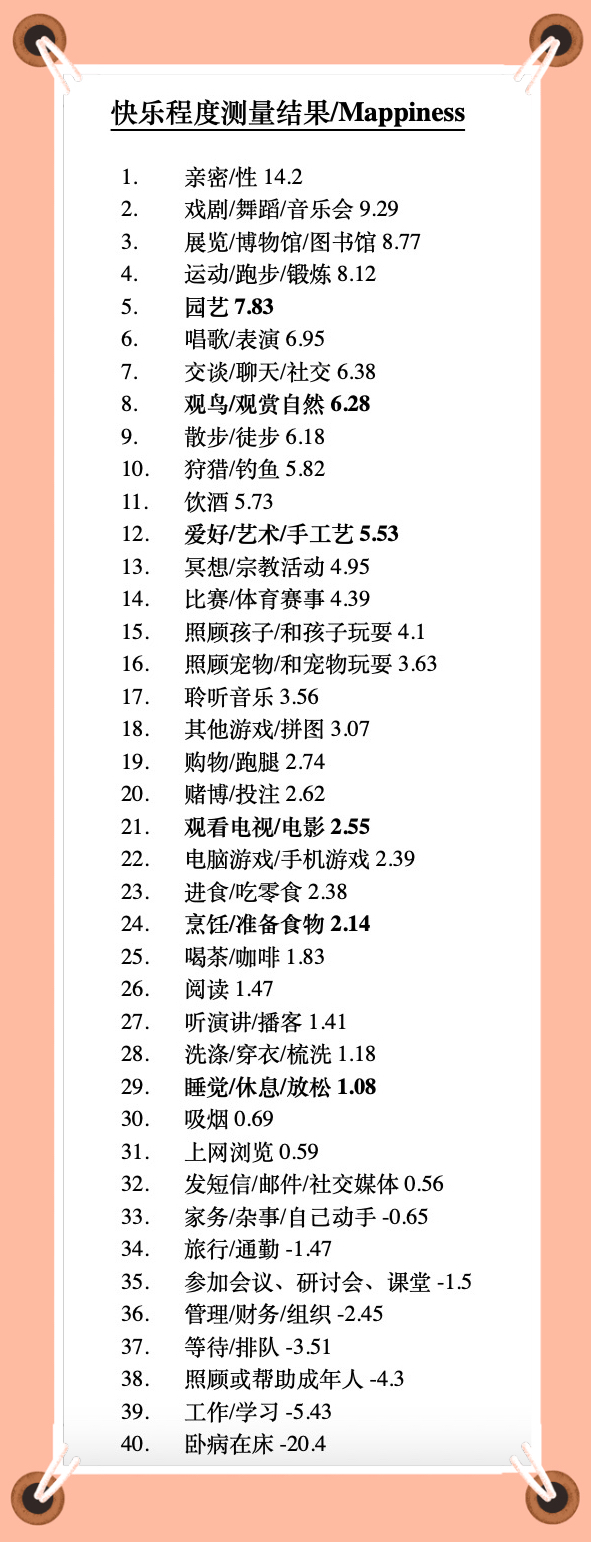
The 40 categories are ranked in order of pleasure, and the score for each item is the difference in scores relative to “doing nothing”. If the score is positive, it means that doing this thing is better than doing nothing, it can be said that it brings you a certain amount of happiness; if the score is negative, it means that it brings pain.
The most pleasurable of all things is sex, with a score of 14.2, and the second most pleasurable is going to the theater to see a play, dance, or concert, with a score of 9.29. The least pleasurable thing was being sick in bed, -20.4 points, followed by work and study, -5.43 points.
These are by far the most objective and accurate statistics we can know about what makes people happy. You’ll immediately notice that some of these items don’t score the way you think they do; don’t worry, chances are you’re thinking wrong.
✵
People are actually not very good at assessing whether they are happy doing something. That’s because we usually estimate whether it’s fast or unhappy after the fact or before the fact of that activity, either by recall or prediction, and that’s both pretty inaccurate.
For example, if a person is being evaluated for tenure, and you ask him how much the matter of whether or not you get a professorship affects how happy you will be in the future? He might say that getting tenure will make me happy from then on, and if I don’t get it, I might be very unhappy thereafter.
Yet when the results come in, and you examine a number of such people in real time over a period of time thereafter, you’ll find that those who got tenure and those who didn’t were about equally happy. People are still happy when they should be, and still unhappy when they should be.
Studies have shown that events like career advancement, breaking up with a loved one, or a politician you dislike coming to power do not have a long-term, significant impact on happiness. It’s the things you do every minute of every day that determine whether you’re happy or not.
So you say predictions are bad, so memories are always okay, right? If you just experienced this not too long ago, you should always remember how happy or miserable you were. Well, not really. You may have heard of the so-called “peak-end rule,” which we talked about in our column [1].
When we recall an experience, we don’t evaluate it based on how we felt at each moment of the experience, or even how long or short the experience was. Rather, we evaluate it based on its “peak” and “end” - that is, how happy it was at its highest point, or how painful it was at its lowest point, and how it felt near the end. For example, if you think about your high school life, do you remember only those few points.
Memories and predictions are inaccurate, which is why the study of Mappiness is so important.Mappiness is asking you, live, while you’re doing it, if you’re happy. That’s the truest feeling.
In order to maximize the experience of true happiness, we should use the results of the Mappiness study as a guide to plan activities. Seth even suggests printing this ranking table on your phone case and checking it later before choosing whether to do something or not ……
✵
There are five activities in the Mappiness ranking that are commonly underestimated in terms of how enjoyable they are -
going to a museum to see an exhibit, 8.77 points
playing sports, 8.12 points
Drinking alcohol, 5.73 points
gardening, 7.83
shopping and running errands, 2.74 points
Most of these are activities that require you to be “on the move” and active.
The pleasure level of the other five activities is overestimated; we think we’re happy doing them, but we’re not–
sleep, rest and relaxation, 1.08 points
computer and cell phone games, 2.39 points
watching TV and movies, 2.55 points
Eating and snacking, 2.38 points
Browsing the Internet, 0.59 points
These are all relatively sedentary activities that don’t consume much energy.
Maybe it’s because we’re usually always a bit tired and don’t want to move, we tend to think that activities like lying in bed and playing with our cell phones will be pleasurable, but in reality you don’t feel so happy actually lying down and playing. We tend to think that going out to an exhibition or something will be a hassle, but you’re actually on the road and you actually feel happy.
*The lesson is that we should do more things that are more proactive. *
✵
Living conditions are getting better these days, especially with the digital economy giving people tons of free entertainment, but the reality is that people are generally unhappy. At any given time surveys are conducted, the number of people who say they feel happy is only about 30% of the total population.
Why aren’t people getting happier?
- One reason is not ‘living in the moment’. *
Many people live in the past or the future all day long. If you don’t enjoy the food when you eat, but keep thinking about tomorrow’s work; if you don’t enjoy the scenery of nature when you take a walk, and you’re thinking about the performance of yesterday’s speech, then you are definitely not happy.
Someone has done a study, in addition to asking what you are doing, happy or not, but also asked one more question: are you thinking about something else? It turned out that 46.9% of the time, we are doing one thing while thinking about another. The researchers summarized this by saying that “a person’s mind is a wandering mind, and a wandering mind is an unhappy mind.”
This is why everyone should learn some ‘Mindfulness’. Positive Mindfulness allows you to focus on what’s in front of you, you’ll find more beauty in your life, and you’ll be happier.
✵
- The more important reason so many people are unhappy is because we don’t spend a lot of time being happy. *
The average American spends only two hours a day doing the happiest kinds of activities, including social conversation, gardening, meditation, and the like; whereas, in addition to sleep, people spend roughly eight hours doing some of the least happy activities, such as work, housework, commuting, and those kinds of things. From 2003-2019, people’s real incomes increased, but the time spent on the happiest activities decreased.
So where did all that time go? Mainly to work. Many people claim to love their work, but when they are working and you ask them if they are happy at that moment, they say no. …… Work is second only to being sick in bed in terms of pain.
But do not work and can not, but you can regulate the degree of happiness at work. Researchers have found three ways-
If you just work, the happiness level is -5.43 points. But if you work at home, the happiness level is 3.59 points; if you work while listening to music, 3.94 points; and if you work with friends, the happiness level even reaches 6.25 points.
Notice it has to be a friend. With friends present, work becomes a game.
In fact, the same is true when you’re not working; being with someone else changes the happiness score, but the score is what the person is. The following set of statistics says how much your happiness level changes if you’re with one of these people as opposed to if you’re by yourself –
- A partner in a romantic relationship, +4.51 points
*Friends, +4.38 points
Other family members, +0.75 points
:: Clients, customers, +0.43 points
:: Children, +0.27 points
:: Colleagues and classmates, -0.29 points
:: Other people known, -0.83 points
Some people increase your happiness just by being present, others make you prefer to be alone.
✵
Seth also lists some interesting phenomena. For example, is being a fan more or less pleasurable?
The team you support winning certainly makes you happy, but losing causes you a lot of pain. Quantitatively, and collectively, becoming a hardcore fan of a particular team is more than worth it.
If you’re a weak team, it goes without saying that you’re certainly not happy losing all the time. But even if you’re a fan of a strong team, and your team is winning a lot, because your expectations of winning are tuned up, winning doesn’t make you particularly happy - while losing makes you particularly miserable, and overall it still doesn’t pay for itself.
Seth says that being a fan is like being a drug addict: the deeper you get into it, the less pleasure you get out of it; and whenever the pleasure is interrupted, it’s a great deal of pain ……
How can we know this without doing live quantitative statistics?
Also, nature brings pleasure. But different natural environments bring different levels of pleasure; at the beach you have the highest level of pleasure, 6.02 points, in the mountains it’s 2.71 points, and in the woodlands 2.12 points ……
A sunny day with the right temperature will make you happy, but rain and snow won’t make you very unhappy either ……
✵
With this data, we can think of happiness as a project and design our activities to maximize it as much as possible.
This doesn’t mean that you should go lie on the beach all day, but you can always do more happy things and less unhappy things. And the Mappings study tells us that we misjudge how happy we are about a lot of things.
A better approach would be to consider that happiness is stackable. If work is inherently unhappy, but being with friends makes us happy, then we should try to work with friends. If you dislike your coworkers a lot, from a life happiness perspective, you should change jobs.
Meetings have a happiness score of -1.5, but a sea view has a happiness score of 6.02, so if we have a meeting in a place with a sea view, isn’t that a happy activity with a score of 4.52?
Of course it doesn’t have to be a straight linear stack, and Mappings scores may not be suitable for us Chinese. But I think it’s important to realize this: * You have the right to do things that are pleasurable, and you need to understand what is truly pleasurable, and that you can regulate your own pleasure. *
The book “Don’t Trust Your Intuition” is all you need to know. The conclusions of the data are not always right, but compared to pure intuition, if someone has the data, we should refer to the data properly.
Annotation
[1] Powerful Moments 1: Experience Design Studies
Highlight
- people are actually not very good at assessing whether they are happy doing something or not.
- One of the reasons we are not happy is because we don’t ‘live in the moment’, and a more important reason is because we don’t spend a lot of time doing things that make us happy.
- You have the right to do things that make you happy. You need to know what makes you happy, and you can regulate your happiness yourself.