Don't Trust Your Gut 4: Effort x Luck

Don’t Trust Your Instincts 4: Effort X Luck
Let’s continue with the book Don’t Trust Your Intuition by Seth Stephens Davidowitz.
One of the characteristics of the social sciences is that there are often several conflicting truths about the same thing. All of them are right individually; it’s all about which one is more important and how they chemically react together. So you need data.
Take ‘success’, everyone knows that it requires at least three things: effort, ability and luck, but the three things aren’t three interchangeable currencies that you can just bring in - they have to work together, and you have to add talent points just right.
If the world were completely fair, you probably wouldn’t need social science. You’d just have to work hard. Often luck matters in the real world, certain places are luckier than others, and you’re more likely to succeed at doing certain things than others. You need to think strategically.
I don’t know how many times we’ve talked about luck in our column, but this one is still new. Let’s start with the relationship between effort and luck.
✵
Let’s look at a study first. We know that West Point is where the United States trains its elite military officers, with very strict entry requirements and a promising future after graduation. A researcher wanted to see if, based on the various performances of West Point students while they were still in school, they could predict which rank they would be promoted to 20 years after graduation.
To put it bluntly, is there anyone who comes with a kingly aura, you can tell when he is young that he will certainly be a vassal in the future to pay his respects?
The researchers accessed the student records of West Point many years ago, checking each student’s cultural test scores and athletic performance, and also examined what kind of family they came from, their affluence, and collected their graduation photos. Can you guess which of all these factors best predicted the size of their official positions 20 years later?
It wasn’t academic performance, it wasn’t athletic performance, and it wasn’t family background - it was graduation photos. Specifically, it was whether the student looked dominant or not, i.e., whether he or she had “dominance,” based solely on the graduation photo. The researchers asked a group of people to rate the dominance of each student’s looks based on the graduation photo, and found that this score was the most predictive of what position they would later rise to.
For example, take a look at the following two graduation photos–

The one on the left looks like a leader at first glance. And this brother on the right looks more naive, like the configuration of the second male in the drama, maybe a warm man, or maybe even a funny character, in any case, how to look at it does not look like an official.
At that time they were all equal youthful teenagers, maybe the right classmate’s grades were even better. And unbeknownst to them, their looks had largely determined who would become a general in the future.
You say that’s not fair, but that’s the way it is. Let’s look at another study.
Below is a picture of two politicians who are two candidates running for Congressional Senate in the U.S. state of Montana in 2022, two for one. Without telling you anything else, just looking at the photos, who do you think is the more competent of the two?
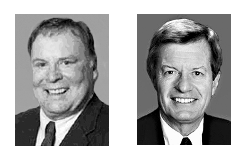
90% of the subjects thought the one on the right looked more competent, and everyone made their judgment in 1 second. The guy on the right has a skinny face with eyes that look and feel savvy. The dude on the left has a bit of a chubby face and seems like a solid person but doesn’t seem competent enough. And the result of the election was indeed that the right side was elected.
Look at two more groups, also politicians running for office. In this picture below, two males in the first row are duking it out, and a man and a woman in the second row are battling it out, and who do you think looks more competent–
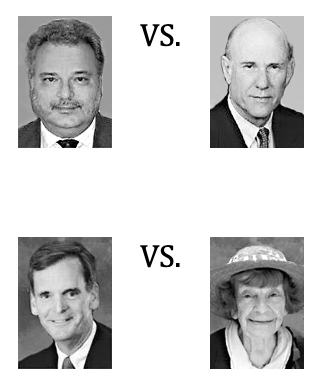
90% of the people chose the man on the right in the first row and the man on the left in the second row. The campaign results were the same.
If it’s all about faces, is there a need for campaigns? It’s certainly not all about faces. Studies have shown that in these one-on-one matchups, the person most subjects perceived as more competent by looking at their face won 71.6 percent of Senate races and 66.8 percent of House races.
The face advantage is not absolute, but it’s definitely very important.
✵
Military promotions and political campaigns can look at the face for competence, but in fact other things may look at the face even more. Say how smart the person is, if they are outgoing, if they are energetic, if they are reliable, people look at faces.
So saying how good a person’s face looks is never just about how attractive TA is to the opposite sex. If you’re not good looking, but you make people feel reliable at first glance, that’s also a big advantage, and you’ll be easily selected when you interview for certain jobs. It’s like saying that Xu Zhisheng, the “Luhan” of stand-up comedy, is said to be not very attractive to women, but it’s a huge unfair advantage when it comes to stand-up comedy.
What should you do if your looks don’t give you much of an advantage in your field of endeavor?
One attitude is that I was born looking like this and it doesn’t matter! I’ll work in another direction and if I do well enough, people will recognize me sooner or later. This attitude is inspirational, but not very scientific. Some opportunities are just too important. If you don’t get picked in your first officer’s draft, you may have to retire; if you run for Senate and get picked right off the bat, you’re an important politician from then on.
The scientific attitude is that since you all look at the face, I’ll work on the face.
It has been proven that people can improve their appearance. It doesn’t mean that you should get plastic surgery, but you can be very different just by practicing your expressions and dressing up a little and designing your design.
For example, one study went like this. The same two people in the picture below, with a slight change in hairstyle and expression, were rated very differently by subjects in terms of their trustworthiness-
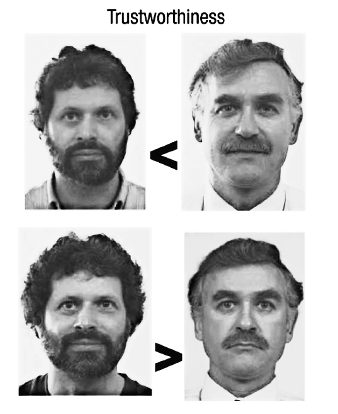
If the person on the left looks more serious and the person on the right is smiling, people judge the right side to be more trustworthy than the left side; if the expressions of the two are switched and the eyes are changed, people consider the left side to be more trustworthy.
I must emphasize that this kind of clinical performance is of limited use - but it does work.
Simply put, data analysis shows that on a scale of 10, a person’s attractiveness to the opposite sex adds or subtracts 1 point depending on how well dressed or photographed they are. For example if on average you are a 5 out of 10 for your looks, then a better photo will get you a 6 out of 10 and a worse photo will get you a 4 out of 10. In terms of trustworthiness, performance can add or subtract 1.5 points. If your base is a 5.5, your actual score will vary between 4-7.
- There is room to work on this. *
✵
Seth, the author of this book, also felt like he was average looking and looked like his ability score was a little on the low side …… But he chose to work on his looks. He made some changes based on data analysis.
There’s an app that uses AI to process photos called FaceApp, which can use one of your photos to generate different expressions and change the appearance a bit, such as wearing glasses or not, having a beard or not, changing your hairstyle, changing your hair color, and so on. Seth used FaceApp to generate several looks - the
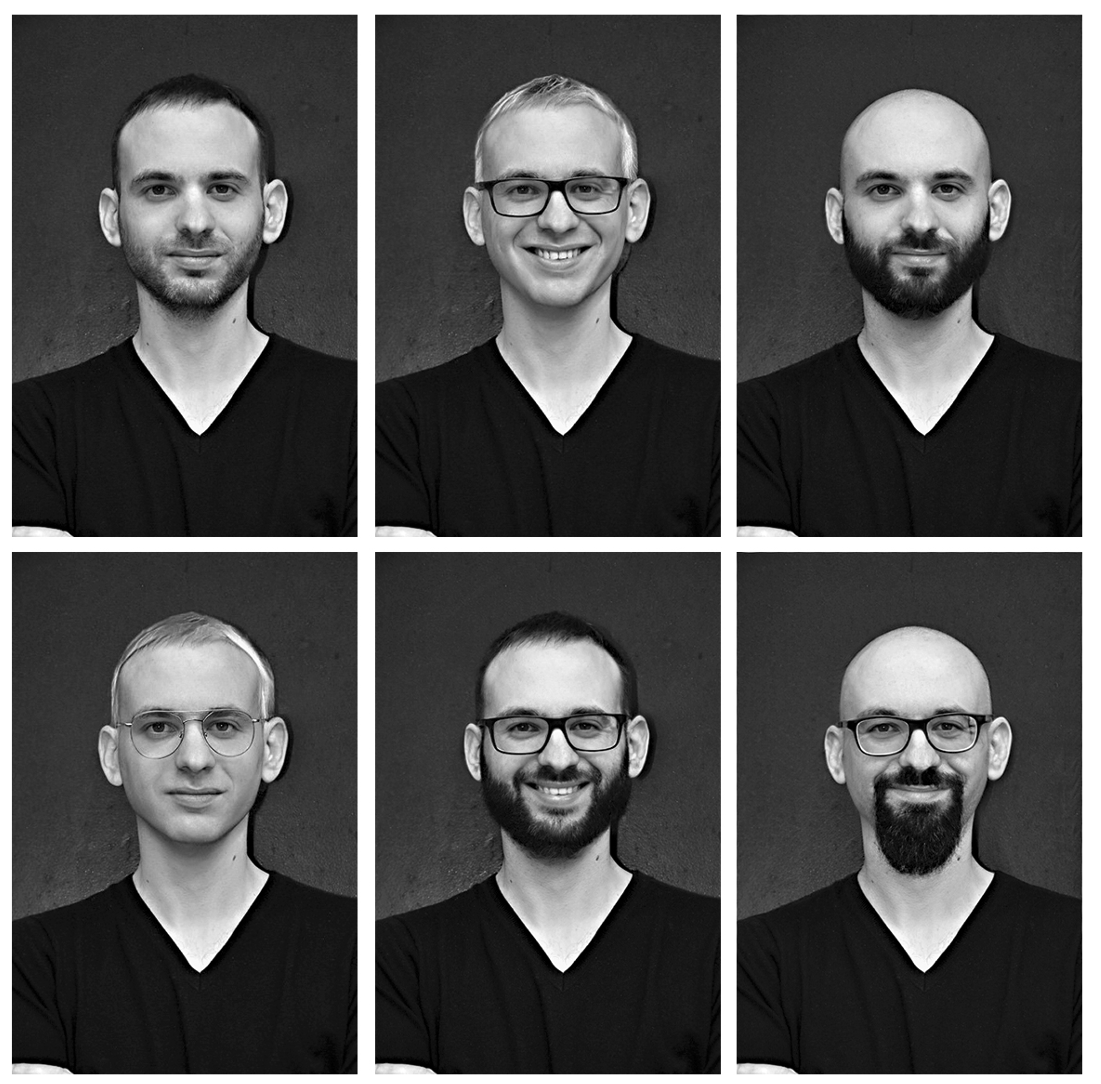
He then takes these photos to a website that hires real people to do market research for you (he uses GuidedTrack and Positly, but also Photofeeler.com), and lets people see his different photos and rate them for their impression of his abilities.
The lowest and highest scores that Seth got were for the following two photos -
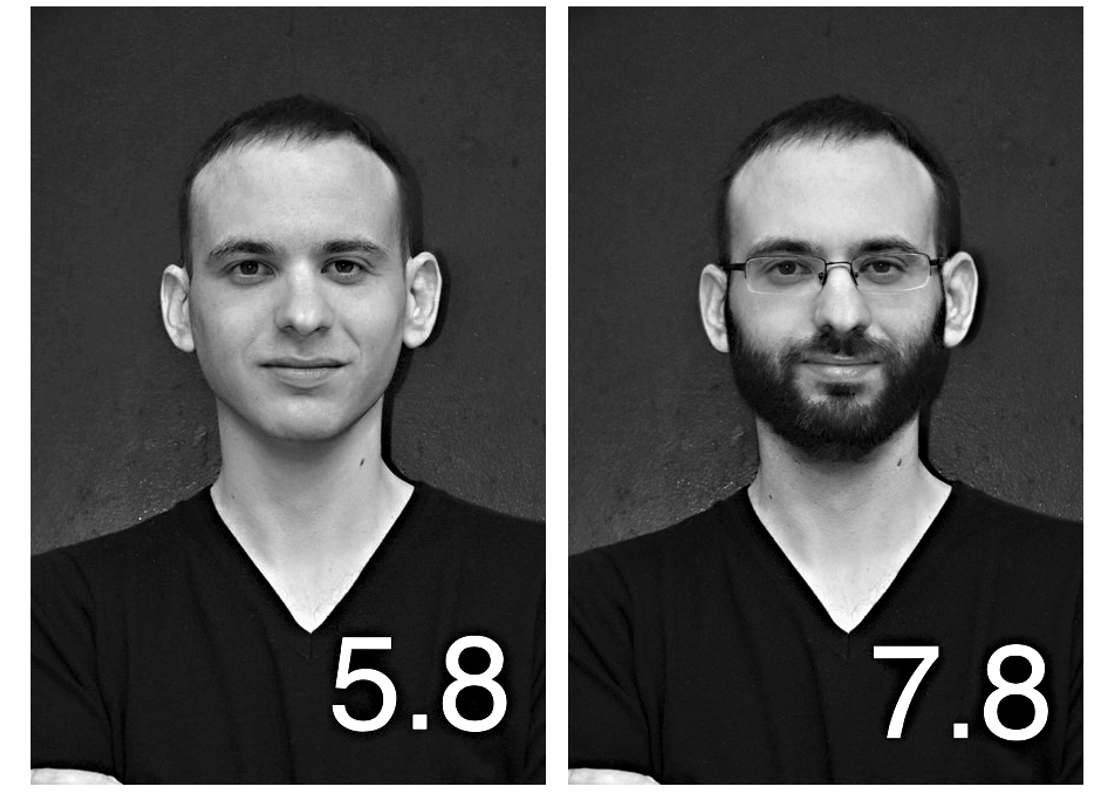
The lowest was a 5.8, looking more youthful without a beard or glasses; the highest was the photo on the right, which scored a 7.8, with a beard and glasses.
Seth then used statistical methods to analyze exactly how much each element affected his ability impression score. The results were that wearing glasses had the biggest boost to the ability score, increasing it by 0.8 points; having a beard added 0.35 points. The two add up to 1.15 points, which is significant. Smiling or not had little effect on the ability score.
The difference between 5.8 and 7.8 is huge. Looks are largely a matter of natural luck, but not something that can’t be worked on.
✵
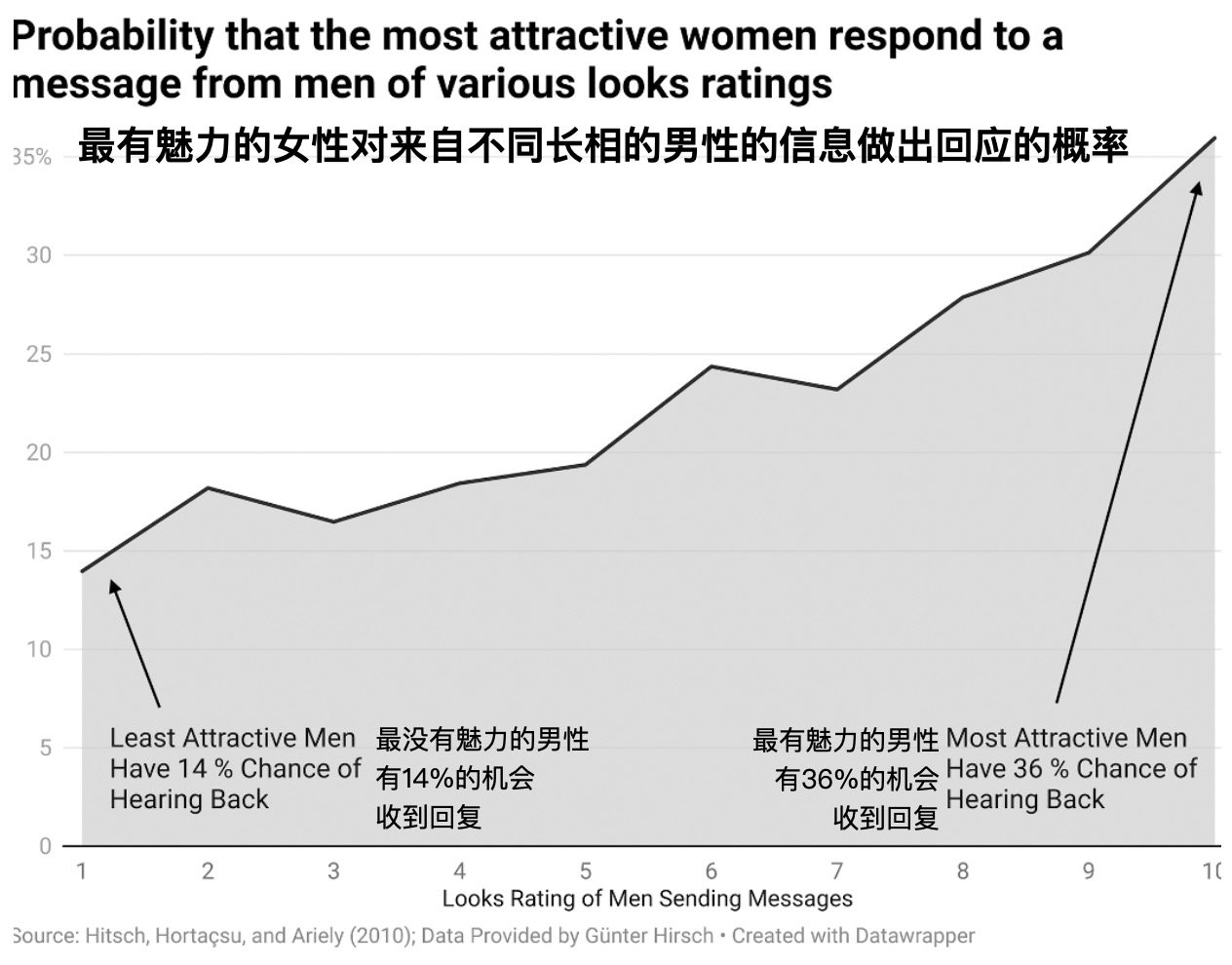
Another example. Earlier, we talked about big data on marriage and how looks are crucial to how sought-after you are in the relationship market, whether you’re male or female. Not being able to look good is reflected in the data that if you message someone on a dating site, they are less likely to respond to you.
The two charts below are statistics from dating sites. Men who rank in the bottom 10 percent of those with the least attractive looks who message women who rank in the top 10 percent of the most attractive looks are responded to at a rate of only 14 percent, while the best-looking men who message the most beautiful women have a 36 percent response rate-
The response rate for the least attractive-looking women messaging the most attractive-looking men is 29%; while the response rate is 61% if it’s the most attractive-looking women -
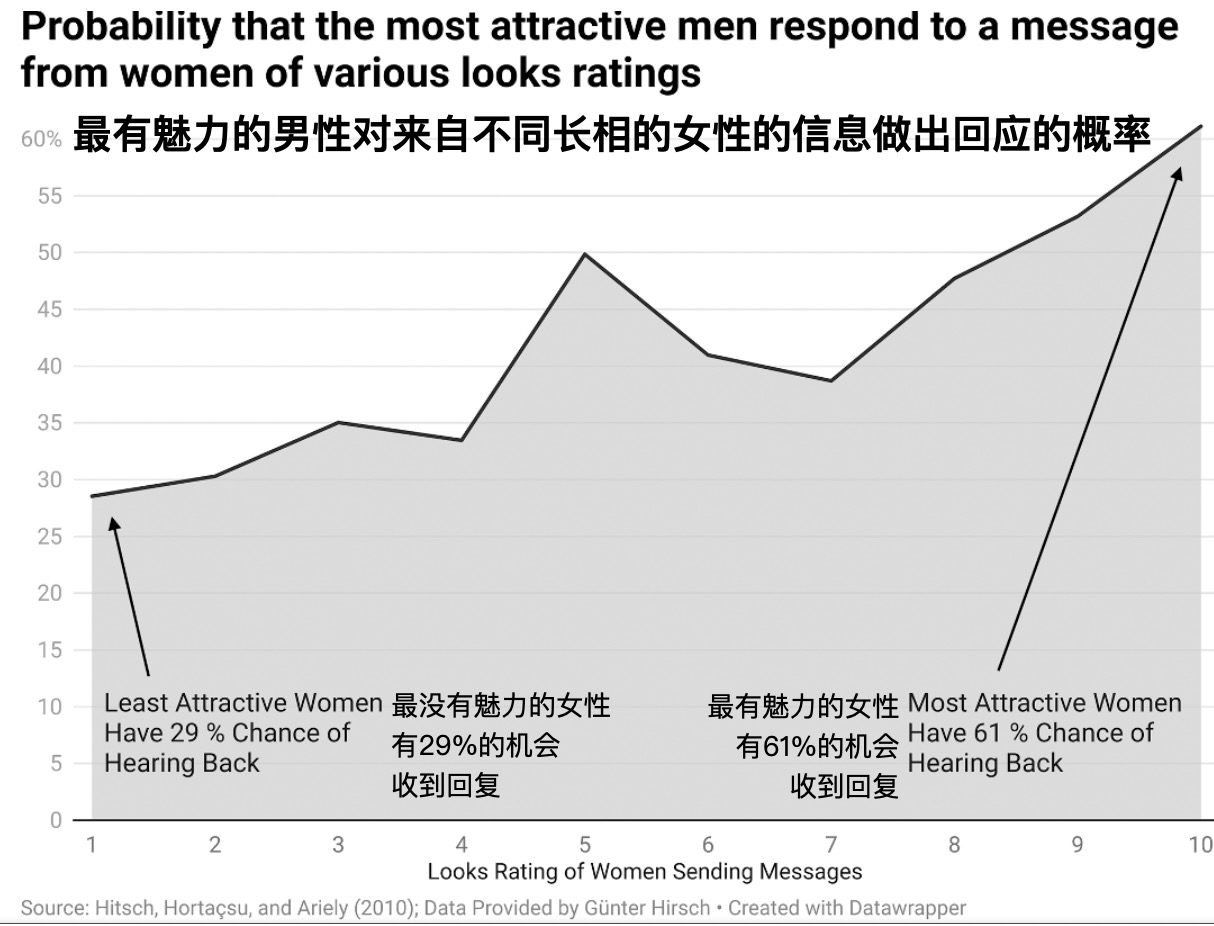
What do these numbers tell us? It depends on whether you think half the bottle is empty or whether the bottle is still half full at the very least. It’s true that the probability of an ugly guy messaging a pretty girl getting a reply is much lower than a handsome guy - but not at all - 14% is much greater than 0. This is even more true of female initiation, where the response rate is half the level of a pretty girl, even if she’s at the bottom of the list in terms of looks.
The best thing to do in this case is to send more messages. Even if you’re not that attractive looking, but you’re determined to have to find the most attractive looking one, you don’t have no chance at all: as long as you send out lots and lots of messages, you’ll always get some replies ……
You might be thinking that it’s not a good idea to use the r-strategy to find someone, it’s not exclusive enough. So let’s change the scenario, what if we were applying for a job?
Some studies have shown that scientists with a PhD want to apply for a research position, and on average, to get a job offer, you’d have to apply to 15 schools to get it.
And the researchers analyzed the data and concluded that the problem for most people is that too few applications are sent out. The most important reason why many people don’t get a position or don’t get the position they want is that they don’t apply to many places. So when you think about it, isn’t it strange that a scientist works 60 hours a week just to get a research position, but he’s not willing to take the extra time to apply to a few more places?
To put it bluntly, it’s a matter of perception. We tend to separate ‘hard work’ from ‘luck’, thinking that luck is uncontrollable and I just have to work hard. I just need to do my research well enough, and sooner or later I will find a position - and if I don’t find a position after all, it must be because I didn’t do my research well enough. I don’t realize that this is not a scientific attitude.
In many cases, your research is not as impressive as it should be, but you still deserve the position. Sending out more applications is the right thing to do.
✵
A previous article in our column was called ‘Wishing You Four Kinds of Luck’, and one of the important kinds of luck is ‘running out of chances’. We also talked about Barabasi’s book The Success Formula, and we know that a lot of artists are successful because they can run: they relentlessly go to galleries and studios looking for opportunities.
The reality is that the most amazing artists are often also the most prolific. They are on fire because some of their work is on fire, and they can have certain work that will be on fire because they have lots and lots of work.
There’s also research that shows that the scientists who are most likely to win major scientific awards also happen to be the ones who publish the most papers. If you do more stuff, you have a better chance of making good stuff.
From this we get that the proper relationship between effort and luck is this-
First, we have to recognize the importance of luck. The world is unfair, and it may often be the seemingly accidental, innate factors that are beyond your control that determine your success or failure.
Second, but we still believe that effort works - though not specifically in the direction of defying luck.
Third, effort can improve luck. The specific way to do this is to work in the direction of luck and multiply effort with luck.
If looks are important to you, you work on looks; if the probability of things is already fixed, you work on quantity. *Luck is not for lamenting, it’s for planning. *
Get to the point
The right relationship between effort and luck is this-
- We have to recognize the importance of luck. The world is unfair, and it may often be the seemingly accidental, innate factors that are out of your control that determine your success or failure.
- but we still believe that effort is useful - though not specifically in the direction of defying luck.
- effort can improve luck. The specific way to do this is to work in the direction of luck and multiply effort with luck.