Don't Trust Your Gut 2: Parenting Methods Don't Matter, Role Models Do

Don’t Trust Your Instincts 2: Parenting Methods Don’t Matter, Role Models Do!
The topic of this talk is children’s education. Our column on children’s education has always been very different from what the people think, and our core view is that there is very little you can do for your children. I don’t think there’s much point in parenting with homework, tutoring, or restricting game playing …… But no matter what I say, you’re still anxious. You always feel compelled to do just a little bit more for your children.
Seth’s book Don’t Trust Your Instincts further illustrates the point with data studies.
The core perceptions are clear: * A child’s destiny is his own, and parents can play very little role. *
But this talk does have an important finding: if you must do something for your child, there is one thing that is most worthwhile for you to do. And that one thing may, indeed, require a lot from you.
✵
Let’s start at the beginning. Some statistics have found that in the first year of a newborn’s life, parents face an average of 1,750 difficult decisions. Things like what to name the baby, to breastfeed or not, to sleep train or not, which pediatrician to go to, and even whether or not to post pictures of the baby on social media ……
Parents feel that everything is a big deal and they are afraid that if they don’t get it right, it will delay their child’s future. You name it, it’s a lot of anxiety.
To what extent does parenting affect a child’s future? For the sake of scientific thinking, let’s digitize it first. Let’s say we have a kid with average qualifications who would normally grow up to be a blue-collar worker or a flight attendant earning $59,000 a year, which is the middle income in the United States. The parent doesn’t like this prospect very much and says we’re not average parents, we want to be the best parents, we want to use the most scientific parenting methods and give our child the best environment to grow up in! OK, so ask, which of the following can the parent’s efforts elevate this child’s fortunes?
slightly above average, such as becoming a registered nurse or dental assistant earning $75,000 a year;
upper middle class, becoming an engineer or a judge earning $100,000 a year;
become wealthy, such as a surgeon, earning $200,000 a year.
Don’t overthink it. Big data studies show that even if you use the best parenting methods, the greatest likelihood is just to turn a flight attendant into a dental assistant and boost your annual income from $59,000 to $75,000. In other words if your parenting methods are costly, you might as well just leave the money to your kids.
✵
This is not very intuitive. Often in life you have a family with several children who are all successful, the oldest is a doctor, the second a scientist, the third a famous director or whatever. People will say that this family is very good at children’s education, and say can you write a book to share your experience, like something like “Harvard Girl Liu Yiting” …… But they ignore a key question: this family’s children are great, in the end, is it because of the good education methods, or the good genes?
Academics have long had hard research. The most intuitive method is to examine identical twins. The genes of these two children are almost exactly the same, and if they are sent to two different families at birth to be raised in different growing environments, guess when they grow up, will they have more of the same, or more differences?
The truth is that the similarities far outweigh the differences. Various studies have found that identical twins raised in different environments are highly similar in terms of life achievements, chosen fields of work, hobbies, and habits.
Another way to look at this is to examine adoption. A family with three biological children adopts another child. The parents educate all four children in the same way and do not favor their own child. As a result, the adopted child did not achieve what the three biological children had achieved. The reasoning is brutal: what kind of parent abandons his or her own child? How good could that gene be?
Of course, one possibility is that the biological parents suffered a misfortune. The Korean War orphaned many children in South Korea, and the American people, believing that they had a parental obligation to these orphans, took it upon themselves to adopt over 30,000 Korean orphans. This gave researchers an opportunity.
At the time, the American adoption law stated that a family could only adopt one child. Some orphans who were originally siblings were sent to different families to be raised. Then the researchers could look at a situation where, for example, three children from one family were adopted by three families and see what they accomplished when they grew up.
Once again, the results proved that nurture is less important than genes: the three children were significantly more similar to each other than to society at large.
Taken together, * Genetic factors have a 2.5 times higher impact on a child’s future earnings than the method of parenting. *
✵
That pretty much means that even if you give birth to a child and leave it alone and let another family raise it for you, that child will still be what it should be in the future.
I used to make the analogy [1] that a child is like a small tree: it’s easier for you to abuse the child and destroy the tree; but it’s not up to you to make the tree grow to excellence.
…… Unless you’re super rich. You donate 100 million dollars to Harvard University, that’s no problem, as long as your child’s level is not too bad Harvard will accept him, and when he graduates you then arrange for him to enter the company as your successor, you do change the child’s fate.
Beyond that, what parents can do is rather limited.
✵
So what’s the point of all the so-called “scientific parenting” lessons that parents learn all day long? Nothing. Large-scale data analysis and randomized experiments have shown that-
Breastfeeding or not breastfeeding has no significant long-term effects on children;
:: There is no significant long-term effect of television viewing on test scores;
:: So-called high cognitive games like chess do not make children smarter;
Some previous studies have suggested that bilingual education for young children makes them smarter, the latest large-scale meta-analysis suggests that bilingual education has very little effect on children ……
Taken together, raising the environmental standards for all aspects of raising a child by a full standard deviation would only increase the child’s income by 26% when he or she grows up.
One standard deviation is a lot. 68% of the population is within one standard deviation, raising it by one standard deviation is expanding the population covered from 68% to 95%. You’re doing significantly better than most and can only raise your child from a flight attendant making less than $60,000 a year to a dental assistant making over $70,000 a year ……
- ‘By technology’ is far worse than ‘by mutation’. *
So let’s think about this: you have to make over a thousand difficult decisions in the first year of a child’s life, and how many more decisions do you have to make to raise an adult? The impact of so many decisions adds up to just a little bit, and how much impact can it have when averaged out to one decision?
That’s why you’re still obsessing about this cram school and that calligraphy class. That’s not important at all, and it adds to the worries.
Then you say, “No. I must do something for my child. Out of all these decisions, is there one decision that is the most important?
There is.
✵
The impact of this one decision accounts for 25% of all the influence you have on your child. Get this one thing right and you’re doing your child a great favor.
*This decision is choosing where to live. *
There’s a Chinese saying, “In the past, Mencius’ mother chose her neighbor’s house, and when her son didn’t learn, she broke the loom.” There’s an African proverb that says, “It takes a village to raise a child.” Are these statements scientific? It is important to realize that higher income families naturally live in better neighborhoods, and the fact that children in good neighborhoods excel may be purely correlation rather than causation. Where can you tell what effect neighborhoods have on children?
Which leads us to a genius level study.
Harvard professor Raj Chetty, an Indian-American economist, very young, born in 1979, specializing in public economics, is most concerned with ‘equality of opportunity’.

Chetty invented a particularly powerful way of figuring out the impact of neighborhoods on children’s upbringing.
Chetty and his collaborators got their hands on tax-related data from the IRS for all Americans. This lets can he know exactly what each child’s parents’ tax records are, where the child spent each year of his or her childhood, and how much money the child will make in a year when he or she grows up.
The genius of Chetty’s work is that he focuses on a particularly interesting subset of siblings who experienced a move as children.
Let’s say there are two kids in your family. When the oldest was 13 and the second was 8, your family moved from Los Angeles to Denver. Then the oldest and the second grew up in different environments. The oldest spent a large portion of his childhood in Los Angeles, while the second spent a large portion of his childhood in Denver.
If Denver is a better place to raise a child than Los Angeles, that’s like saying that the oldest spent five more years of his childhood in a better neighborhood. Then we can expect that the second will earn more than the oldest in the future. Right?
Of course, this math doesn’t make a lot of sense for any given family because there are so many factors that affect a child’s future. Maybe the second is smarter than the oldest, and you can’t attribute the income gap entirely to the neighborhood. But if 10,000 families moved from Los Angeles to Denver, and on average, the second in those families just earns more than the oldest, then we can draw conclusions.
In other words, every time a family with at least two children moves from one neighborhood to another, it is testing both neighborhoods. If the oldest grows up to do better than the second, then they have moved from a good neighborhood to a bad one; if the oldest is not as good as the second, then they have moved from a bad neighborhood to a good one.
And Chetty has data on all Americans in his hands. He uses tough data to prove that neighborhoods just matter to children’s development.
Chetty and others found that there are five cities in the United States that are the best places to raise a child, and number one is Seattle, Washington–
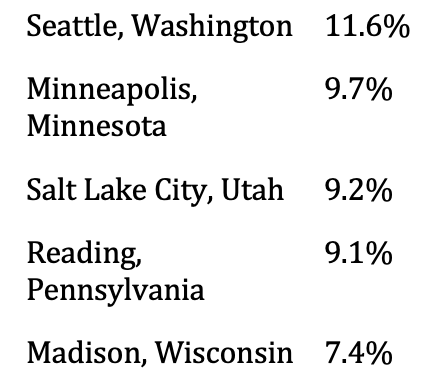
You move your family from the national average to Seattle, and your children will grow up to earn 11.6 percent more. This already rules out your direct impact on your kids, it’s purely a function of the neighborhood.
Chetty also has a website (https://opportunityatlas.org/ ) that looks up the effect of growing up in every neighborhood in America on your child’s income at age 35.
Choosing where to live is the single most important thing you can do for your kids. “Mummers choose their neighbors” is right.
✵
So how exactly does the neighborhood affect your child? Is it because of the school district? Is it because of the kind of kids your child can hang out with? It isn’t.
Chetty’s research found that the three most important predictors for asking whether or not a neighborhood has a positive impact on your family’s children - the
1. the percentage of college graduates in the neighborhood;.
2. the percentage of two-parent families;.
3. the percentage of people who return census forms on time.
In other words, if the neighborhood has a high number of people who have gone to college, a high number of two-parent families, and people who are more reliable, it is a neighborhood that has a positive impact on children. What’s interesting is that none of these indicators look at neighborhood kids, but adults.
*Chetti’s insight is that the real impact of a neighborhood on a child is that the child looks to the adults around them as role models. *
There’s a lot more direct evidence for this. For example, if a child is surrounded by adults who are inventors, the child is more likely to grow up to be an inventor - and if those adults are inventors in the medical industry, the child is more likely to grow up to invent medical devices. It’s rare for girls to become inventors, but if a girl is surrounded by female inventors, she’s much more likely to become an inventor in the future.
Another example is that we know that the biggest problem for black people in America is that there are too many single-parent families. Many black males leave their wives and children and run away. Then if there are a lot of two-parent families in a black community, even if a boy is in a single-parent family himself and has no father, and he sees that all the males around him are able to be good fathers, he will think that males should be good fathers, and he will be a much more dependable person.
That’s the power of role modeling. So why do you think it has to be the community? Aren’t your own parents role models too?
There’s a subtle difference here in that children tend to have a rebellious streak towards their parents and like to go against them. But they will silently imitate the adults around them.
✵
I hope this talk eases your parenting anxiety. The reality is that most of the things parents do don’t have much of an impact on their children, and if you have to look for an impact, it’s the kind of neighborhood you’ve chosen for your family and the kind of adults your children look to as role models.
Actually, thinking about it another way, now that we’re all grown up, who among us would argue that the reason we’re underpaid is all because our parents didn’t lead programming classes in the first place? The kids won’t complain about us in the future.
On a societal level, though, there’s actually a point here that’s worth your anxiety: people are not equal to people in terms of opportunity. It’s not fair from birth. There’s a recent book called The Genetic Lottery that talks about this.
The data in this talk are all from the U.S. For China, I think the impact of community may be more important. You have to realize that in the United States, although some states are poor and some are rich, the population of poor states is also small, and overall the per capita GDP of each state is almost the same. In China, development is very uneven across the country, and the number of good adults a child has access to in this part of the country may be very different than in other parts of the country.
Note
[1] Elite Day Class, Season 4, Family of Origin, Innate Intelligence, Lifelong Learning: How useful is it all really?
Highlight
- a child’s destiny is his own, and parents can play a very small role.
- Genetic factors have 2.5 times more influence on a child’s future income than the method of parenting.
- choosing where to live - this one decision accounts for 25% of all parental influence on a child.