Don't Trust Your Gut 1: Big Data on Marriage

Don’t Trust Your Instincts 1: The Big Data of Marriage
Today we start with a book that will be published in May 2022, Don’t Trust Your Gut: Using Data to Get What You Really Want in Life.
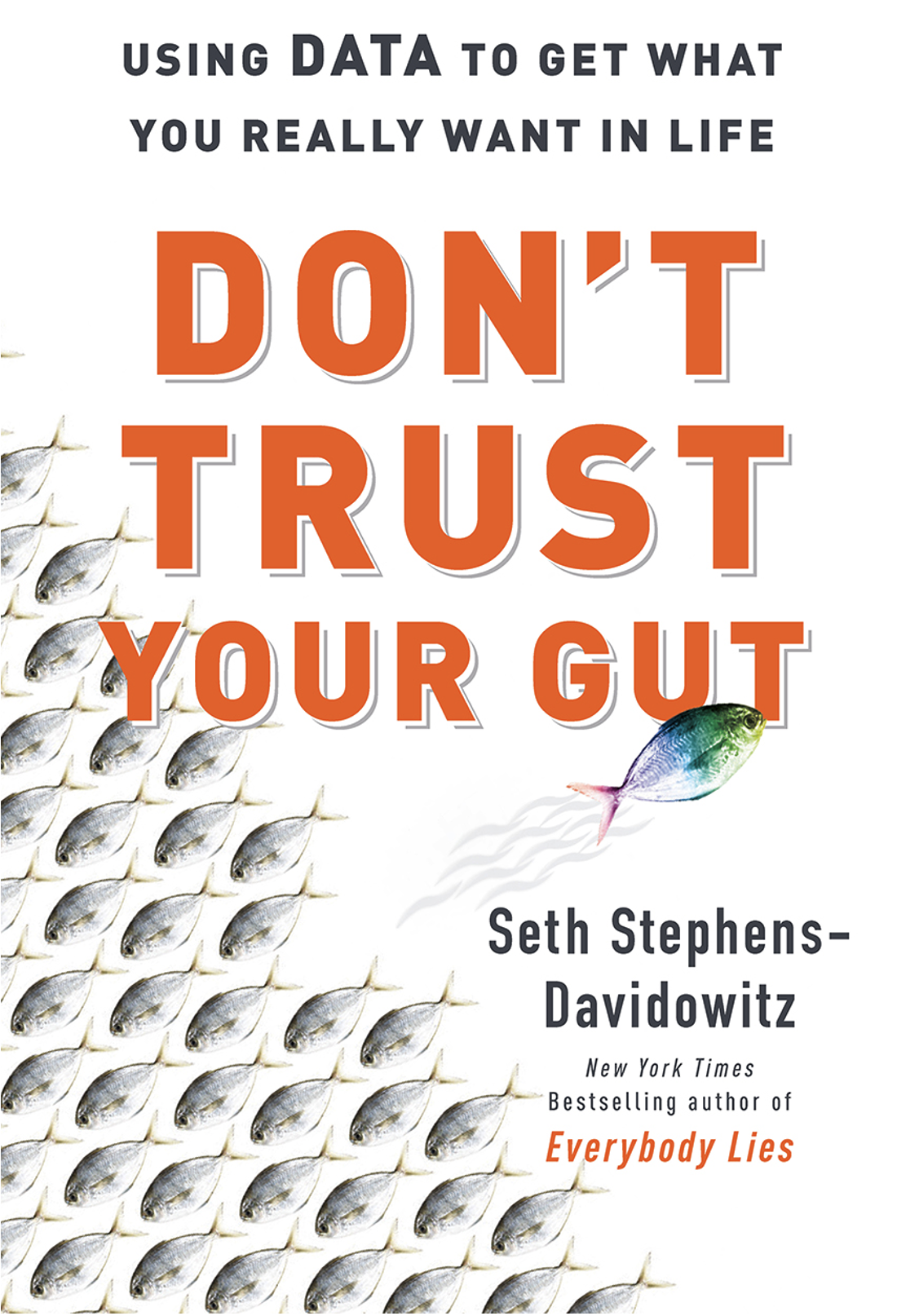
The book is written by Seth Stephens-Davidowitz, who we talked about in the first quarter of our column in a book called Everybody Lies, which was all his own research at the time. A former data scientist at Google, Seth is now a lecturer at the Wharton School of Business, where he writes a regular column for the New York Times.

Seth specializes in using data to discover the truth about society, and this new book does the same. What makes this book different from the last one is that it synthesizes the research of many people and speaks more practical truths about very everyday topics like marriage, education, and getting rich.
Every conclusion in this book is backed up by strong research and data, and many times it is not one, but a combination of many studies. So whatever outlandish claim you hear next, I suggest you think about why it’s true before mulling over whether or not to question it.
Those studies and data show that you had a lot of things wrong before.
I kept asking myself as I read, this is all practical everyday truths, so it stands to reason that so many people should have known these truths by now, after all these years of living with them, right? How is it that we’re all thinking about it wrong? I hope you come to me with that question as well.
The topic of this talk is, if you want a happy marriage, how should you find your other half?
One of the key insights that Seth came up with is that *what people actually seek in the marriage market, and what they should seek, happen to be two completely different things. *
✵
Let’s look at what people actually seek first. In the old days, without the Internet, when you asked young men and women what they valued most in a date, everyone said “personality” was the most important thing, and appearance and income were the least important. …… As you can imagine, people tend to lie in such surveys. Now with dating sites, researchers no longer have to listen to what people say they think, but can directly observe their behavior.
Simply put, the people you send private messages to on dating sites asking for a relationship, the people you reply to the private messages they send you, and the people who reply to the private messages you send them, reveal what you’re after and how popular you are.
Using this data, researchers have found that your popularity in the dating market is highly predictable.
What do people actually look for?
✵
The first important thing is beauty. Both men and women place special importance on good looks.
In order to measure the objectivity of the results, the researchers specifically asked a group of people to score the attractiveness of the appearance of each dating user, and then compared the scores with the private messages sent and received by these people - the results were very clear, people like good-looking people.
30% of women’s scores on dating sites could be explained by their appearance, compared to 18% for men.
The second is height. The graph below shows the achievements of men and women of different heights in receiving private messages - the
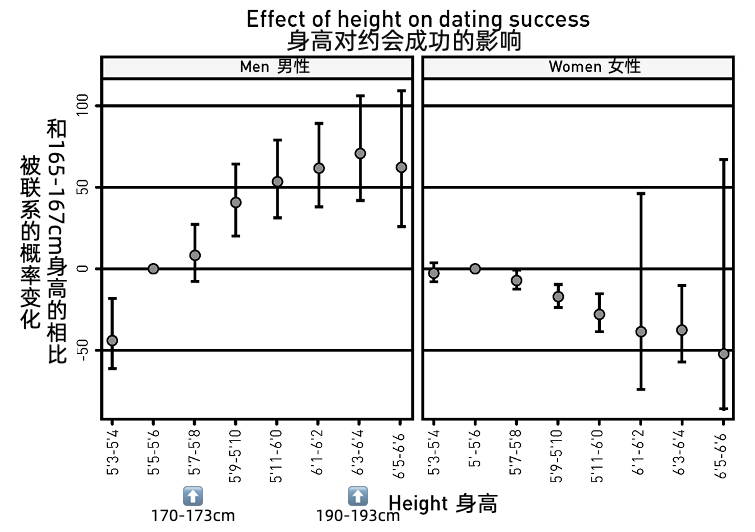
The most popular male height is between 190cm-193cm and he receives 65% more private messages than men between 170cm-173cm.
How important is male height? The researchers made this calculation. A man who is 167cm tall is clearly less attractive than a man who is 183cm tall. So do you think I can make up for my height if I earn an extraordinarily high income? Yes, but your income has to be very high. This man, who is 167cm tall, would have to earn $237,500 a year if he wanted to be as popular as a man who is 183cm tall and earns $62,500 a year!
In other words, a 20cm height difference is worth the equivalent of an extra $175,000 in annual salary in the dating market.
Women’s height is not very important. The most popular female height is 165cm, any higher is slightly unfavorable and not very influential.
The third is race. No one wants to admit that there is a racial bias in their search for a date, but the data is clear.
The two graphs below show the popularity of the four races Asian, Black, Mexican and White on dating sites. The data in the graphs is the percentage of women or men of one race, who send a private message to a man or woman of another race, who get a reply.
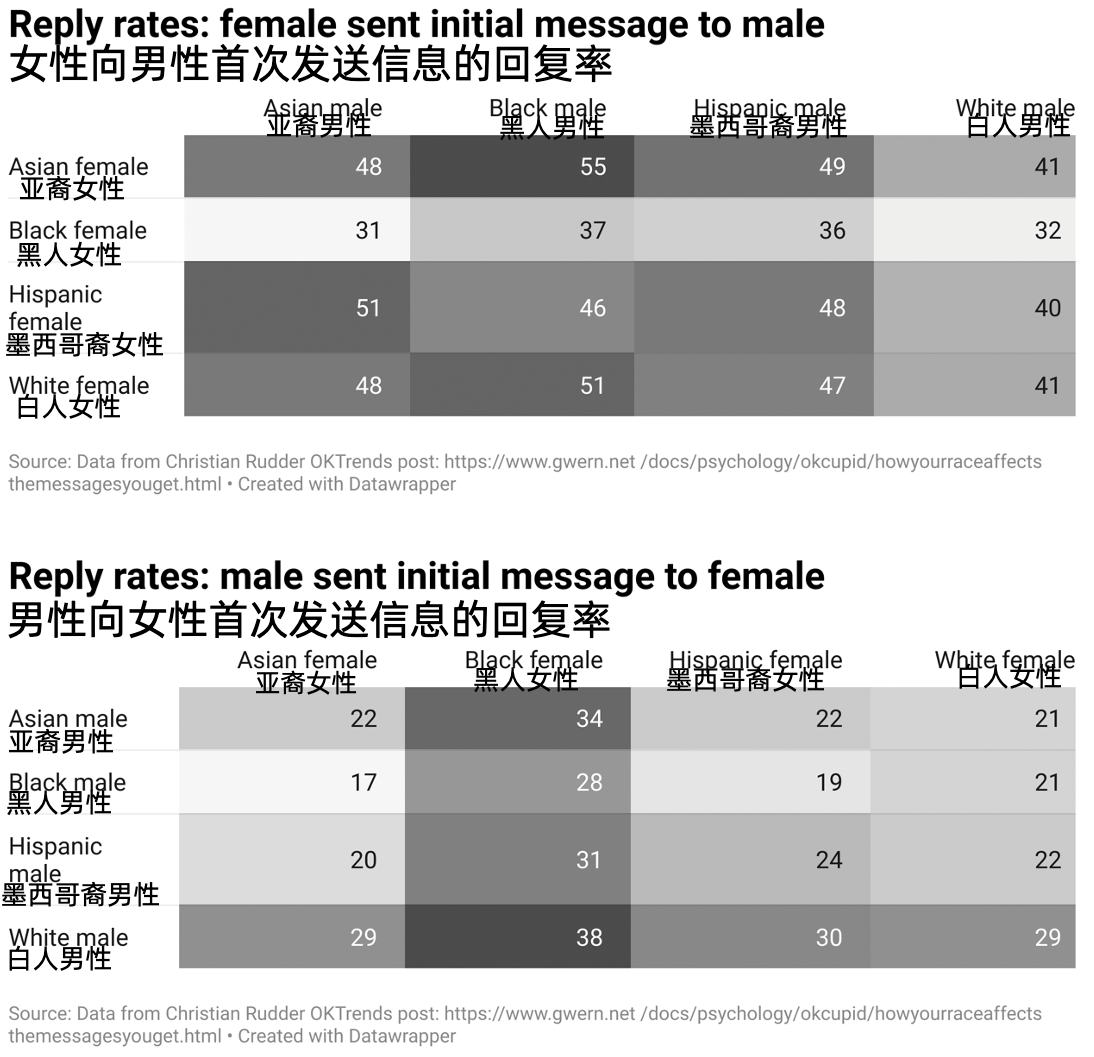
The most popular were white males and the least popular were black females …… But what was most interesting to the researchers was the fact that Asian males are vastly underestimated. When Asian men message people, they don’t respond much; when people message him, he’s more than willing to respond. Asian men are treated only slightly better than black men.
The point is, Asian men have the highest incomes of any race. But our attraction doesn’t work. For example, in order to attract an average white woman to respond to a private message, a subman would have to earn $245,000 more per year to get the same response rate as a white man. And that’s too hard.
The fourth is occupation. As you can probably tell from the discussion above, Americans don’t really value income when it comes to marriage. But women will place more value on a man’s occupation.
You’d better be in some sort of powerful, manly occupation. Lawyers and firefighters are very popular with women. Hotel attendants, on the other hand, are significantly less attractive, even if they make a lot more than firefighters.
The following table depicts how attractive men in various occupations are to women -
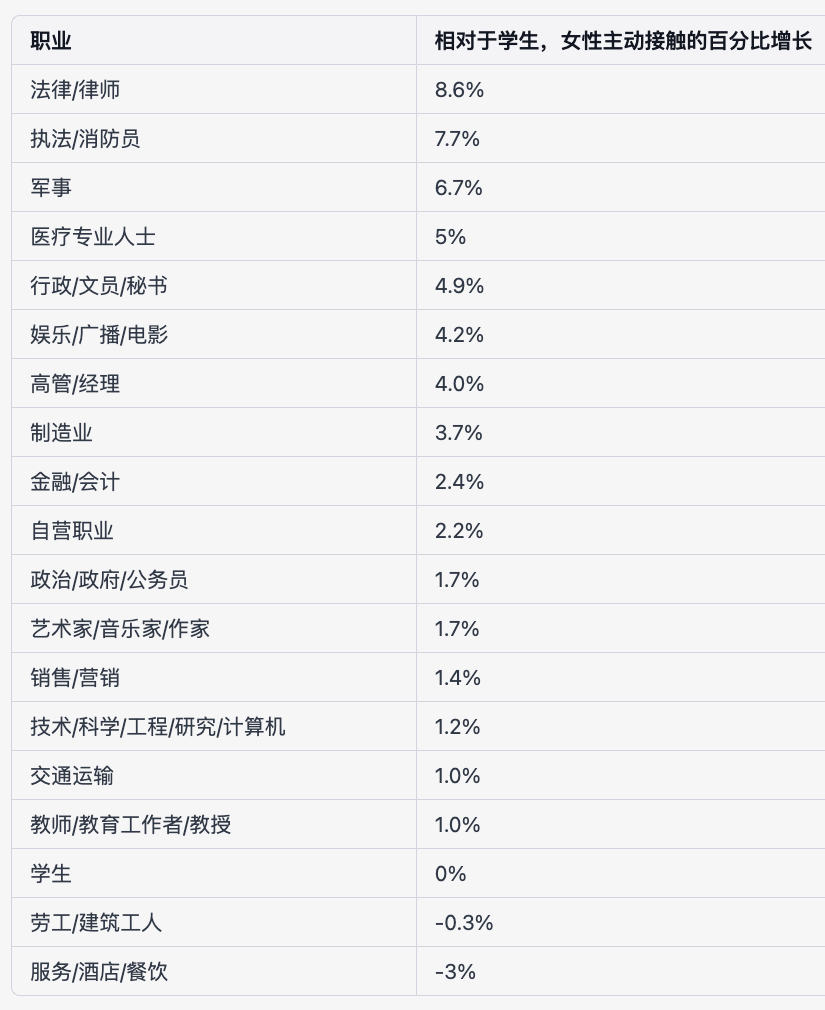
I was very surprised to find that the popularity of teachers, professors and tech workers was comparable to that of students, only slightly higher than that of construction workers, and nowhere near that of doctors or military personnel.
Of course this is the US market, the Chinese marriage market may be very different. However, I believe the following criterion should be similar between China and the United States: “personality”.
What kind of personality is most popular? The answer is any personality. The mechanism is that whether your personality can attract ta or not depends entirely on whether your personality is like ta or not.
The researchers looked at 102 quantifiable personality traits, including your depiction of your character, your hobbies, and even the fact that you submitted a few photos to a website for these traits …… The results found that all of these traits indicate that people are attracted to people who are similar to them.
Simply put, a woman who describes herself as “creative” will seek out men who also describe themselves as creative. Men do not require as much personality matching as women, but they do prefer similar people. One of the most bizarre findings is that even having the same initials increases the likelihood of a match by 11.3% - and that excludes religious beliefs from having an effect on names.
To summarize, good-looking, tall, racially white, with a visible profession and a similar personality to yours is the person you’d most like to date.
✵
Now here’s the big question. Dating is dating and marriage is marriage. Do those previous characteristics lead to a happy marriage? The answer is almost never mind.
Researchers have used statistical analysis, big data analytics, and even machine learning, and haven’t found a good algorithm that accurately predicts what kind of partner to look for that is most conducive to marital happiness.
The key reason here is that your marital happiness is actually not primarily dependent on your significant other - it’s dependent on you. The most important predictor of your marital happiness is whether or not you were happy before you got married: if you were happy with your life before you got married and weren’t depressed and were always upbeat and positive, you’ll be the same way after you get married.
*Your pre-existing happiness is four times more important as a predictor of marital happiness than all the indicators in your significant other combined. *
So if you were already happy, you’ll be happy after you get married. If you’re already unhappy, you’re less likely to become happy by marrying someone who is ……
So you’re saying that even if myself is most important, the other half is always useful, right? I can’t just find anyone. Even if it’s not a big influence, I’d like to know what factors of the other half are most critical to marital happiness. The researchers’ advice is that you should try to find someone who has the following four qualities -
**The first is a high level of satisfaction with life.**This person is inherently happy, not the complaining all the time kind.
The second is a “secure attachment style”. We’ve talked about this in our column before [1], and it’s a style that is attached to you, but doesn’t restrict you all day long because it’s secure. To put it bluntly, they love you, but they don’t check your cell phone.
The third one is “conscientiousness “. This is one of the ‘big five personalities’ that we’ve talked about many times in our columns, meaning dependable, disciplined, efficient, and organized.
Fourth is “growth mindset “- we’ve talked about this too many times - people who are willing to work hard to improve themselves.
Don’t you notice that this is what gets the picture of a user? Especially like our Elite Day Class readers. It seems that the qualities we’ve been advocating are also good for marriage …… It’s called Virtue is not alone, there must be a neighbor, “high kernel sex is similar, low kernel habits are far away.
But all of these qualities don’t have a particularly large impact on marital happiness; it’s you who matters most.
An interesting question is, if your current marriage doesn’t feel very happy, but you feel that both of you are good people, will your marriage become happy if you stay together for a few more years? No algorithm can know. Studies have shown that the best indicator for trying to predict where your marriage will be 10 years from now is where you are now. If you’re not happy now and expect to be happy when you have kids, the data doesn’t support that expectation.
✵
While researchers are not very good at predicting what qualities in a significant other will lead to happiness, they do have strong conclusions about “what doesn’t matter”. The following eight factors in a significant other have nothing to do with marital happiness-
:: Race
Religion
Height
:: Physical attractiveness
:: Previous marital status
Preference for sex
Similarity to self
And these are pretty much what was just mentioned earlier, some of the most important metrics that people look for when they are looking for a date!
We are looking for people based on the wrong indicators. And why is that?
According to Seth, these indicators are characterized by being ‘shiny’, making a particularly easy first impression, and grabbing your attention quickly. Short-term relationship will make you like it, but it is not an indicator of marriage and life.
In this regard, someone did a very interesting experiment in the university. At the beginning of the course, the professor asked the students to score all their classmates of the opposite sex to see which ones were the most attractive. The scoring results were very much like the performance of a dating site, where everyone likes tall and good-looking ……
When the semester ended, the professor asked the class to score them again, still asking which of their classmates of the opposite sex were the most attractive - resulting in a marked change in rankings. This is, of course, because everyone has been together for a while.
It seems that mates are like beverages; one sip feels different than one bottle. First impressions don’t work particularly well when it comes to relationships and fits.
This reminds us of the book Moneyball, which says that before big data, the baseball transfer market was all wrong. People over-emphasized the “shiny” qualities of a player, such as whether or not he had a good looking body or not……. Unbeknownst to them, the chubby-looking player was the real star of the future.
✵
Putting all these findings together, how should you look for a marriage partner?
Unusual points of attraction - looks, height, occupation, personality like you or whatever - don’t matter at all. If you’re going to force a pick, look for people who have good qualities, including life satisfaction, secure attachment style, dutifulness, and a growth mindset.
Perhaps the greatest value of this talk is that it will help you pick up the slack! Men who are short, Asian, and whose careers aren’t that shiny, and women who are too tall or average looking, are severely undervalued in the dating market. You need to have a sense of “Spot the Gold” and should focus on them.
Finally, going back to the question at the beginning, why didn’t we know these truths earlier? Maybe because relationships are a complex issue and it’s hard for an outsider to tell if two people are happily married or not.
Or maybe it’s because of the lack of a quick feedback mechanism. You’re immediately happy with good-looking people, but good qualities take a long time to see. What’s more, we don’t have a lot of experience with people over a long period of time, and if we only get married once in our lives, we won’t be able to use the experience we have.
Maybe it just has to be analyzed by big data to find these patterns.
Notes
[1] Elite Day Classes Season 1, How to Increase Welcome
Get to the point
- what people actually seek in the marriage market, and what they should seek, happen to be two completely different things.
- How should you look for a marriage partner? Unusual points of attraction - looks, height, occupation, personality like you or whatever - don’t matter at all. If you’re going to force a pick, look for people who have good qualities, including life satisfaction, secure attachment style, dutifulness, and a growth mindset.