Consciousness Red Capsule 4: Emotional Neural Networks
Consciousness Red Capsule 4: Emotional Neural Networks
Previously we used several experiments to demonstrate the influence of the body on consciousness, and in this talk we sort out the basic framework of the academic understanding of consciousness so far, to set the stage for what follows.
If everyone would just do some cold calculations and think only about maximizing the benefits of their own existence, our lives would certainly not be as they are now. The reason you have pleasure and pain, the reason you intensely like or hate something, the reason you feel that everything has meaning, is because you have consciousness.
But consciousness is a hard problem - there’s a famous expression just called the “hard problem“ of consciousness, and the problem is this:
The various objects that make up our bodies and surround us are nothing more than atoms and molecules, and these are objective beings. The structures and signals formed by the interactions between these things are also objective. We are simply living in an objective world determined by physics. So how is it that these objective things give you a subjective consciousness?
Simply put, the conundrum of consciousness is how spirit arises from matter.
Many people may think that this is not a problem, and they will say, ah, I’m a materialist, I believe that spirit originally arose from matter, end of proof. But for those who are curious enough, how a bunch of atoms can produce emotions requires an explanation.
It’s a question that countless scholars have sought to answer, but according to Steven Pinker’s categorization [1], I don’t think this ‘hard question’ can be considered a scientific ‘problem’ at all, but only a ‘mystery’, because you don’t even know what kind of answer you want, let alone how to test it.
How a black hole bends space is a scientific question, because you have the theory of general relativity, and you can test it with gravitational waves. To explain what consciousness is, we first need a testable theory for that as well.
✵
As far as I know, there are probably several schools of thought in academia discussing consciousness right now, some of which can be described as theories and some of which can only be described as hypotheses.
One school of philosophers argues that matter can produce subjective consciousness because matter is not objective.
These philosophers say, “You just talk about the hard problem of consciousness, do you realize that there is also a hard problem with matter? That question is what matter actually is. All of our scientific knowledge, all of our laws of physics, are describing various behaviors of matter - such as the conditions under which electrons behave - not about the nature of matter.
What the hell is an electron? You don’t. You’re just good at dealing with electrons. Since we don’t even know what the nature of matter is, we naturally don’t know how consciousness arises from matter.
Accordingly, some philosophers have suggested that perhaps it is not just people who are conscious, but anything that is conscious, and that electrons are conscious [2]! This school of thought is called ‘panpsychism’, and you could also say that it’s a form of panpsychism, which is the same as saying that everything has a spirit …… It’s an interesting set of claims, but it’s also the same as saying nothing at all, because it doesn’t address anything, there’s no way to test it, and it’s only a hypothesis.
There is a testable theory called “Integral information theory (Integrated information theory, IIT)” [3], proposed by the Italian Giulio Tononi. This theory sets quantitative metrics that say there must be sufficient information exchange between the parts of a system to be considered conscious. You can even use this metric to determine whether a patient in a coma is conscious or not …… The overall information theory is very testable, but the explanatory is too weak: you still don’t know why, if there is an adequate exchange of information between the parts of a brain, that brain has joy and sorrow.
There is another school of theory from the godforsaken and famous physicist Roger Penrose. He argues that the brain is not an ordinary machine, much less a computer: it is conscious because of some mysterious quantum mechanical process [4]. No experiments have been able to confirm this claim, and the available evidence points in the opposite direction: the brain’s thinking should not be affected by quantum mechanical processes, because the scales are too different.
Also, Mr. Hou Shida has a hypothesis in his book “Gödel, Escher, Bach: A Collection of Dissimilarities” that says that for the brain to be conscious it would have to be sufficiently complex to produce a logical loop pointing to itself in order to be able to do so. …… That’s only a claim.
So you can imagine what a rudimentary stage the academic discussion of consciousness is still in: not only is there no consensus, but it’s literally at the opposite end of the spectrum …… What we’re going to talk about, however, is a pretty solid school of thought, and that is *Explaining Consciousness in terms of Brain Neuroscience. *
✵
The head honcho of the brain neuroscience school is called Antonio Damasio, a Portuguese-American philosopher and neuroscientist.

Born in 1944, Damasio is now almost eighty and still very active. He says he respects philosophy so much that he doesn’t want to be called a philosopher [5], which I think is more likely because neuroscience is the harder discipline - but I see that his work in recent years has been mainly on the level of philosophical discernment, so let’s pretend he’s a philosopher.
In 2022, Damasio has a new book out called Emotion and Cognition: letting consciousness illuminate the mind - the
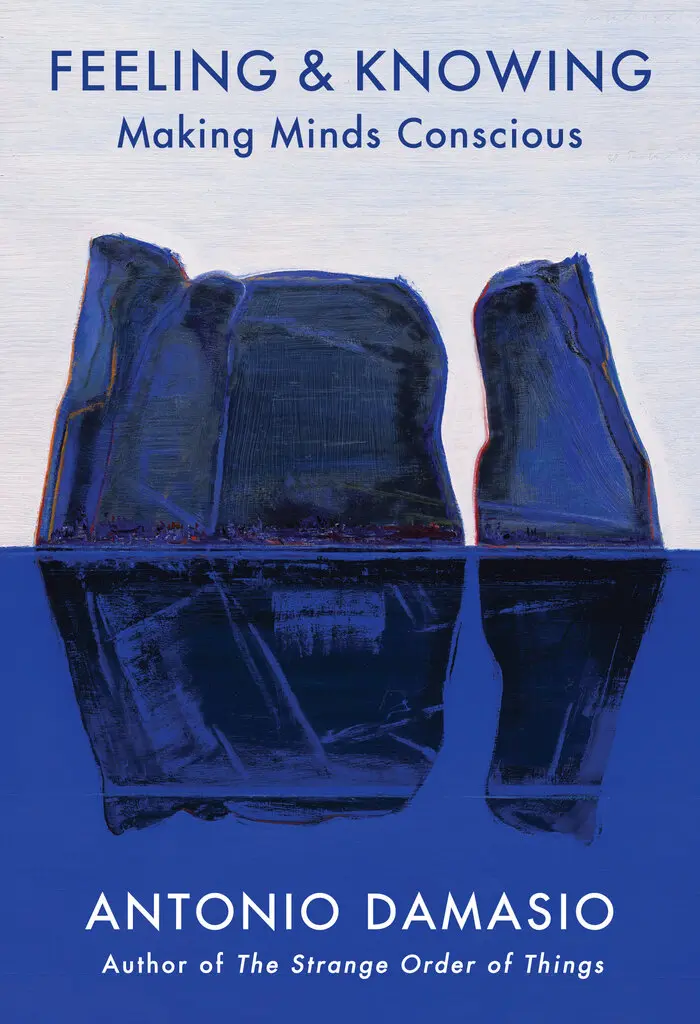
In this book he suggests that *consciousness is essentially a combination of human body signals, sensory signals, and emotions, the most critical element of which is emotion (FEELING). *
I’ll summarize this doctrine of Damasio’s a little bit for you.
Our perception, or spirit, can be divided into four levels.
✵
- The first level is * * “sensing (sensing)” * * which is a direct response to various signals. * * The five human senses, sight, touch, hearing, smell, and taste, are all senses. Any living thing has sensing, even the simplest bacteria has to be able to react to information from its surroundings, otherwise it cannot be called a life.
According to Damasio, if a creature only reaches this level of sensing, it is not conscious.
✵
To be conscious you have to at least reach the second level, ‘emotion (feeling). To have emotions you need to have a nervous system to be conscious, and only vertebrates have nervous systems.
Now that we have AI, you can understand it. We can say a nervous system is a computational model. Instead of reacting directly to external signals, you feed that information into your model, do some complex calculations, and then output something.
Of course, this model needs to be trained and grow. The point is that this is the same as all AI neural networks: there are inputs, models, and outputs.
And the things that human neural networks output are all kinds of emotions. When you see a snake, you feel scared because your neural network calculates the “snake information” and gives you the emotion “scared”.
Organisms without a nervous system react only when they have been hurt and feel pain; while organisms with a nervous system can run away when they have not yet been hurt, and when they look at the situation in front of them, they can automatically calculate the emotion of fear. So emotion is definitely a higher function.
Things like like like, dislike, pleasure, pain, want, excitement, these are all emotions. I understand that ‘emotion’ is perhaps a more complex emotion. Neural computation doesn’t just happen in the brain, you have a nervous system all over your body, so a lot of emotions are bodily sensations. But wherever it is, emotion is something that arises from automatic neurological computation, a quick, spontaneous response that doesn’t require conscious involvement.
Damasio’s key assertion is that *it’s not with consciousness that you have emotion, it’s with emotion that you have consciousness. *
The process by which emotions form consciousness is analogized by Damasio. The various sensory images that you experience from moment to moment, like a silent movie projected in front of you, are soulless; they do not, by themselves, bring you to consciousness. Adding emotion, on the other hand, is like putting music to that movie, and the music provides a subjective voice: whether it’s positive or negative, whether it’s loved or hated, and suddenly all kinds of meanings come out, and you become conscious.
According to Damasio, emotion is the bridge between the body as matter and consciousness as spirit.
✵
There is another kind of consciousness at the third level, which is the ‘presence (being) of the self’. Self-consciousness is primarily the heartbeat, the breath, and other bodily signals - the inner perception we talked about earlier - that come together to emerge. *
As we said earlier about Catherine Taron Baldry, the rhythms from the viscera give the brain a hook on which you can hang the self - and Damasio’s theory goes even further by suggesting that the self is what these inner perceptions are made of.
With emotion (feeling) and self (being), you are ready for the next layer.
✵
*The fourth layer is ‘knowing’. Cognition is the synthesis of the lessons you have learned in your past history, the memories you have generated from your interactions with your environment, which forms knowledge. *
With knowledge, the next time you encounter a relevant situation, you can engage in slow thinking - that is, rational judgment, which is one level higher than emotion. Actually, rational judgment is not always accurate, but you can now deal with, say, abstract problems, unfamiliar problems, that are difficult to deal with by emotional calculation.
✵
This Damasio view of consciousness is not really complicated, but it has three important lessons for us.
- First, emotion is prioritized over cognition. * In the words of a psychologist, fast thinking in System 1 is prioritized over slow thinking in System 2, and intuition over reason.
We’ve talked so much about AI before that you’re pretty much aware that whether it’s generative AI like language models or specialized AI trained specifically for one function, it’s essentially a neural network.
The reasoning process of AI is essentially is intuitive judgment. Especially with specialized AI, the output is essentially an emotional value: it can be joy, anger, sadness, good reviews, bad reviews, or whether or not that chemical molecule has the effect of an antibiotic.
Our column’s previous talk on Wadhwa’s Internal Control, External Influence also said [7] that intuition is the computation of a neural network model trained with a certain dataset.
Why is AI’s reasoning often inexplicable? Because it is a neural network computation, there are no formulas, only structures and parameters, and it takes place at the level of the “body”, before consciousness is formed in the brain.
This is why the body is better at making certain judgments than the brain in the previous two lectures.
*The second inspiration is that emotions cannot be canceled. * For example, if you are afraid of something when you see it, can you make yourself unafraid of it through rational restraint? Impossible.
Consciousness is made up of emotions, and emotion comes before consciousness; emotion happens before consciousness. By the time you think of actively eliminating that emotion, that emotion has already appeared. You can only regulate and control emotions, but you cannot refrain from generating them. That’s why meditation never abolishes emotions, it allows you to let them go.
- The third inspiration is that mind and body are inseparable. * “Embodied cognition” is a very powerful law, and the most important lesson of our first two lectures is that the brain must think with the power of the body, and even ask the body for advice.
I hope you will keep these three inspirations in mind. Damasio’s doctrine is not necessarily correct but these three inspirations I believe are. We will use them again later, and in the future there will be countless experiments and interesting ways of practicing them.
Does this doctrine of Damasio still not feel too overwhelming to you? Yes, I believe that consciousness emerges from emotions and inner perceptions, but ‘emergence’ is a catch-all word, anything can emerge - how does consciousness emerge anyway? We’ll return to another neuroscientist’s point of view in the next talk.
Notes
[1] Steven Pinker, How the Mind Works.
[2] Elite Day Class, Season 3, Either Electrons are Conscious or Everything is an Illusion
[3] Life 3.0 7: The ABCs of Consciousness (below)
[4] Quantum Mechanics 22: Quantum Buddhism
[5] https://nautil.us/whats-so-hard-about-understanding-consciousness-238421/
[6] Antonio Damasio, Feeling & Knowing: Making Minds Conscious (Vintage, 2022).
[7] Internal Mastery, External Influence 5: Abstinence Makes Minds Conscious
Crossing the line
- Damasio’s view of consciousness: consciousness is essentially a combination of a person’s physical signals, sensory signals, and emotions, with the most critical factor being emotion.
- Our perception, or spirituality, can be categorized into four levels: sensing, emotion, self-existence, and cognition.
- Damasio’s view of consciousness has three important inspirations for us: emotion takes precedence over cognition, emotion cannot be canceled, and mind and body are inseparable.