AI Topic-X3: Advanced Everyday Applications

AI Topics - X3: Advanced Everyday Applications
AI has entered my workflow to quite an extent and can’t be separated from it. Maybe when this wave of AI tide first came up, you found it fresh and interesting and tried to use it for a while, and then the novelty wore off and you went back to your old ways …… That would be a shame. I hope you can also use AI to improve your work a little bit.
This talk shares a couple of my usual uses of AI. I’m still actively exploring them, but these are a few uses that I can say I’m more than comfortable with. And they yield productivity value.
I’ll talk about three main application scenarios: * Rewriting, researching, and writing. *
✵
My father recently died of cancer, and I couldn’t do any work for ten days, and I didn’t feel like reading, just grieving. Then I thought about some things in terms of the meaning of life, and I didn’t come up with anything, there was just more helplessness: why did someone as nice as my dad have to go through such a brutal illness?
That’s all beside the point. What’s off-topic is that one day I was listening to a podcast [1] and had a new question about the meaning of life that seemed worth jotting down. I then used a web app called AudioPen (AudioPen.ai), which organizes your voice into smooth documents.
I didn’t organize my words, I just mumbled them into my phone’s microphone, and AudioPen’s automatic speech recognition converted my words into text first – and then into a text file.
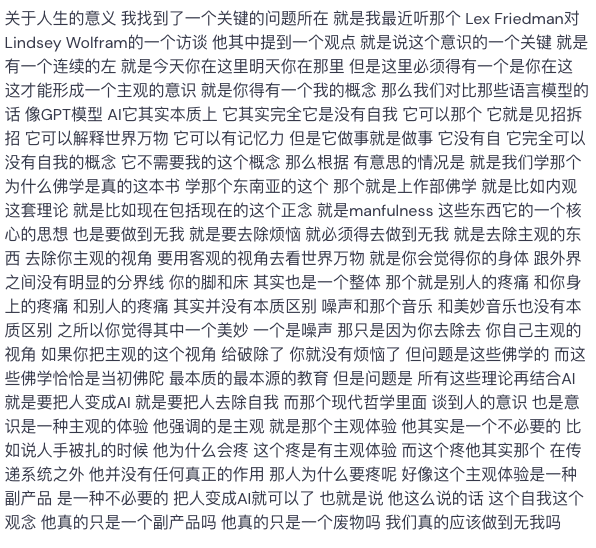
I suspect it’s using OpenAI’s Whisper speech model. Mind you I’m usually prone to slurring my words, and was still lying in bed whispering, and Chinese interspersed with English. The model automatically recognized both languages, and the overall accuracy was very high. The recognized text has no punctuation, no segmentation, there are a number of places in the middle of the model misheard, and I said nothing, not sharp, a lot of repetition. If you read the passage directly, the reading experience is extremely poor.
The magic happened in the second step. I didn’t need to do anything, AudioPen automatically organized the passage into a smooth written language based on my pre-set style – the
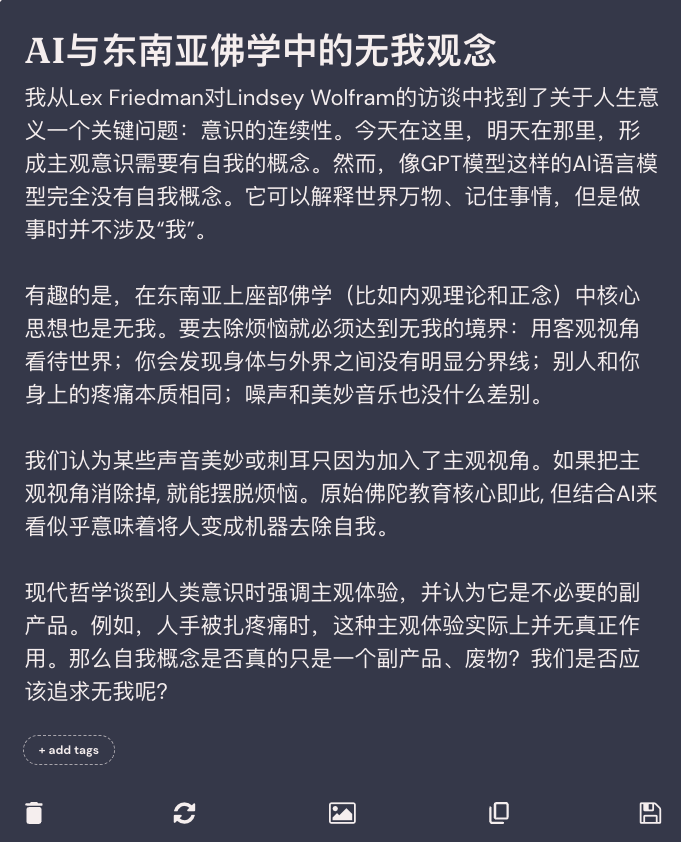
You see now if the passage is not just quite readable. Not only is the language fluent, but the meaning is clear, and it’s divided into paragraphs.
This is just like you have a proficient secretary beside the words, you casually say, he gives you a good organization. He can even organize it directly into English or any other language, which can be long or short.
This thing is so useful. It can keep track of what you’re thinking; it can generate an e-mail just from your dictation, and it can be in a foreign language; it can take minutes of a meeting; it can turn your scattered conversations directly into an essay.
You don’t have to use AudioPen; related tools have been popularized. You can use any speech-to-text tool to generate raw text without being particularly precise; you can also throw raw text directly to ChatGPT, which provides a more nuanced output.
✵
That’s rewriting. Aside from programming, I think rewriting is one of the most useful everyday features of GPT. Rewriting is any operation on a piece of text, which can be -
Translate a text into another language;
change one language style into another, e.g. from strict to relaxed;
:: To change one tone of voice into another, such as informal colloquialisms into a formal, polite letter;
Generating a summary of a long passage;
Generating an executive summary of a long video with the help of a plug-in;
Extract key information from a document and do categorization and labeling ……
These things aren’t easy for people either, you need to have some writing skills, you need to take the time to carefully read the original text, you need to make judgments and trade-offs - but now AI does all this not only easily, but also accurately, and most importantly, exceptionally fast.
Let’s look at one more advanced use. in April 2023, famous computer scientist Ernest Ng and OpenAI collaborated to launch a “ChatGPT Prompt Engineering for Developers” course [2], focusing on how to program GPT to batch process documents. Let’s say you’re in charge of a company’s customer service operations, and you guys are getting tons of user reviews. You want to use AI to read, judge, categorize, and selectively respond to these comments, which GPT can now do very well.
For example, here is a user review [3] for a particular electric toothbrush:
My dental hygienist recommended an electric toothbrush, which is why I purchased this one. So far, I’ve been impressed with its battery life. After the initial charge and keeping the charger plugged in for the first week to take care of the battery, I’ve unplugged the charger and have been using it to brush my teeth twice a day for the past 3 weeks, all on the same charge. However, the toothbrush head is too small. I’ve seen baby toothbrushes bigger than this one. I wish the head of the toothbrush was bigger and the bristles were a different length to better clean the spaces between the teeth because this toothbrush doesn’t do that. Overall, if you can get this toothbrush for around $50, it’s a good deal. The manufacturer’s replacement brush heads are quite expensive, but you can get a more reasonably priced universal brush head. This toothbrush makes me feel like I go to the dentist every day. My teeth feel sparkling and very clean!
This user rambles on and on, but there’s really just a little bit of key information. What you want to know is firstly, whether the sentiment of this review is positive or negative and secondly, what she said about the pros and cons of the product.GPT is very good at extracting this information.
The prompt sets up a scenario of a user review on an e-commerce site and then asks to summarize the review in up to 20 English words:
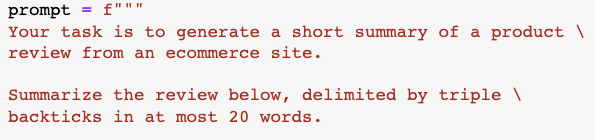
GPT Output: ‘Long battery life, small toothbrush head, but cleans well.’ If the purchase price is around $50, then this is a good deal.” Exactly the information you care about most.
With a little bit of simple programming, you can have GPT output the sentiment value and key information for each review in a fixed format, and then automatically reply to all positive sentiment reviews with a thank you, reply to all negative sentiment reviews with an indication that our customer service staff will help you solve the problem, and actually list the problem the customer reported in the reply.
That is to say, now “get” can let AI is responsible for selecting and replying to readers’ comments …… but we choose not to do so.
✵
By May 2023, all paid ChatGPT users will have access to GPT-4 with Internet access, Google has launched a new generation of Bard, which is faster and inherently Internet-enabled, and Microsoft’s New Bing, so letting AI search for information on the Internet on your behalf can be considered a common occurrence. So what’s the difference between researching with AI, and searching online yourself?
One is to help you save time.AI can search for relevant information by itself according to your intention and generate a comprehensive report for you. For example, I asked ChatGPT, what are the advantages and disadvantages of the new AI grand model released by Google, compared with GPT-4? It browsed through a number of web pages and provided me with the following answers -
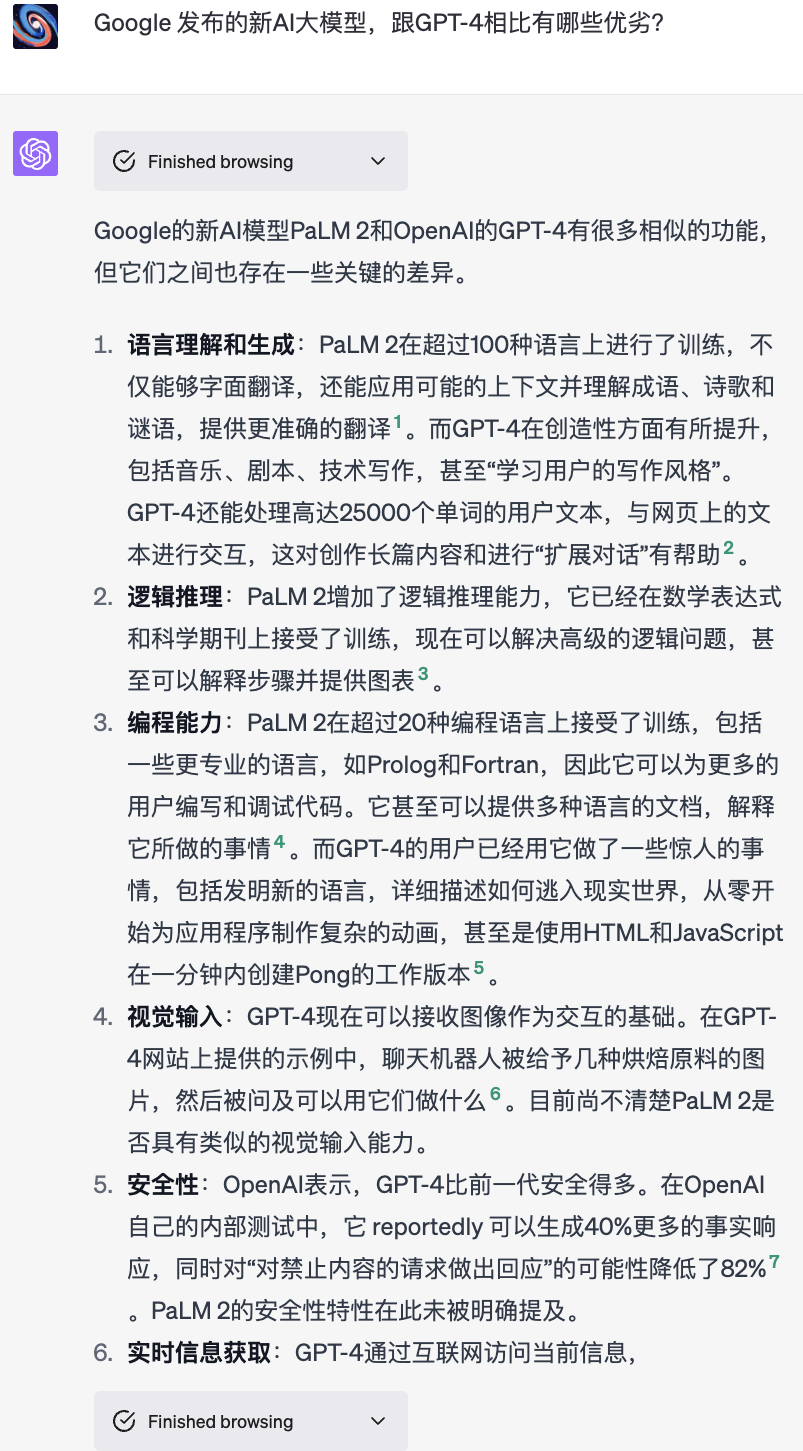
It doesn’t do a perfect job and sometimes fails to access, but it can be said to have been very useful. For example, if you want to research the reputation of a car, the reputation of a law firm, the admission procedure of a public high school or something, it’s not that you can’t do it by yourself, but it’s time-consuming and meaningless, and you just want to find a random person who understands it to give you a few words, then letting the AI do the research is the best way to do it.
And there is a kind of research, but the traditional search engine is difficult to do, have to use AI to do to be good. For example, I saw a movie many years ago, I just vaguely remember the plot, but the title, the actor’s name and other keywords all do not remember. How can I search in such a case, ChatGPT can help me–
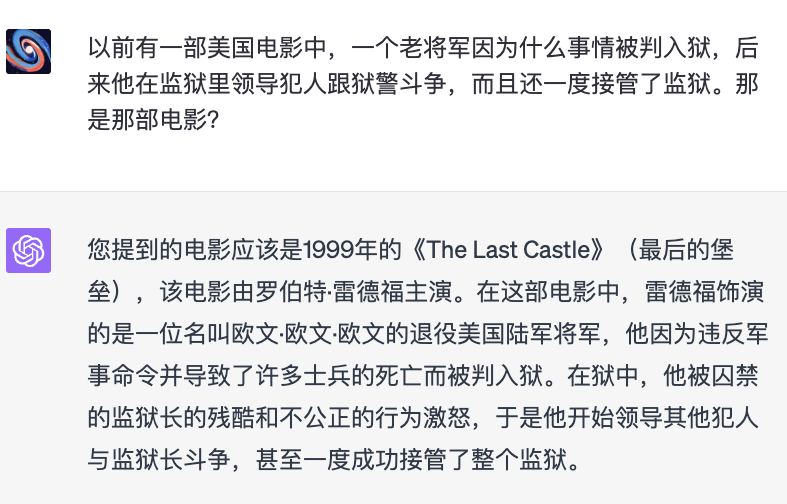
GPT-4 says the wrong year the movie came out (it should be 2001), but it does say the movie I’m thinking of.
Don’t underestimate this kind of dialog, this is an upgrade from the old keyword search, to content search, and arguably even to pattern recognition. Let me give you another example.
Have you noticed, the general public is very like the behavior of the slovenly, unkempt, and preferably also give the impression of a very poor image of scholars, such as wearing rags of academicians and mathematicians who eat only steamed bread every day. The public may think that people who really do scholarly work should be like this, just as in martial arts novels, the highest kung fu master must be the most humble appearance of the “sweeping monks” …… I think this is a cognitive bias, but I do not know if someone has already summarized this pattern, or even proposed any theories about it. Then I could ask AI–
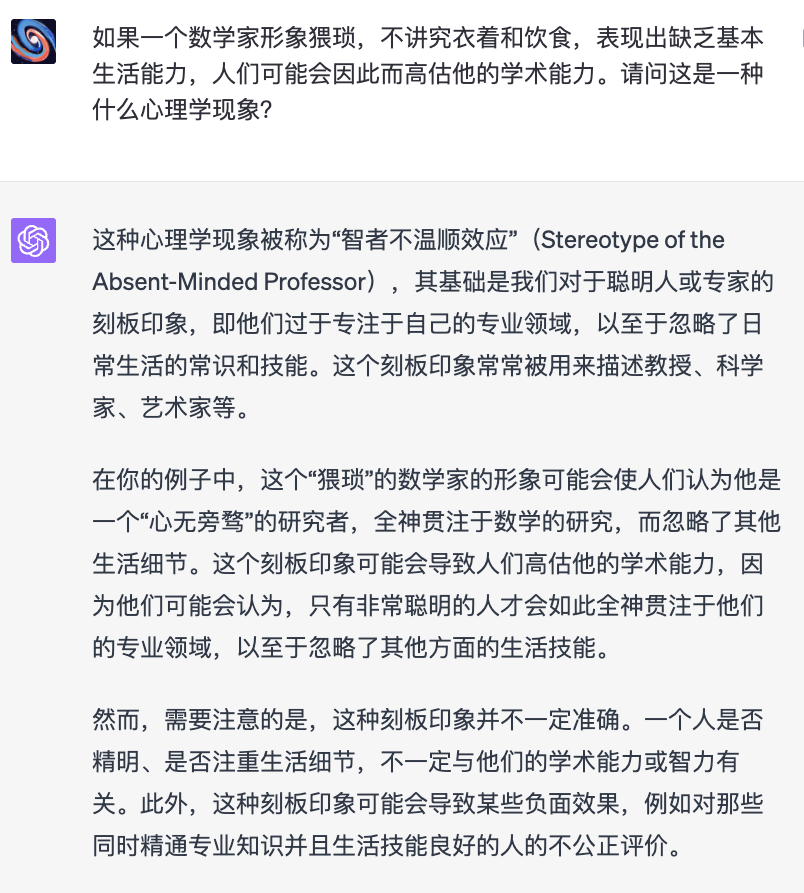
ChatGPT says that there is indeed such a general phenomenon called “Stereotype of the Absent-Minded Professor”. The term it says is not accurate in Chinese, it should actually be called “Stereotype of the Absent-Minded Professor”, but that English term is accurate.
This ability is especially useful for writing articles and doing research. Maybe the phenomenon you observe has already been observed and studied by someone else, so you can avoid reinventing the wheel by looking at what they say first. I often ask GPT questions like “Is there a theory that says ……”, “What kind of psychological phenomenon is this”, “Is there a famous quote or proverb that says ……” questions like this.
It doesn’t always give me good answers, and you always need to do some personal research to know if what it says is accurate, but it often does. Quick questions like this are not only a thinking aid, but they make you more sensitive and you observe more interesting phenomena.
✵
Writing is an innate ability of generative AI, you have to write a product synopsis to post on Taobao, a thank you letter to a requesting customer, including some kind of commendation in your unit’s internal publication, ChatGPT can help you do it well. Nowadays, note-taking tools like Notion have integrated AI features, so it’s easy to abbreviate, amplify, and rewrite. But rest assured, I certainly won’t use AI to write a column for you to read, I won’t use a single sentence. Why?
Maybe AI can write better than 90% of the population. But if you’re going to publish your work publicly, or even get paid for it, you’d have to be in at least the top 100,000 out of over a billion Chinese, and that means you’d have to write better than 99.99% of the population to do so. Your outlines, material, argumentation methods and language had better be new and interesting, something that AI would have trouble coming up with to be good.
But the AI can still help you. The one I use most often is ‘brainstorming’. For example, if I want to make a point about something, and I feel like I’m missing a stronger example or argument, then I can ask ChatGPT. it might give me six arguments, two of which I’ve thought of as well, and two of which don’t work, but often there’s always one or two, which are illuminating to me.
It would be sloppy to just put the arguments the AI gives you straight into an essay, you need to do a little more research and then put it in your own words.
Another approach is for me to set the title and rough main idea of an article and write the opening first paragraph, then let the AI finish the whole thing. This is the most typical ‘predicting the next word’ and is the watchword of GPT. For example, in the following example, I conceptualized an article called “The Messenger of Mediocrity and the Messenger of Surprise”, I wrote the opening and the executive summary, and asked ChatGPT to investigate the relevant theories to generate this article –
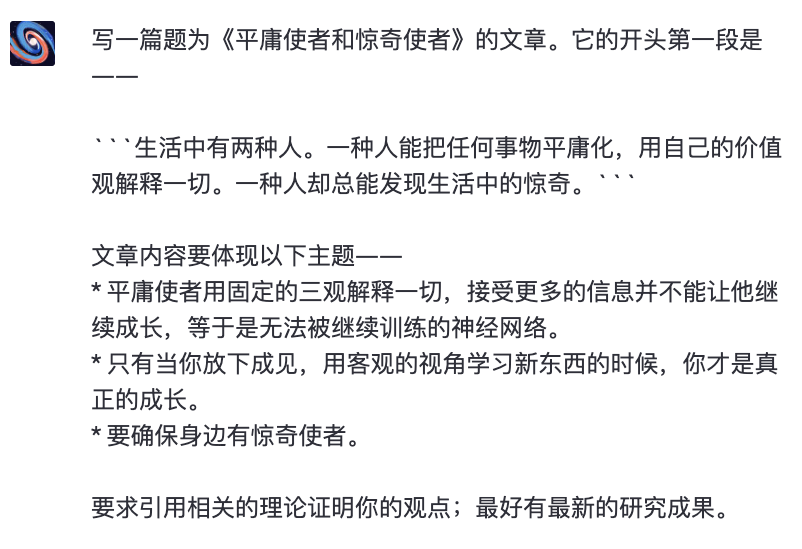
It went and did a bit of searching, which didn’t work very well, and many of the pages wouldn’t open …… However it did find a theory to support the article’s points –
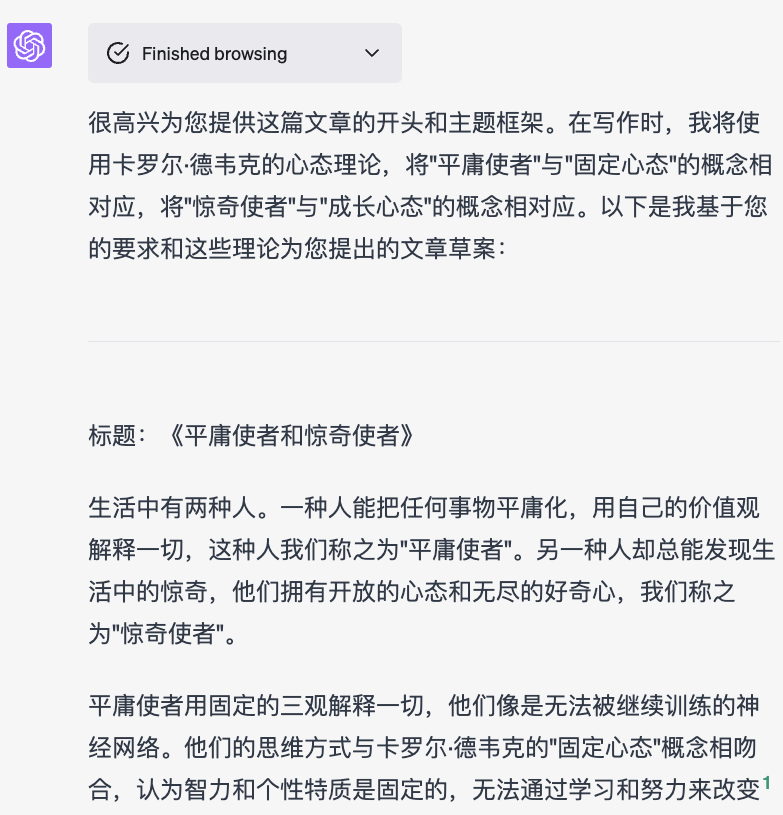
It’s just a shame that that theory is one that our column readers have long been familiar with, and it’s not interesting, so I won’t be using it.
That’s the day-to-day of a columnist’s job; you go through a lot of failures to find the good stuff. the AI’s task here isn’t really to put the article together for me, it’s to generate a piece of content with a certain level of sophistication for me to refer to: maybe there’s a point or two in it that I can learn from; and even if there’s nothing in it, I at least have an idea of where the baseline for the ‘average level’ is.
I’m not going to tell you where in which column I referenced the AI. But you can understand the manipulation.
Able craftsmen copy their shapes, and skillful artisans take their souls. Did I use the AI? Yes, I did. Did I have any AI-generated content in my article? No. This is called “using AI in an invisible way”.
✵
I hope this talk has inspired you in your work. If you have any interesting usage of AI, feel free to share it in the comments section as well. We are done with this AI topic for now, let’s calm down and wait for the next big AI event.
Notes
[1] This program is Lex Fridman Interview with Stephen Wolfram: ChatGPT and the Nature of Truth, Reality & Computation | Lex Fridman Podcast #376, May 9, 2023. https://www. youtube.com/watch?v=PdE-waSx-d8
[2] Isa Fulford and Andrew Ng, ChatGPT Prompt Engineering for Developers, https://www.deeplearning.ai/short-courses/chatgpt-prompt- engineering-for-developers/ This class is good, short and free, recommended.
[3] The original text is in English, I used ChatGPT to translate it into Chinese.