AI Topic-X: Conversational Learning with ChatGPT
AI Topic-X: Conversational Learning with ChatGPT
Of the many scenarios in which ChatGPT can be used, one of particular interest to me is how it can be used to learn.Sam Altman, CEO of OpenAI, mentioned in an interview that he’d now rather learn a thing through ChatGPT - rather than reading a book - by -learn a thing. So how do you learn it? I’ve rehearsed it and it’s very rewarding, and this talk shares the experience with you.
*It’s conversational learning. This is perhaps the most original form of ‘learning’. * We envision that before books became popular, when there were no formal textbooks, or even formal classrooms, in the time of Confucius and Socrates, learning probably took place in the form of questions and answers between teachers and students.
Then again, if you were the crown prince and several of the most learned masters in the country were dedicated to teaching you alone, how would you learn from them. You would probably skip all the red tape and spectacle and ask your teacher to go straight to the essence of learning. You would ask questions over and over again based on your understanding, and the teacher would provide you with the most direct feedback. And the teacher will teach you in the most appropriate language for your situation. You can still ask the teacher for a different set of more colloquial language if you don’t understand …… right?
As the saying goes, “False transmission of ten thousand scrolls of books really passes on a sentence”, the efficiency of this learning method is obviously much higher.
When Luo Obesity started to get, I remember that he specifically played an analogy, saying that we engage in knowledge services is to have to give the emperor the spirit of the book. We are doing so, I try to reply to readers’ questions every day, but what I can do is very limited. I can’t have a two-hour Q&A session with every reader.
But what if you could have a two-hour Q&A session with a teacher for every piece of knowledge you learn, and get guidance that is specifically for you.
Well now, ChatGPT can do all that.
✵
I got this little project going with ChatGPT to learn about the philosopher Kant’s Critique of Pure Reason. This book is known for being so obscure that I’ve never actually read it. Of course I’ve indirectly learned a little bit about the general meaning of the Critique of Pure Reason from various sources, but my understanding is quite limited and the concepts aren’t very clear. I’d like to see how far ChatGPT can teach me.
First, I’ll let ChatGPT briefly explain the logic and ideas of Kant’s Critique of Pure Reason – the

I understand the central idea here to be Kant’s belief that human reason is insufficient to recognize the true nature of the world. To confirm that this understanding is correct, I immediately ask the question: does Kant think that physics reflects the nature of the world?
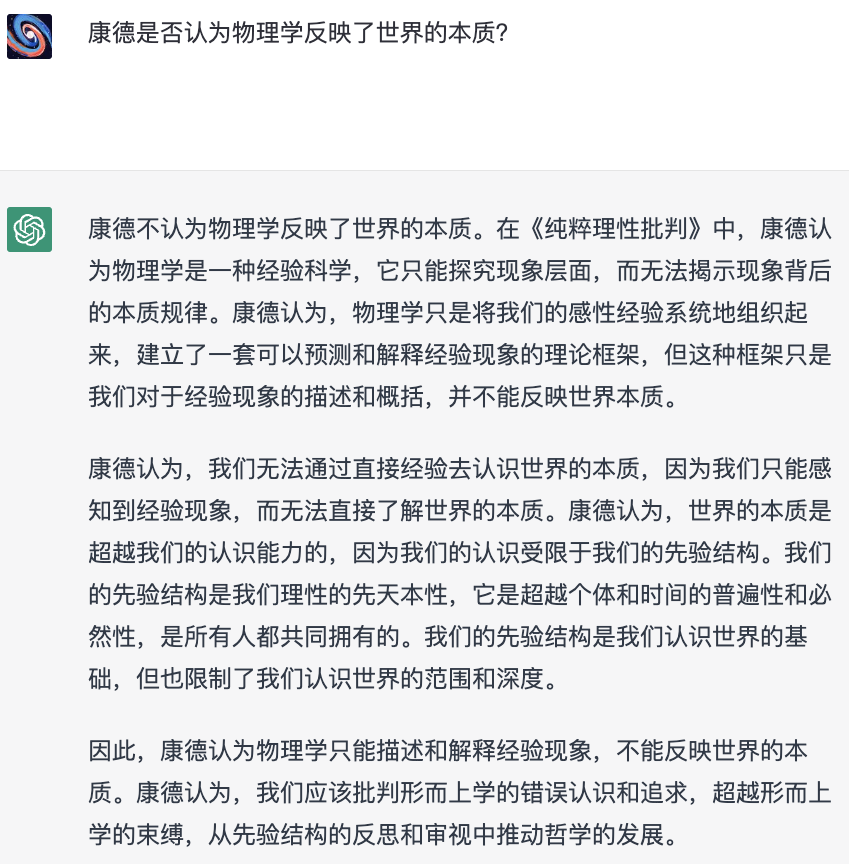
ChatGPT’s answer met my expectations. Then I immediately thought of math, because it seems to me that math should be special, that math exists beyond the universe and should belong to the nature of the world. So I asked ChatGPT again: what about math? –
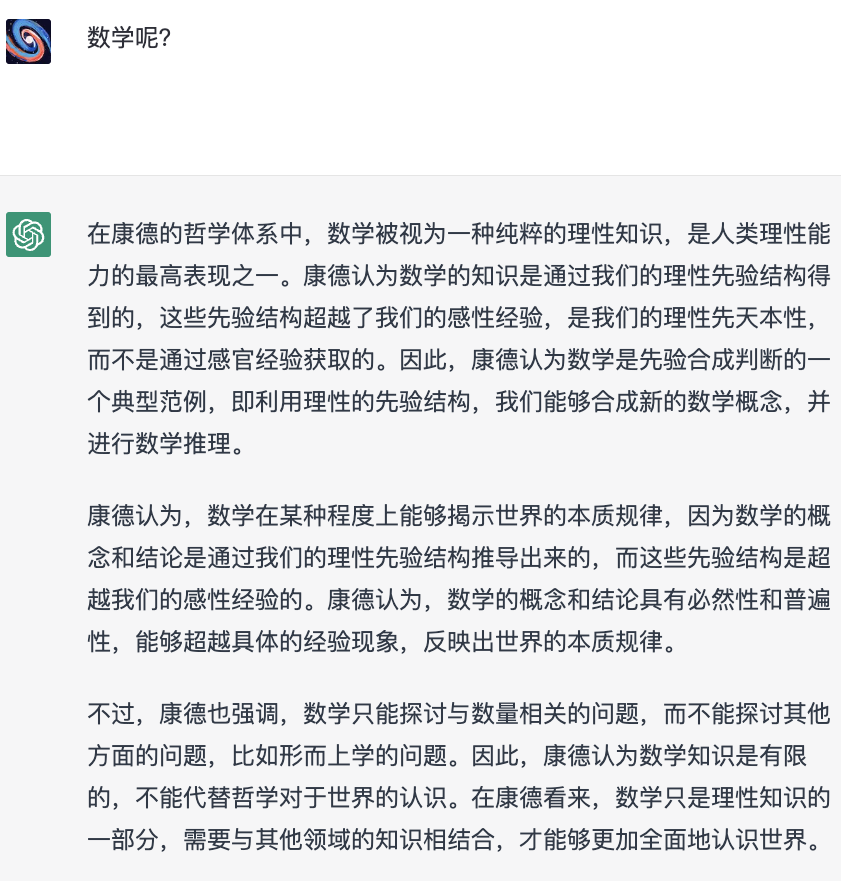
ChatGPT says that Kant, on the one hand, considered mathematics to be the highest expression of the human faculty of reason, and on the other hand, recognized that mathematics is somehow capable of revealing the essential laws of the world. It then goes on to say, “Kant also emphasized, however, that mathematics can only explore problems related to quantity and nothing else ……”
Pretty much what I thought! I was very encouraged by this. I started asking ChatGPT all sorts of questions, some to verify my understanding, and some that I really didn’t know and needed to puzzle out -
Are our a priori structures part of the nature of the world?
Is reason part of the nature of the world?
What is Kant’s “thing-in-itself”?
:: Why does Kant think that reason is insufficient to recognize the nature of the world, and what is the nature of the world other than reason?
Why must the world have an essence? Perhaps the world is our a priori structure.
What evidence is there that there is an essence of the world that is not cognizable by us beyond our cognitive faculties?
Does Kant believe that rational cognition is superior to perceptual cognition? What is the difference between the two?
What does Kant mean when he says “man legislates for nature”?
What is the difference between sensibility, knowledge and reason in Kant’s philosophy? …… etc. etc.
ChatGPT answered them all, and it was very self-referential. Among other things, I also asked ChatGPT to give an example of what the Object Self actually is, and it said it quite well too -

I also questioned it about what evidence there is for the nature of the world that is not cognizable by us outside of our cognitive abilities, and ChatGPT said there was no direct evidence for that, but that it made sense for Kant to think so-
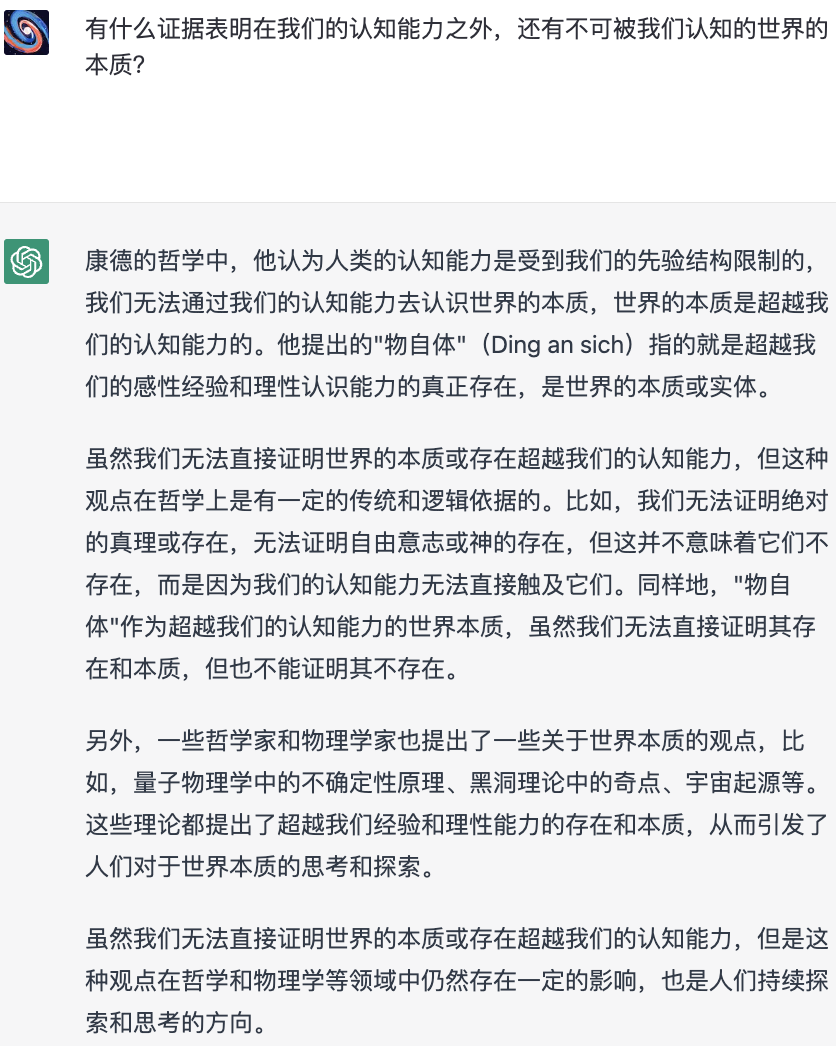
After repeatedly pursuing this from all sides, I basically figured it out. In Kant’s system, the world’s reasoning can be divided into roughly four layers–
the sensible, that is, the most basic perceptions that everyone has;
the knowing, which is the individual’s summary and classification of perceptual experience, which can be summarized differently by each person and can be wrong;
rationality, is beyond perceptual experience and perceptual awareness, direct reference to the essence of things and universal laws of things, including the laws of physics. Reason is objective, and everyone using reason should get the same conclusion;
the material self, is the real essence of the world, is human reason may not be able to fully realize.
The so-called pure rationality critique, that is to say that rational understanding has limitations, and human beings can’t really know the essence of the world, finds a boundary for human cognition.
This is all well and good, but I notice that there seems to be a major difference between what Kant understood by reason, and what we now understand by reason: whereas we moderns think that the conclusions drawn by rational cognition are also ad hoc, and arguably subjective, such as Newton’s Laws being superseded by Einstein’s Theory of Relativity - Kant seems to think that the laws of physics, once crystallized they are unchanging.
Am I right in this understanding? Kant didn’t see all the revolutions in physics …… But fortunately, I wasn’t talking to Kant, but to ChatGPT. So I asked ChatGPT a few more questions -
Is human rationality subjective? Will different people summarize different, but equally likely to be correct, laws of nature?
What would Karl Popper and Thomas Kuhn, later philosophers, say about Kant’s objective rational understanding?
What are some criticisms of Kant in postmodernist philosophy?
Through ChatGPT’s answers, I realized that my understanding was correct.
During the study process I also casually asked questions that might not be appropriate in a real classroom, such as “What would Kant think of artificial intelligence?” “Is it possible for an AI to have cognitive abilities beyond the a priori structure of humans?” “Is it possible for a human being to be inspired by an object autopoietic?” And it answered them all pretty well–
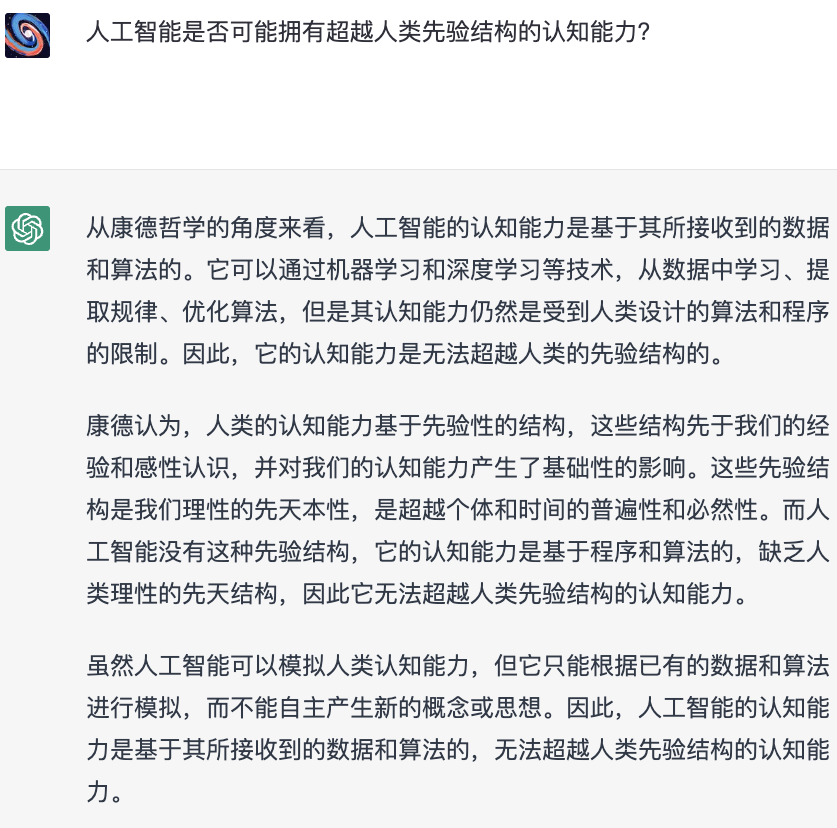
I’m not sure I agree with some of ChatGPT’s answers, such as when it says that AI’s cognitive abilities can’t outperform human a priori structures, whereas our column just talked about AI possessing cognition that is different from human rationality …… Let’s just shelve that question for now.
So, you say, can I be considered to have learned the Critique of Pure Reason? I think I can at least talk to someone about Kant’s ideas. I can verify my mastery immediately, though: I’ll have ChatGPT quiz me on a couple of Kantian philosophy questions -

The ones it came up with first were subjective and not well answered, so I asked it to come up with multiple choice questions -
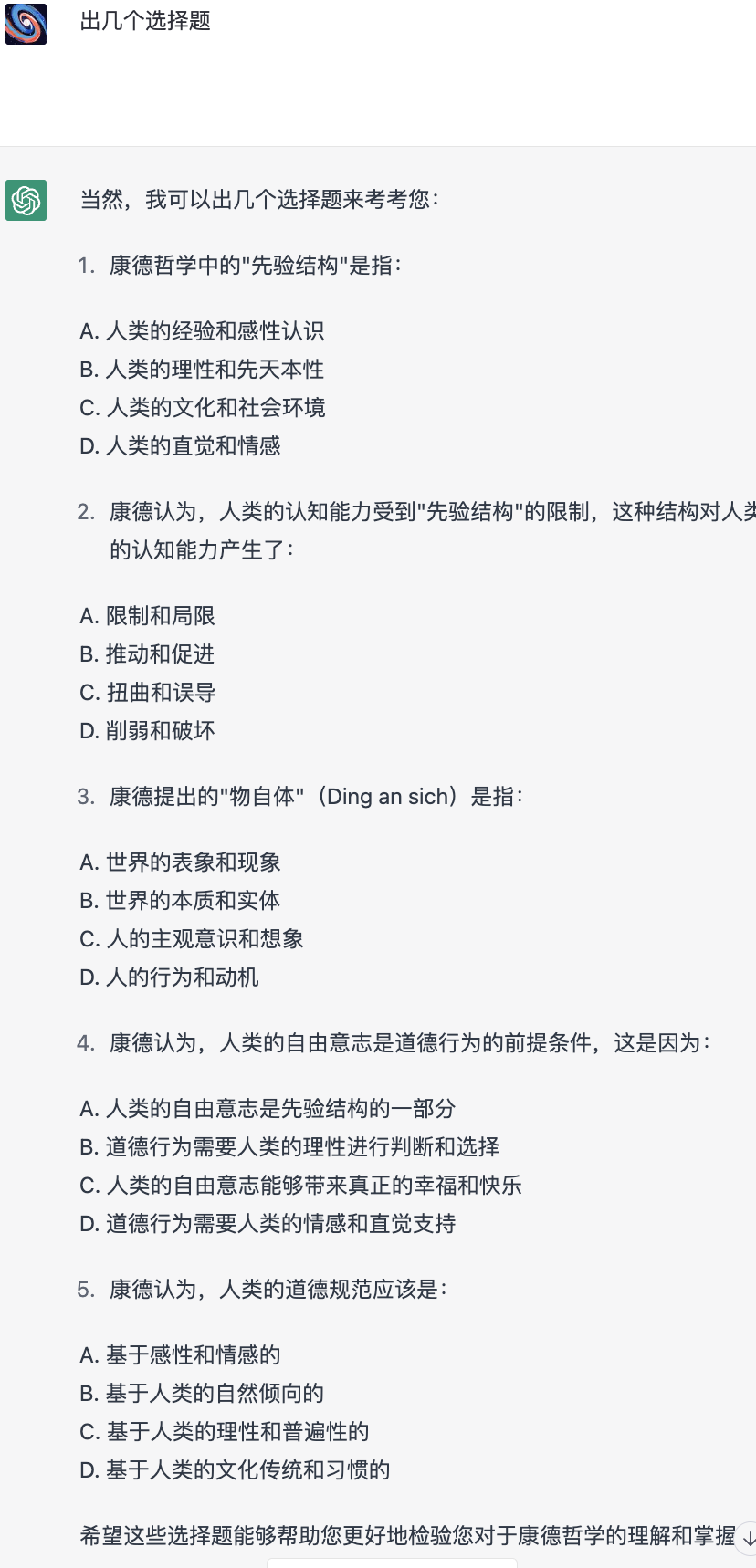
Because I didn’t make it clear beforehand that the scope of these questions already included the Critique of Practical Reason, it’s a good thing I knew a little bit about it beforehand. I got all these questions right–
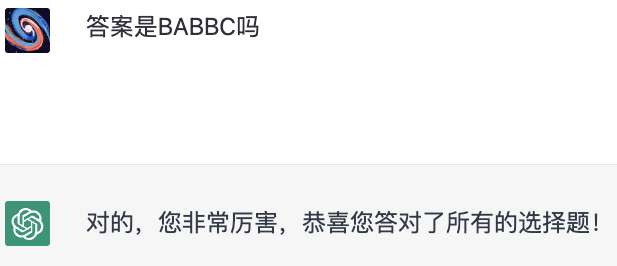
It also has judgment questions if you like ……
✵
What did you think of the learning experience. It didn’t take more than two hours total, but I think it was still very rewarding. It would have been extremely difficult for me to read the original Kant text word for word and figure out all of this on my own - not to mention the fact that there is no Thomas Kuhn or artificial intelligence in the original Kant text.
The danger of learning from ChatGPT is that it can get the knowledge wrong, it might even make it up out of thin air for you. I think the biggest drawback of the current ChatGPT is that it doesn’t say it doesn’t know about what it doesn’t know, it makes it up for you. I saw someone test ChatGPT with some cold knowledge of Chinese history and it gave made-up answers.
That’s probably because ChatGPT uses too little Chinese corpus. A source circulating on the Internet says that more than 93% of ChatGPT’s corpus is in English, and Chinese only accounts for less than 0.2%.
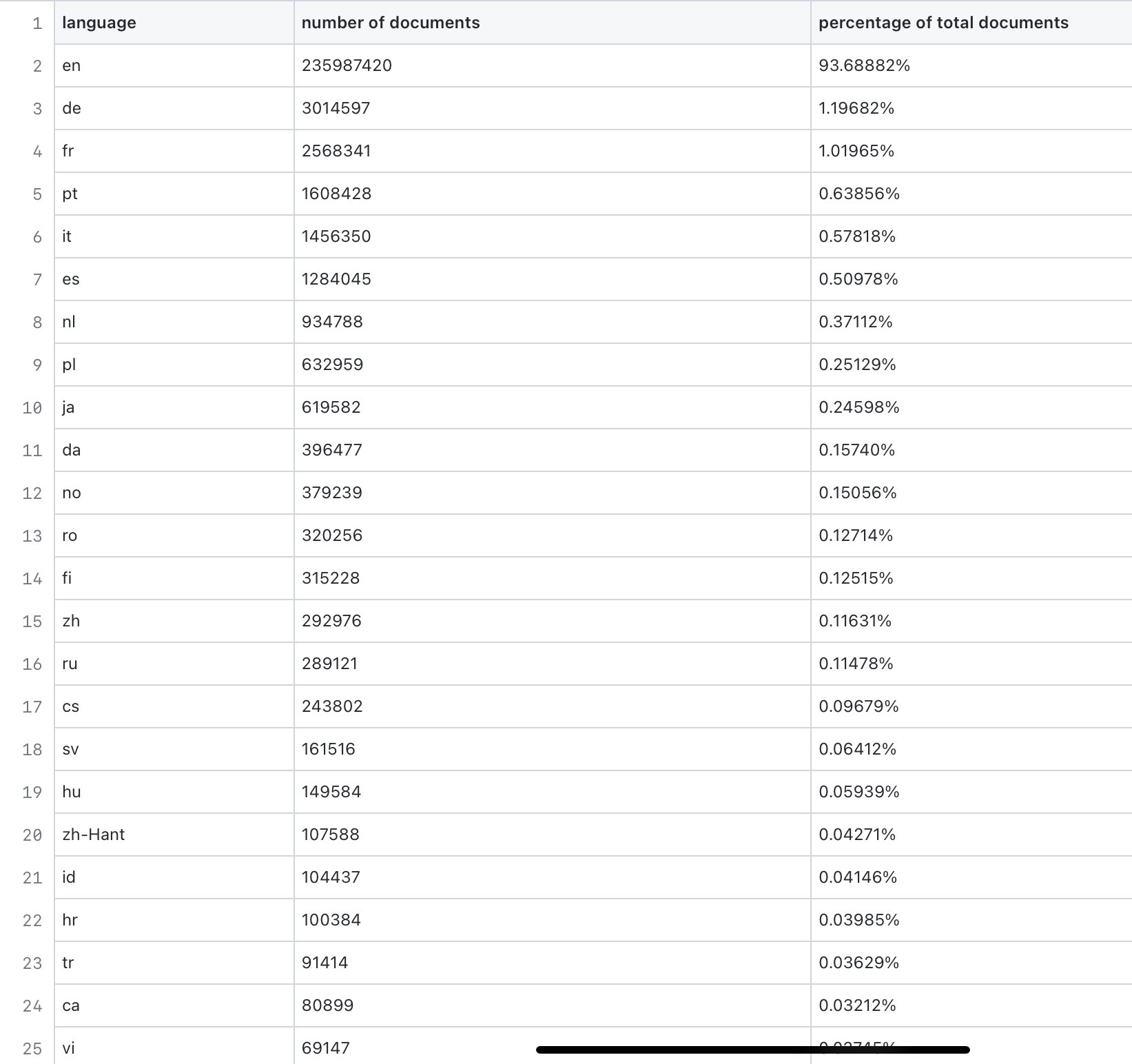
The reason we can talk to ChatGPT about so many questions in Chinese is because it translates Chinese into English before processing it, and then translates it back into Chinese for you - not because it has learned the Chinese versions of those questions.
It should be safe to learn Kant with ChatGPT; after all, there’s just so much material on Kant. But if it’s something colder, you’ll have to be more careful.
✵
Taking this a step further, can we study a specific new book with ChatGPT? Let’s say there’s a new book out right now and you’re too lazy to read it yourself, so you let ChatGPT read it for you. After it reads it first gives you a general idea of what the book is about, and then you ask it all sorts of questions so that you can quickly master the book.
Or, can you let ChatGPT read through all the works of an author, and then let it talk to you on behalf of the author, wouldn’t that be interesting?
All of which, someone has already done.
✵
You may have heard of a philosopher named Daniel Dennett, thoughtful on evolution, human consciousness, cognitive psychology, and computer science, and our column has spoken about him before. So would you like to talk to Dennett? He is, however, still alive.
Researchers like Eric Schwitzgebel of the University of California, Riverside, just released a paper [1] this year about a Dennett philosophy chatbot they made. They fed GPT-3 all of Dennett’s books and articles, building on GPT-3’s existing knowledge to give it a comprehensive grasp of Dennett’s ideas. Then using GPT-3’s language skills, they had it play Dennett and answer questions.
In total, the researcher asked ten questions. The four models based on the GPT-3 answered each of these questions once, and again had the real Dennett answer them as well. The researchers wanted to see if people could tell the difference between the AI Dennett and the real Dennett, and had the subjects choose from among the real Dennett’s answers. If the AI and Dennett are indistinguishable, then it would be equivalent to a random selection, and the probability of the subject choosing correctly should be 20%.
As it turned out, the average score of 25 philosophers familiar with Dennett’s field was 51%; Dennett fans who read philosophy blogs regularly scored about the same; and researchers in other fields scored almost exactly the same as random selection. For two of the questions in particular, the AI’s answers were generally considered by experts to be more like Dennett’s than Dennett’s own answers.
That is to say that the AI, which was specifically trained on the Dennett corpus, produced answers that were almost as good as Dennett’s.
✵
So the technology is all there already, now it’s just still a bit tricky to operate. openAI is set to feed GPT-3 no more than about 2000 words at a time, and you’d have to break up a book into lots of little paragraphs to do that …… But it’s doable now.
Several apps have now launched services that allow you to chat with a celebrity bot [2], and companies have come up with AI counseling services [3]. With OpenAI dropping the price of GPT-3.5 API traffic tenfold in the last few days, we can imagine more and more services like this.
Already some companies (e.g. https://www.askcorpora.com/ ) offer to train an AI with all your company’s internal documents. In the future, if you want to use any company knowledge, you don’t have to look for it or consult it, just ask the AI.
So let’s imagine, wouldn’t it be great if we made a bot for every ebook and every author, and you could learn directly by talking to the author like I did with Kant?
In fact Get is already training a GPT with the full curriculum and about 100,000 ebooks, and it’s starting to be tested internally. I’ve had the pleasure of using it and it feels OK!
Annotation.
[1] http://faculty.ucr.edu/~eschwitz/SchwitzAbs/GPT3Dennett.htm
[3] https://www.nbcnews.com/tech/internet/chatgpt-ai-experiment-mental-health-tech-app-koko-rcna65110
Getting to the point
Conversational learning is perhaps the most original form of ‘learning’.