AI Topic 8: What leadership skills are needed in the age of AI?

AI Topic 8: What Leadership Skills Are Needed in the Age of AI?
With the recent onslaught of ChatGPT, we are in dire need of new ideas to understand this new era of AI. I have bought basically all the new AI related books and will report back to you as soon as I can.
The logical order of our little topic is from macro to micro. Having previously talked about the philosophy of how to understand this big era, and talked about macro business and economics, this topic begins to talk about micro business, specifically company leadership.
What is the difference between a company and a company in the AI era? How is the value of leadership reflected? To put it bluntly, how can this company make more money than others?
✵
Let’s start with a small example: after OpenAI lowered the price of API traffic by 10x, countless small GPT-based apps sprang up within days. Many of them are amateur individuals who write a few lines of program to get a website and implement a feature to attract a lot of people to use it.
We talked earlier about how one of the most needed services is to input a book to GPT and then learn it with a quiz. As a result, there are now several such applications, the hottest of which is called ChatPDF. it was launched in less than a week there were 100,000 PDF uploads, and in ten days there were more than 300,000 conversations-
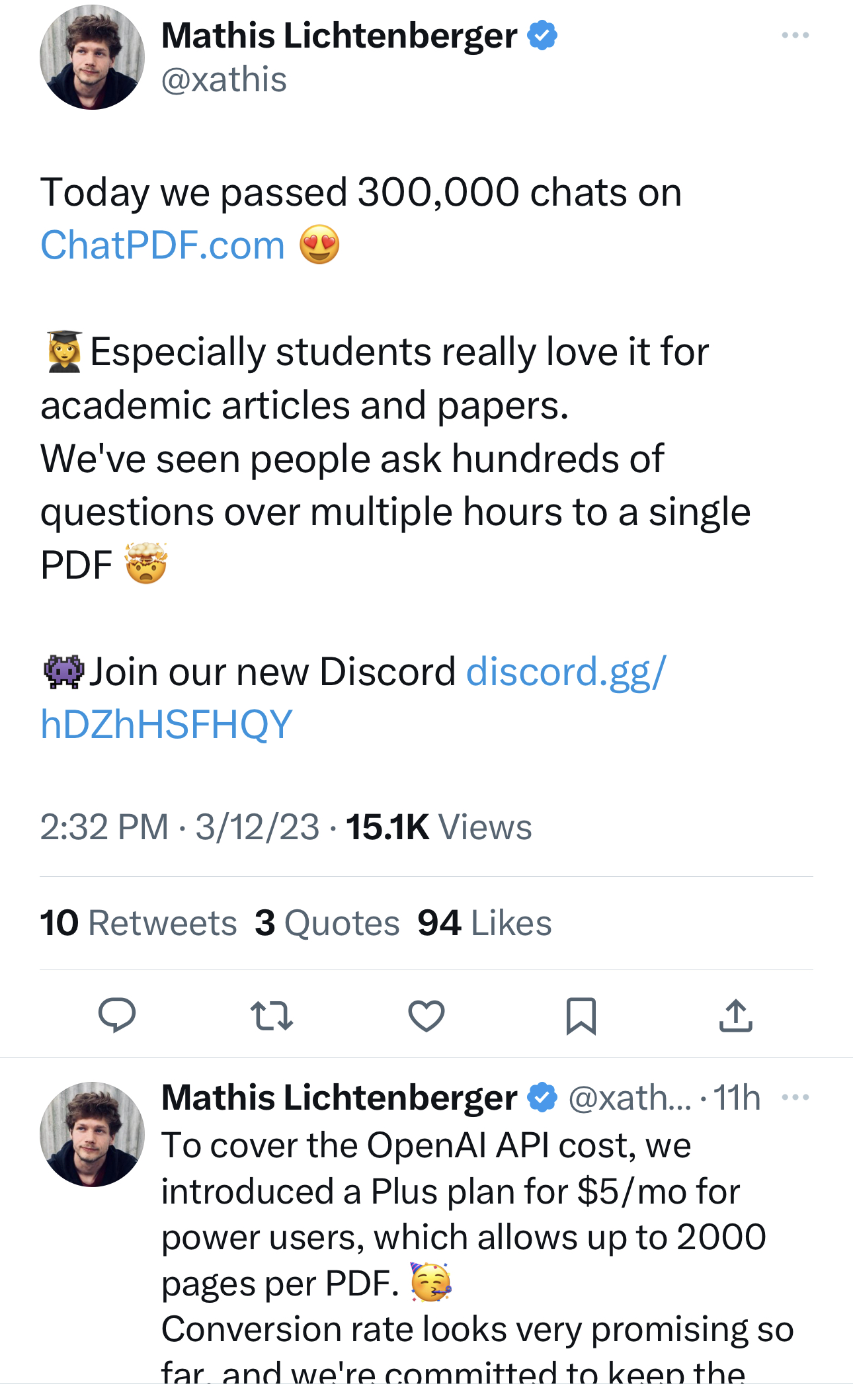
Then it launched a paid service for $5 a month and started making money.The author of ChatPDF only had three thousand Twitter followers, but now there are countless people on Twitter talking about this tool.
Everyone started from the same place, so why did ChatPDF steal the show? All the tools needed to start this site were readily available, and its popularity didn’t come entirely from AI. was it just because it got lucky?
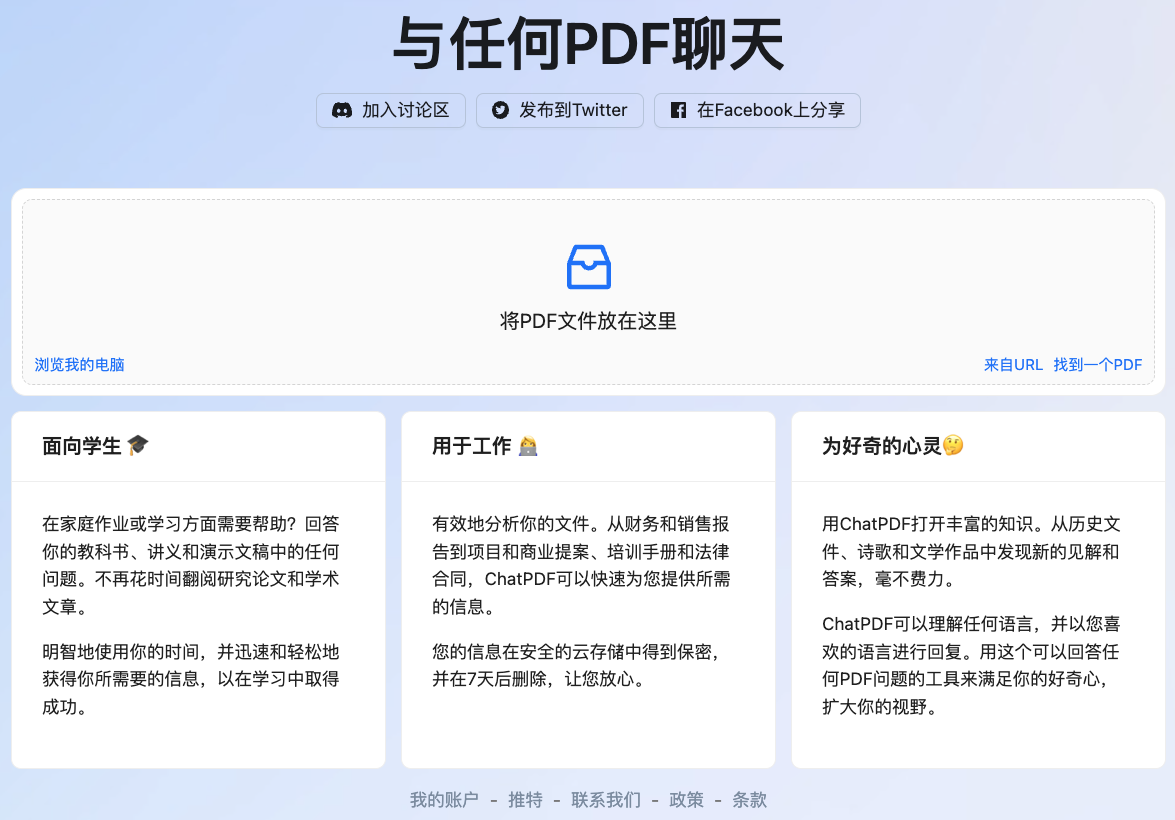
The ChatPDF website has a clean and user-friendly interface. It’s straightforward to get started, and also explains what the thing does for students, for work, and for the generally curious, respectively. It has two levels of service, free and paid, and the free is also useful and the paid is cheap. It also has its own user community.
By contrast, competitors, such as PandaGPT, do a good job as well, but are so much less intuitive and user-friendly in every way -
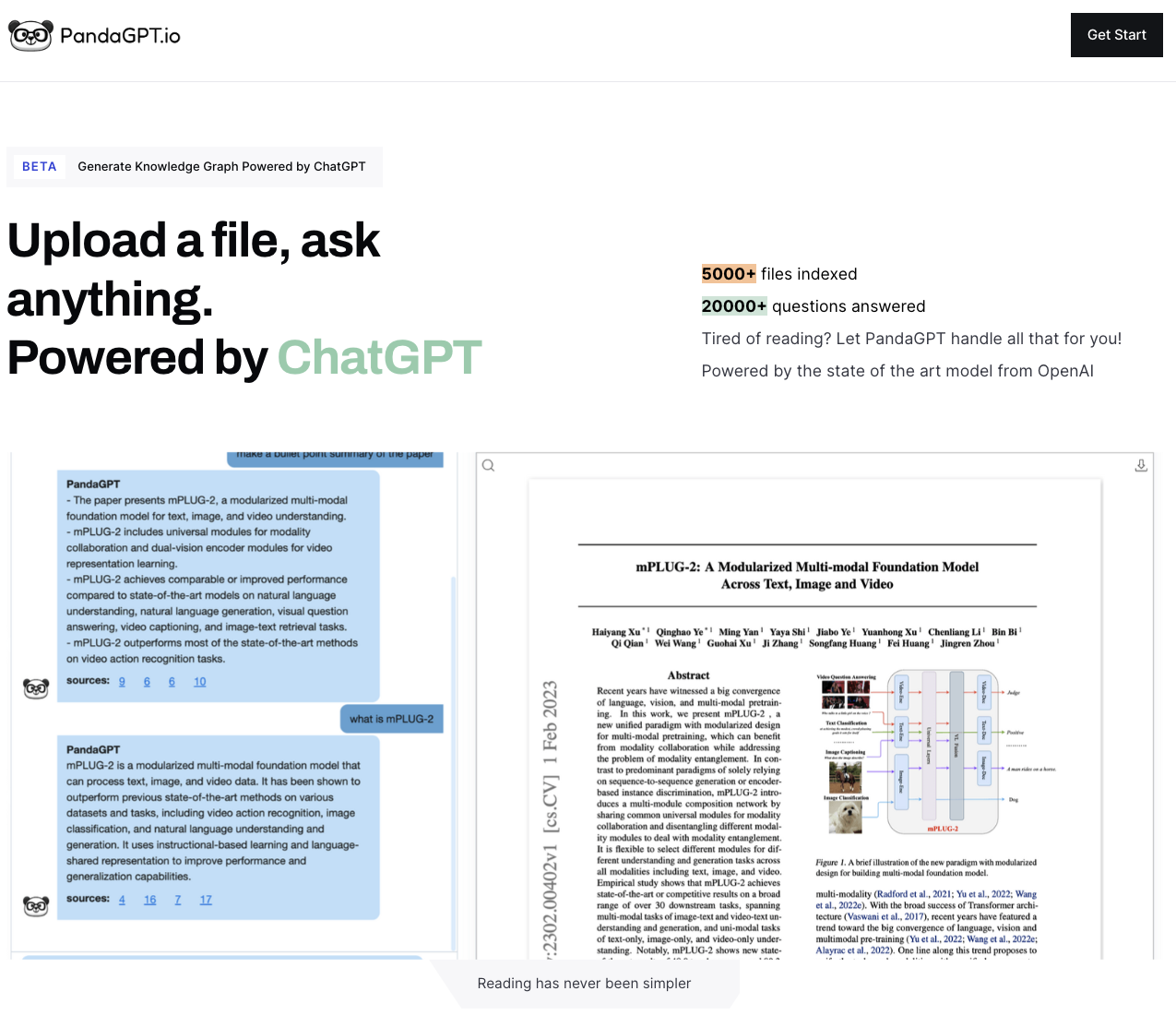
This little bit may seem simple, but it’s not easy to do. You have to understand the user very well in order to provide the most comfortable experience.
This little bit is perhaps the most valuable skill in the age of AI.
Nowadays, only general necessities like pork are only about quality and price, most goods have to be about branding and market positioning, and especially in the internet age it’s also about interaction with the user. For this you need two things -
First, you need to understand very well what users want nowadays.
Second, you need to be recognized.
That is, recognize and be recognized, understand and be understood. And these are exactly what AI can’t give.
✵
Let’s start this talk with a new book just published on February 28, 2023, The Threshold: Leading in the Age of AI.
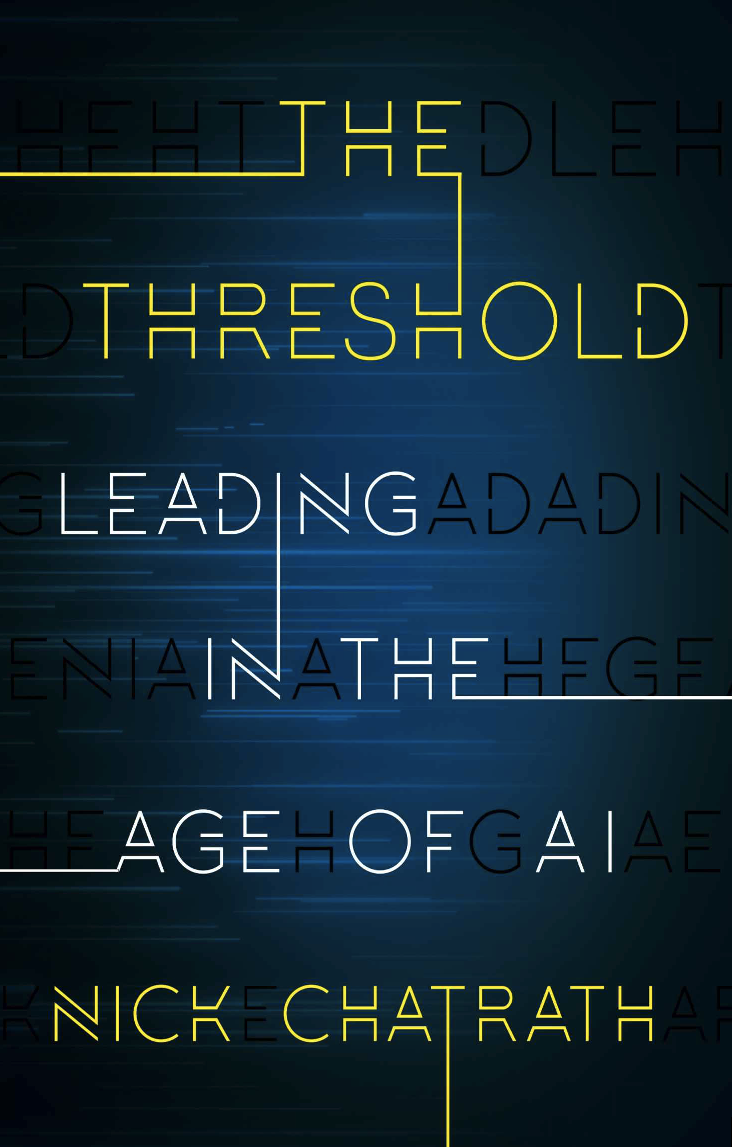
The author, Nick Chatrath, is a business consultant, now starting his own business, and formerly a consultant at McKinsey.

This book is about what leadership should look like in the age of AI. Chatrath’s suggestion is called ‘Threshold’, meaning the middle of two rooms - * This kind of leadership requires you to combine the new with the old, the heart with the brain. * What’s different about Threshold Leadership? Let’s start by reviewing the evolution of leadership.
The earliest form of leadership was ‘heroism’. I’m the most capable fighter in this wolf pack, so you all have to listen to me and do what I say …… This is the most earthy form of leadership.
In the modern era, there has been an emergence of “military-style” leadership. It’s about stability and reliability, and it’s about doing things by the book and not changing things around. The problem with this kind of leadership is that it is easy to get out of the bureaucracy, similar to the state-owned enterprises, everything is about the system and process, sometimes forget the original intention.
Later, mainstream management science advocates “machine-style” leadership. It takes the goal as the core, talks about assessment, accountability, meritocracy, advocates a relatively flat organizational structure, the pursuit of maximum efficiency. This is a common leadership style in domestic private enterprises. The problem with this type of leadership is that it can narrow the vision, focus too much on specific goals, and over time produce burnout and even loss of vision.
These first three can be said to be selling pork thinking, than the implementation.
One type of leadership advocated by the new generation of management is to talk about ‘values and vision’. It says that we are not a company that only knows how to make money, but we are a company that creates value for our customers……. It talks about “servant leadership” and hopes that employees will reach a consensus on what they want to do, and not only know what to do but also why to do it. The problem with this kind of leadership is that nowadays various values in society are in conflict, and it is difficult to reach a consensus. What should we do?
Chatrath proposed “Threshold Leadership”, which is to fully understand the complexity of things and be able to deal with conflicting ideas. I understand that Threshold Leadership is especially about charisma: your company is essentially an amplification of your personality - how much cognition you have, how much the company can do; how complex your cognition is, how complex the company can do business.
How do you develop threshold leadership? Chatrath says there are four ways: * “Meditative Contemplation,” “Autonomous Thinking,” “Embodied Intelligence,” and “Growing Awareness.” * The key is that these are not intelligences that AI can have.
✵
IQ is just a number that doesn’t summarize all the dimensions of your intelligence. Cognitive psychologists now classify human intelligence into 9 broad categories -
logic and math;
language;
space;
appreciation of nature and understanding of living things;
music;
coordination of body and senses;
knowledge of yourself;
interpersonal relationships, that is, the understanding of empathy for others;
existential intelligence, i.e., intelligence about the “big questions,” such as why am I alive and what is love.
This “existential intelligence” is difficult to quantify and assess, so academics can’t say whether it’s a kind of intelligence or not - but Chatrath specifically lists it here because he thinks it’s a key business competency. Chatrath predicted that the latter four capabilities, AI in the short term will not be able to surpass the human.
The two aspects of intelligence that are most useful for business in particular, you won’t be replaced by AI: one is emotional intelligence, understanding yourself and understanding others; and one is existential intelligence.
✵
Our column on the book The Future is Whistling Away talked about ‘emotional computing’[1], and there’s a company out of the MIT Media Lab called Affectiva that claims to be able to sense human emotions. Now the news is that it has been acquired by an eye-tracking company for use in “road safety products.”…… It seems that the scope of its application is narrower than we thought. The reality is that AI has been very slow to make progress on emotional computing.
Why is affective computing so difficult? Chatrath listed four reasons, that AI in the short term can neither learn human emotions, much less understand human consciousness.
**First, detecting emotion is very difficult.**As we talked about in our column [2], the doctrine of ‘micro-expressions’, which supposedly allows you to look at a face and judge a person’s emotions, has been disproved. The reality is that people’s emotions can be very different in different cultures and scenarios. People are very good at camouflaging and hiding their emotions - it’s an evolved social instinct - and you can’t come up with a set of codes for AI to automatically recognize them.
**Second, we humans learn to understand other people’s emotions by doing.**You grew up fumbling with your friends, you’ve pissed people off, you’ve been made to cry, and it’s through the feedback of those interactions that you learn emotion. ai has no such learning opportunities.
**Third, human emotions are very complex.**After millions of years of evolution, the logical computing ability of the human brain is average, but the emotional computing is absolutely immensely developed, and it’s “System 1” fast. We can sense subtle dangers in complex environments, construct emotions for ourselves, and make unnamable judgments with our intuition. Emotions are affected by the current environment, life experiences, cultural wisdom, and so on, so much so that a DeepMind scientist once told Chatrath that such complex calculations may be beyond the reach of AI arithmetic.
**Fourth, there are some human feelings that cannot be expressed in words.**For example, as we discussed before when we talked about Tegmark’s Life 3.0 specifically, consciousness, is hard to put into words.
Philosophers have a basic concept called ‘qualia’, which means the particular feeling that a particular object brings you. What do you feel about the color red? What is the sensation of drinking milk? You have no way of explaining the color red to a blind person, or of describing milk precisely in words to someone who has never drunk it …… That AI, and how can you know?
We started this feature by saying that some of AI’s perceptions are beyond human comprehension - but let’s not forget that some of human perceptions are also beyond AI’s comprehension. Since AI can’t even understand the most basic human sensations, how can it be expected to do emotional computing?
✵
You have to actually understand human emotions and the meaning of life in order to deal with the various conflicts and contradictions in modern society.
Chatrath was a CEO for a while, and he found that customers and investors most often asked him three types of questions-
Recognize self and others: Who are your team? Who are your customers?
Purpose: What do you want your organization to achieve and why?
ethics and values: how will you deal with ethical issues such as data privacy?
These are questions that can only be answered by a human, not an AI. Look at that ChatPDF mentioned earlier, it divides its customers into three types, each describing how this will work for you; it’s driving the popularity of AI apps; it has values, it emphasizes sharing, and maximizes the services reserved for free users. the creators of ChatPDF are indeed commercially minded, and at the same time, they are indeed very geeky.
AI can of course suggest various options to you, but like free or charge, to spend how much cost to protect user privacy these full of contradictions and paradoxes of the problem, is that you have to make their own choices. Those aren’t intelligence questions or knowledge questions, they’re personality questions.
You see this connects to what we were talking about earlier with Wadhwa’s book Internal Control, External Influence: for companies modern society is becoming a society of acquaintances, and you need the ability to be a saint on the inside and a king on the outside. Chatrath, like Wadhwa, advocates a contemplative - or meditative - way of thinking about these questions.
Chatrath says, “Whatever leaders think they are doing when they lead, they are revealing their essence.”
What you and your employees are is what the company is. You are both exploring who you are and helping your customers discover who they are …… All of this sounds simple, but it’s much more difficult and important than programming or whatever.
The moral choices of self-driving AI must be formulated in advance by a human, how do you formulate them? For example, does the car prioritize protecting the people inside the car or the people outside the car in an emergency? If you have to choose to protect the people inside the car, society will condemn you; if you have to choose to protect the people outside the car, customers won’t buy your car. How do you set it up so that everyone is happy? Another example is that the data used to train the AI model is biased and invariably discriminates against certain customers, how do you explain that to the public?
People didn’t care if you used to sell pork, now even if you sell fabric for clothing, people will demand your values. Now all business is show business (All business is show business - “Entertainment to Death”), and all brand competition is a contest of people’s spiritual core.
AI just amplifies that contest.
One of the things this wave of ChatGPT has taught us is that it’s easy to use AI, and any company can buy OpenAI’s arithmetic very cheaply. A company with AI but no core is like a lot of so-called calligraphers who have practiced calligraphy for their whole life, and their writing is really pretty, but they have no content: if you ask them to write a banner, they will only use mundane phrases like “Heaven rewards the diligent” and “Self-improvement”. They should be eliminated by AI.
Comments
[1] The Future is Faster Than You Think 5: Entertainment and Education
[2] Talking to Strangers 3: Are “micro-expressions” reliable?
[3] Life 3.0 6: The ABCs of Consciousness (above)
Highlight
“Existential Intelligence” is the intelligence that deals with “big questions” such as why am I alive and what is love.
The two most useful aspects of intelligence for business that you won’t be able to replace with AI are emotional intelligence, understanding yourself and understanding others, and existential intelligence.