AI Topic 4: Replacing Rules with Predictions
AI Topic 4: Replacing Rules with Predictions
This talk starts us talking about specific applications of AI in business and how it’s changing the economy. There are actually a lot of AI applications already, but you can’t seem to say that AI has changed socio-economic activities. What’s going on here?
There’s a new book that just came out on November 15, 2022, Power and Prediction: The Disruptive Economics of Artificial Intelligence, by three Canadian economists, Ajay Agrawal (Ajay Agrawal, Joshua Gans, and Avi Goldfarb, says it all.
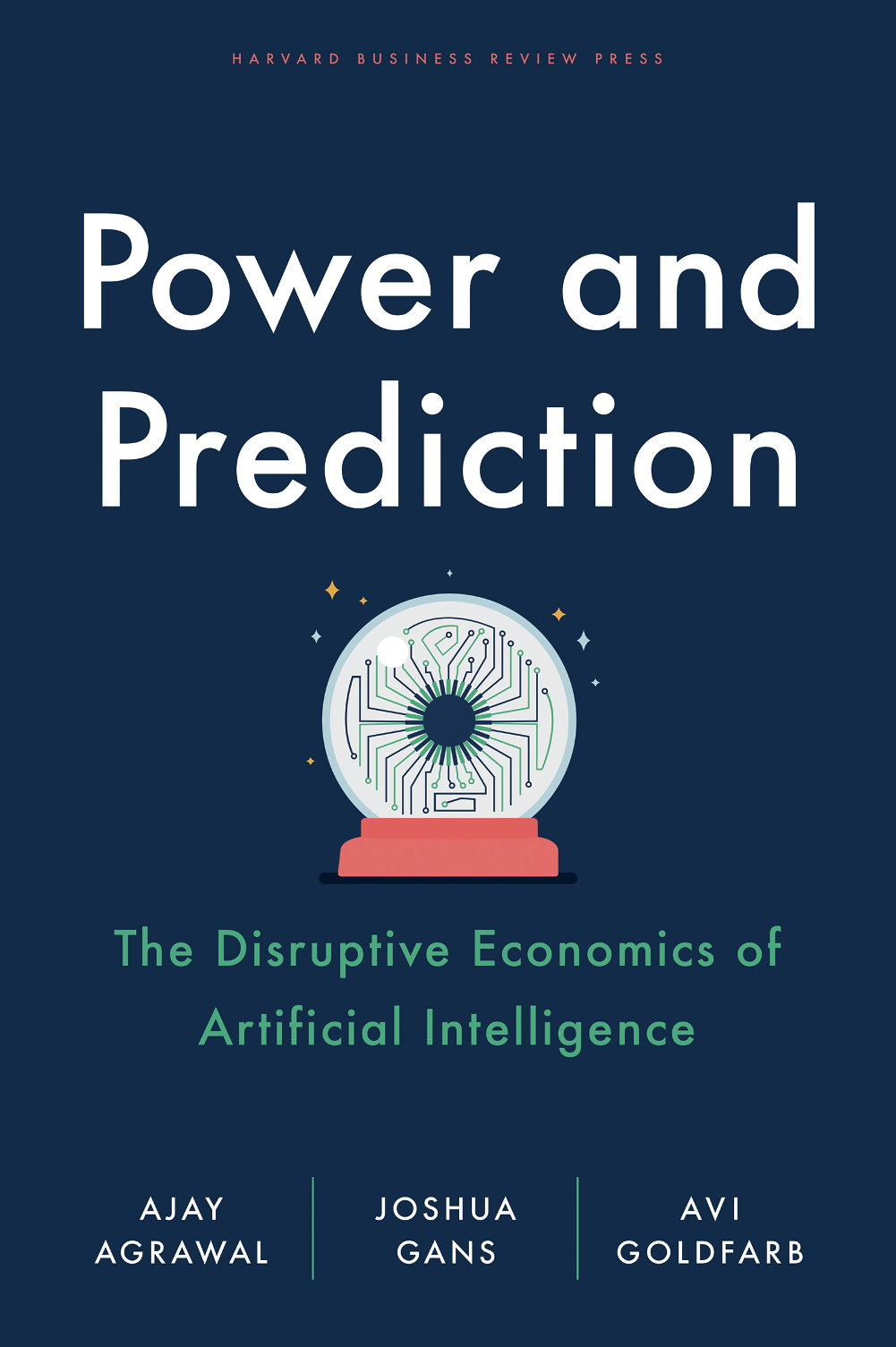
The book argues that we’re in the ‘The Between Times’ of AI at the moment, which is roughly the period where the future has arrived, but just hasn’t yet delivered much benefit.
As many people have observed, AI has been used in many fields, the stock prices of related companies are soaring, and everyone is talking about it. However, the economic impact of AI on productivity in developed countries has yet to be realized. A few years ago people were talking about the ‘Great Stagnation’ - the real income levels of Americans have stopped growing from the late 1990s to the present day.Where exactly does AI fit in?
MIT’s Sloan Management Review did a survey in 2020 and found that 59% of business people said they had an AI strategy, and 57% of companies have deployed or have tried some kind of AI solution - yet only 11% of companies, actually benefited financially from AI.
To put it bluntly, that’s why AI hasn’t helped you make money yet. In fact, this phenomenon is not an exception, it’s a normal stage of development.AI is a ‘general purpose technology’ that many believe will have a greater impact on society than electricity. Like the steam engine, electricity, semiconductors, the Internet, these are all general-purpose technology. General-purpose technologies, none of which can create huge wealth right out of the gate.
For example, in 1987, economist Robert Solow (Robert Solow) had a sentiment that computers can be seen everywhere in our time, except in productivity statistics ……
Actually, that’s normal, because general-purpose technologies don’t immediately transform economic activity when they first come out.
✵
Let’s review the development of electricity for a moment. The chart below tells the history of the spread of electricity in American homes and factories - the
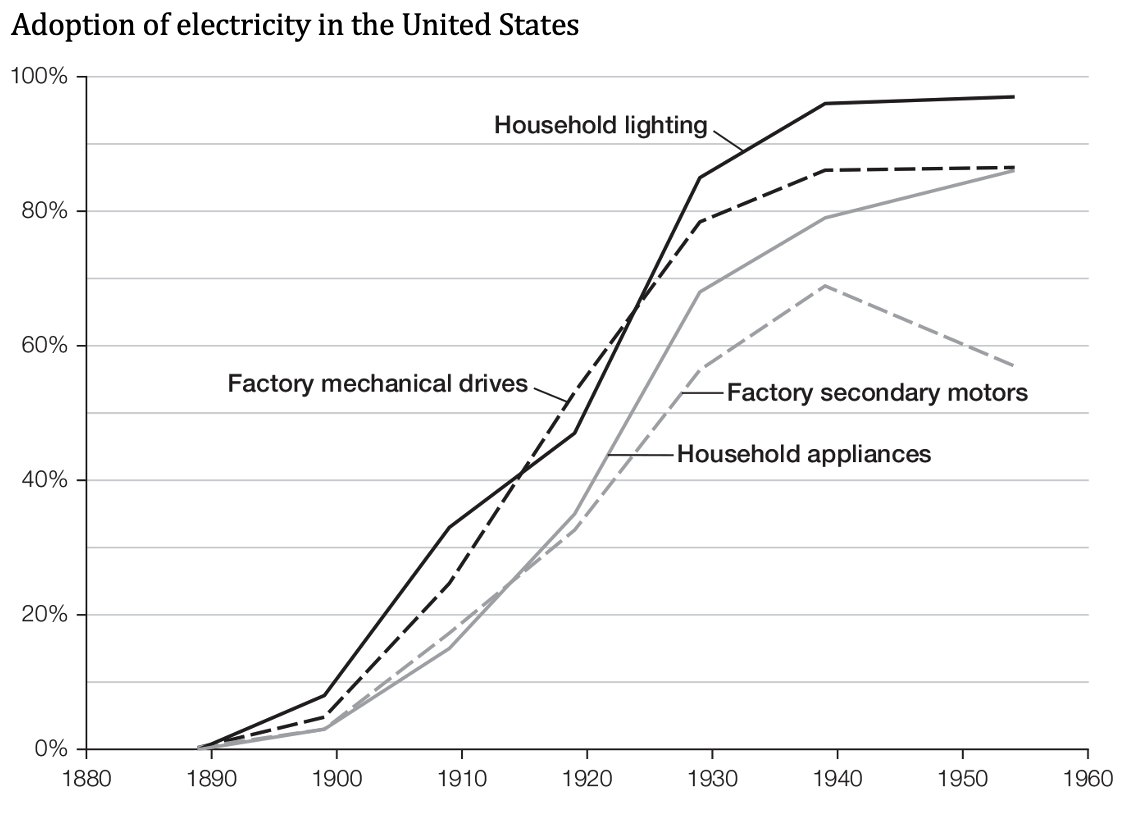
Thomas Edison invented the electric light in 1879, but it took 20 years before only 3% of U.S. homes had electricity. By 1890, only 5% of U.S. factories used electricity; even by 1910, new factories still prioritized steam power. Why is this?
The book Power and Prediction argues that there are three stages for general-purpose technology to be truly productive.
*The first stage is called “The Point Solution”, which is a simple replacement of inputs. *
Light bulbs are a little bit more convenient than candles, and using electricity for power is sometimes a little bit cheaper than steam power, and you may be willing to replace them. Your life is a little bit more convenient, your costs are a little bit lower, but that’s about it.
- The second stage is called “The Application Solution” (The Application Solution), which is to replace the production unit as well. *
In the past, factories using steam power used to have one steam shaft connecting all the machines, and when the steam was turned on, all the machines were turned on. After switching to electricity, factories realized that if each machine had its own power supply, it would be possible to turn on whichever machine was needed, and wouldn’t that save money? It wasn’t easy because it meant you had to modify the machines, what with machine tools, drills, metal cutters, presses, all of which had to be redesigned for independent power. This is something that takes time.
- The third stage is called ‘The System Solution’, which is a change in the entire production method. *
In the factory buildings of the steam era, all the machines had to be arranged near the central shaft because they had to use the steam shaft. With electricity, you could install plugs anywhere, and machines could be placed anywhere in the factory, so you could make the most of the space, and there was no need to centralize all the machines. This made the ‘production line’ possible. This is no longer a localized improvement; it requires a systematic change in both the way production is carried out and the way it is organized.
The same is true for AI. So far, our application of AI is still at the stage of point solutions and certain application solutions, not yet system solutions. This is why AI has not yet been maximized.
✵
What is AI, really, from a business perspective? The book Power and Prediction argues * AI is a ‘prediction machine’. *
The three authors don’t discuss generative language models like ChatGPT; this book is focused on predictive AI applications like discovering new drugs, recommending goods, and weather forecasting, which are indeed also the most commercialized.
For example, if you apply for a loan from Anthem, you don’t have to wait, it approves it on the spot, and that’s because the AI predicts your ability to repay based on your track record. Prediction is a prerequisite for decisions, and AI predictions can change the way people make decisions.
Once electricity was widely used, people’s use of electricity, and where it came from, was decoupled. You don’t have to care where the power plant is, you don’t have to care how the electricity is generated, your plant can open anywhere. Then we can imagine that when AI is widely used, prediction, and decision, these two things can also be decoupled: you don’t have to care how the AI predicts, you just make decisions based on the prediction.
The three authors suggest that the point solution for AI is to use AI to improve your existing decisions, the application solution is for AI to change the way you make decisions, and the system solution is for AI to enable new decisions, where your entire production model changes.
As an example, let’s say you shop at Amazon. Now, Amazon’s AI will recommend items to you based on your shopping preferences, which is a point solution.
But Amazon can do exactly this: the AI judges that you like certain goods, and Amazon doesn’t tell you or ask you, and sends these goods directly to your home. Maybe send you a box of items every month or even every week. You open the box and look at it, and you’re pleasantly surprised every time: if you like it, you keep it, if you don’t like it, you return it.
This sales method is sure to get you to buy more! After all, people come all the time, and holding something in their hands and wearing it on their body certainly feels different than looking at a web page. So it’s clearly a good idea, it’s an app solution where the way you make shopping decisions is changed.
In fact Amazon has long since patented this shopping model, called ‘Anticipatory Shipping’.
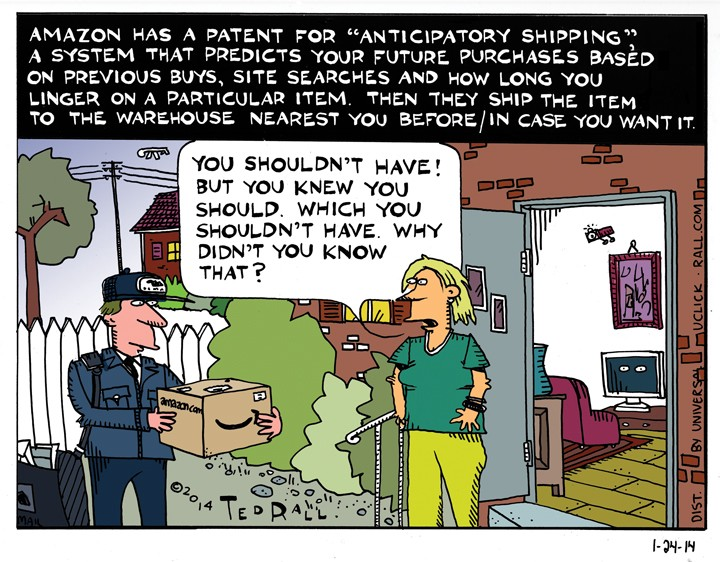
However, this sales method, so far, has not been officially implemented. Why? Because the existing return system is not good enough.
Processing returns is still a pain in the ass. Transportation is quite cheap, the problem is to return the goods checked, packaged, and put back on the shelves, this thing is very laborious, so now the practice of Amazon is to receive a lot of returns directly thrown away.
But if AI can take over the returns in the future, such as using robots, Amazon can engage in pre-shipment. Maybe then the merchant’s whole sales approach will change, and that’s a system solution.
✵
AI predictions can change the way decisions are made, they can change the way life is lived.
Many times in our lives we don’t make decisions at all, we do things based on habits or rules. If you feel like it’s going to rain today, you decide to bring an umbrella. But if it rains a lot in the area, maybe you make a rule for yourself that you must bring an umbrella to work every day. Another example is that because they are afraid of missing their flight, some people make it a rule that they must leave four hours early for their flight.
These rules are just in case something goes wrong, and they pull down the efficiency of life.
Let’s imagine that if the weather forecast was so accurate that you didn’t have to bring an umbrella every day, you could turn the rule into a decision: decide whether to bring an umbrella or not based on the weather forecast. If AI could give you an accurate prediction by taking into full consideration how congested the traffic is on the way to the airport, whether the flight is late, and roughly how long the security line will be when you get there, you could do away with the rule of leaving four hours early. Right?
Then let’s take it a step further. Why even ask the AI for a prediction and make the decision yourself? Wouldn’t it be better to just hand the decision over to the AI and let it arrange whether or not you’ll bring an umbrella and when you’ll leave?
Young people often get into trouble because they don’t think things through. Adults make a lot of rules for themselves in order to avoid trouble, but in fact, they exchange it for another kind of trouble. Some people are lucky enough to have people around them to remind them at all times. The more fortunate ones don’t have to worry at all, you guys make the arrangements, I can do it.
When the time comes, you’ll be happy to leave the decision to the AI.
- That’s where prediction replaces rule. *
✵
Reflected in the economy, take an example. The earliest farmers planted their fields were to look at the weather forecast and make their own rough estimates of when to sow, when to fertilize, and when to harvest; the decisions were their own, and the forecasts were just a reference.
Later, the weather forecast is more and more accurate, the United States weather company to humanize the forecast results, specifically on the farmers output a precise prediction, saying that you sow this year only 8 days of the window period, you look at it. Based on the weather forecast on the one hand, and based on the type of crop on the other hand, the weather company directly informs farmers of the best time to sow, fertilize and harvest.
That saves the farmer’s ass. Why bother making decisions on their own? Wouldn’t they just listen to the weather directly? You see, the weather companies are now deeply involved in agriculture.
So Monsanto bought a weather company in 2013. This time, it not only provides farmers with seeds and teaches them how to plant, but also directly directs them what to do on what day, which is tantamount to providing a package solution and making all the decisions for farmers.
And AI can change the way agriculture is produced.
Many agricultural products are now grown in greenhouses. Greenhouse farming has many benefits but also has a problem, that is, easy to grow pests. So now there are companies using AI that can accurately predict a week in advance whether your greenhouse will grow insects. With this week’s time, farmers can order insect-resistant supplies a week in advance. But this is still only an application solution.
The system solution, is that since the AI prediction ability is so strong, farmers do not need to be afraid of pests. Since you’re not afraid of pests, you can plant crops that you would otherwise be afraid to plant because you’re afraid of pests. You can also get bigger greenhouses because you don’t have to worry about pests attacking a large area. Your whole way of production changes.
✵
- For AI to be fully productive, you have to replace rules with predictions. *
AI-assisted instructional technology is perfectly capable of doing this now. ai can decide which words you should memorize today based on the vocabulary you already have, which math facts you should learn today based on your score on your last math quiz, and ai can make sure that you’re in your own ‘learning zone’ every time, maximizing your learning productivity. But AI hasn’t really improved our learning efficiency.
Why? Because schools as a whole are still organized in an age-graded manner. Schools have rules. Each class is an age group of students who are at very different rates of mastery of course content, but the rules of instruction stick them together, and they have to listen to the same teacher talk about the same content every day.
What would school look like if we could reorganize teaching using the logic of AI so that each student receives truly personalized learning and each teacher can use his or her individualized abilities? Maybe some teachers are particularly good at helping students with dyslexia, some are particularly good at leading math competitions, and letting teachers pair up with students and letting AI help teachers keep track of everyone’s progress, that would be a systemic change.
Every time you think about how to use AI, think about the electricity that was there in the first place. Our production, life, and society will soon be reset around AI, and it’s just beginning.
Highlight
There are three phases for general purpose technology to be truly effective in terms of productivity.
The first stage is called “point solution”, which is a simple replacement of inputs.
The second stage is called “application solution”, which is to replace the production equipment.
The third stage is called “system solution”, which is the change of the whole production method.